
30,000-Word Deep Dive: Mga Counterintuitive na Katotohanan sa Global Creator Affiliate Marketing na Hindi Nauunawaan ng 90% ng Sellers
Isang pangmatagalang field guide para sa cross-border ecommerce founders, operators, at creator BD teams
Sino Ako—at Bakit Ko Isinulat ang Malalim na Gabay na Ito
Una, hayaan mong ipakilala ko sandali ang background at ipaliwanag kung saan nagmula ang karanasan ng artikulong ito.
Ang pangalan ko ay Changjiang. Gumagawa ako ng cross-border na e-commerce at sa ibang bansa creator marketing sa nakalipas na ilang taon. Ginugugol ko ang halos lahat ng oras ko sa pagitan ng creator at seller.
Ang TikTok Shop ay mabilis na lumawak sa mga nakalipas na taon, ngunit ang pag-unawa ng seller sa "sa ibang bansa creator affiliate marketing" ay lalong nahati: ang ilang mga tao ay itinuturing na ito sa ibang bansa na bersyon ng Taoke, ang ilan ay itinuturing na extension ng paghahatid ng nilalaman, at ang ilan ay itinuturing ito bilang isang shortcut para sa pagsubok ng mga produkto. Ang pag-unawa ay iba, ang diskarte ay ganap na naiiba, at ang resulta ng agwat ay napakalinaw.
Ang pinakamalaking pakiramdam ko ay: Ang karamihan ng "mga bitag" at pag-aaksaya ng badyet ay talagang walang kinalaman sa "kakayahang magsagawa". Ang mas malaking problema ay nakasalalay sa maling pag-unawa ng mga creator sa simula.
Ang 30,000-salitang mahabang artikulong ito ay maaaring ituring bilang 102 kontra-intuitive na karanasan pagkatapos ng pangmatagalang alitan sa mga tagalikha, brand, at institusyon sa ibang bansa sa nakalipas na ilang taon. Walang grand methodology (may metodolohiya pa rin tungkol sa creator value judgment sa dulo ng artikulo), paulit-ulit lang ang mga detalye at commonality. Umaasa ako na makakatulong ito sa iyo na isulong ang iyong pag-unawa sa "overseas creator affiliate marketing" nang kaunti.
Patuloy ding ina-update ng may-akda ang praktikal na karanasan at pag-iisip ng creator marketing sa ibang bansa sa pamamagitan ng kanyang personal na pampublikong account na "CJ Global Expansion Practice" para sa sanggunian ng mga practitioner.
Para Kanino ang Gabay na Ito
- Ang taong namamahala, boss, at kasosyo ng TikTok na namamahala / sa ibang bansa creator affiliate marketing;
- Umaasa ang mga taong namumuno sa BD/creator operations team na makapagtatag ng cognitive bottom line para sa team na mas malapit sa realidad;
- Isang pangkat na naghahanda na lumipat mula sa domestic live na pagsasahimpapawid at pamamahagi ng advertising sa ibang bansa creator collaboration.
Para Kanino Maaaring Hindi Ito Angkop
- Mga mambabasa na nangangailangan ng "SOP template na maaaring ilapat kaagad"; kung gusto mong tingnan ang mga detalye ng SOP, maaari mong ipagpatuloy ang pagbabasa "Operational Notes of Overseas Creator BD: outreach email, Title and First Round of Establishment";
- Ang tanging pinapahalagahan ko ay ang panandaliang laro ng "Available ba ang dami ngayon?" "Mataas ba ang creator na ito na ROI?"
Paano Gamitin ang Gabay na Ito
- Tratuhin ito bilang isang "pira-pirasong kuwaderno": hindi mo kailangang basahin nang sabay-sabay, basahin lang ang mga volume na pinakamahalaga sa iyo;
- Gamitin ito bilang mga materyales sa pagsasanay ng koponan: pumili ng 10 hanggang 20 pinakatunog at gawin itong PPT para sa panloob na pagbabahagi;
- Gamitin ito bilang iyong sariling frame of reference para sa paghusga sa mga creator: Sa bawat oras bago makipagtulungan sa isang bagong creator, basahin ang ilan sa kanila at ihambing sila sa iyong sariling intuwisyon.
Paunang Salita
Volume 1 · Pagkilala sa lumikha: Nauuna ang buhay bago ang pagtutulungan
Kapag napanood mo ang "cooperation", ang kinabubuhay nila ay totoong buhay
Nakatuon ang volume na ito sa isang pangunahing premise: Ang lumikha ay una sa lahat isang taong nahihirapan, pumipili, at nararamdaman sa totoong buhay, at pangalawa ay ang iyong kapareha. Kung paano nila nauunawaan ang mga kinakailangan sa pakikipagtulungan, kung handa silang kunin ang kanilang mga mobile phone para kumuha ng litrato, kung saan inilalagay ang mga produkto sa bahay, at kung natural ba silang lalabas sa camera ay lahat ay nakabatay sa lohika ng buhay, hindi lohika sa proseso. Ang background ng buhay ng creator, pagkakakilanlan sa sarili, at pang-araw-araw na ritmo ay tumutukoy kung tatanggapin nila o hindi, kung paano sila nag-shoot, at hanggang saan sila nag-shoot. Ang dahilan kung bakit maraming mga kooperasyon ang hindi maaaring itulak pasulong ay hindi dahil ang mga panukala ay hindi sapat na propesyonal, ngunit hindi lamang naiintindihan ng mga tatak ang pagsasaayos ng buhay ng kabilang partido. Ang tunay na pangmatagalang kooperasyon ay kadalasang dumarating kapag ang produkto ay nakahanap ng isang makatwirang posisyon sa buhay ng ibang tao, at naramdaman ng lumikha na "ito ay isang bagay na gagamitin ko" sa halip na "Kailangan kong gawin ito para lang sa iyo." Kapag natutunan ng team na unawain muna ang lumikha at pagkatapos ay pag-usapan ang tungkol sa pakikipagtulungan, magiging mas madali ang lahat ng susunod na aksyon.
1. Kapag mas matagal na nakikipagtulungan sa kanila ang isang creator, mas makikita nila ang pagiging makatwiran ng brand sa kanilang buhay
Habang unti-unting lumalaki ang oras ng pakikipagtulungan, magiging natural na makita kung aling mga creator at produkto ang tunay na magkatugma. Ang akma ay hindi dahil ang nilalaman ay mahusay na ipinahayag, ngunit dahil sila ay orihinal na kailangan ang bagay na ito sa kanilang buhay. Ang ilang produkto ay tila natural sa buhay ng ilang partikular na creator. Kung ang mga ito ay mga gamit sa kusina, mga gamit sa bahay, mga laruan, mga gamit sa palakasan o mga gamit para sa alagang hayop, lahat sila ay makakahanap ng lugar sa kanilang nilalaman. Ang ganitong tagalikha ay hindi sadyang magdidisenyo ng mga kuha, ngunit lilitaw ang mga produkto sa iba't ibang punto ng buhay. Ang kasunod na pagkilala ng user na dulot ng ganitong uri ng hitsura ay napakalakas. Ang pakikipagtulungan ay hindi itinataguyod ng mga script, ngunit sa pamamagitan ng "kung pinahihintulutan ng buhay na makita ito."
2. Ang pag-unawa ng creator sa "mga kinakailangan sa pakikipagtulungan" ay hindi batay sa proseso, ngunit sa kanilang karaniwang gawi sa pagpapahayag
Kapag nagtatrabaho sa creator collaboration sa China, tumpak na mauunawaan ng karamihan sa mga creator ang script ng pakikipagtulungan at mga pangunahing punto, ngunit hindi kukuha ng impormasyon ang mga tagalikha sa ibang bansa sa ganitong paraan. Ang paraan ng kanilang pag-unawa sa pangangailangan para sa pakikipagtulungan ay mas malapit sa "pagkatapos basahin ito, maaari silang magbalangkas ng isang pangkalahatang direksyon sa kanilang mga isipan ayon sa kanilang sariling mga gawi." Kung ang mga kinakailangan sa pakikipagtulungan ay masyadong detalyado, hindi nila alam kung saan magsisimula. Kung mas malaya ang ibinigay na nilalaman, mas madali para sa kanila na makahanap ng kanilang sariling paraan ng pagpapahayag. Dahil dito, ang mga aktwal na video na natatanggap ay kadalasang naiiba sa mga inaasahan, ngunit hindi ito dahil hindi binibigyang pansin ng kabilang partido, ngunit dahil ang paraan ng pagpapahayag ng nilalaman ng gumawa ay hindi kailanman naging "magpatupad ng mga tagubilin", ngunit upang "panatilihin ang kanyang sariling istilo." Ang mga taong nakasanayan na sa modelo ng domestic cooperation ay madaling mapagkakamalang isipin na ang creator ay perfunctory. Sa katunayan, sila ay sumisipsip lamang ng impormasyon sa kanilang sariling paraan at kinukunan ito ayon sa istilo ng kanilang sariling channel.
3. Tinutukoy ng mga gawi sa lens ng creator kung saan lumalabas ang produkto, hindi ang mga pangangailangan ng brand
Habang dumarami ang bilang ng mga pakikipagtulungan, lalo mong mararamdaman na naayos na ang mga gawi sa camera ng bawat creator. Ang paraan ng pag-shoot nila ng content ay malapit na nauugnay sa kanilang mga personal na gawi, at maraming pagbabago ang hindi maisasaayos ng brand sa isang salita lang. Palaging nakasanayan ng ilang creator ang pagbaril mula sa kanang bahagi, hindi ipinapakita ng ilang creator ang kanilang mukha sa lens, ayaw ng ilang creator ang pag-zoom, at palaging nagluluto ang ilang creator mula sa itaas pababa. Ang mga gawi na ito ay hindi idinisenyo para sa pakikipagtulungan, ngunit mga natural na pattern na nabuo sa loob ng mahabang panahon ng pagbaril. Kung ang produkto ay makikita nang malinaw sa larawan, sa maraming pagkakataon ay hindi dahil ayaw ng gumawa, ngunit dahil sanay sila sa ganoong anggulo. Hindi nila sinasadyang baguhin ang istraktura ng shot para sa isang partikular na pakikipagtulungan, dahil magiging madali para sa mga tagahanga na makita ang pagbabago. Habang umuusad ang kooperasyon sa loob ng mahabang panahon, higit na mauunawaan natin ang "katatagan ng mga gawi sa lens", at malalaman din natin kung anong uri ng mga produkto ang natural na naghihirap mula sa ilang mga lente ng creator.
4. Ang background ng buhay ng creator ay nakakaapekto sa paraan ng kanilang pag-unawa sa pagtutulungan
Pagkatapos ng pangmatagalang pakikipag-ugnayan sa mga creator mula sa iba't ibang bansa, dahan-dahan mong matutuklasan ang mga pagkakaiba sa kanilang mga background sa buhay, na direktang makakaapekto sa kanilang pag-unawa sa pakikipagtulungan. Ang ilang mga tagalikha ay nagmula sa medyo matatag na mga propesyonal na kapaligiran at mabilis na tumugon sa mga email ng pakikipagtulungan; ang ilang mga creator ay nakasanayan nang lumipat sa pagitan ng mga freelance na trabaho, at ang buhay mismo ay hindi naayos, kaya ang pakikipagtulungan ay hindi masyadong apurahan para sa kanila; at itinuturing ng ilang creator ang paglikha bilang isang libangan at kunan lamang ng content kapag sila ay inspirasyon. Kung ang tatak ay hindi alam ang ritmo ng buhay sa likod ng lumikha kapag nakikipag-usap, madaling ma-misjudge ang kanilang paraan ng feedback. Sa katunayan, ang kanilang mga ekspresyon ay hindi nakakalito, ngunit pare-pareho sa kanilang mga background. Matapos maunawaan ito, magiging maluwag ang pakikipag-ugnayan sa lumikha, at mas matatanggap mo ang iba't ibang pagbabago sa ritmo sa pakikipagtulungan.
5. Ang interes ng isang creator sa pakikipagtulungan ay kadalasang nagmumula sa tunay na paggamit sa halip na mga insentibo sa pananalapi
Pagkatapos magtrabaho sa ibang bansa creator collaboration sa loob ng mahabang panahon, unti-unti mong mapapansin ang isang kababalaghan: ang ilang creator ay handang mag-shoot kahit na hindi mataas ang profit margin; hindi magiging interesado ang ilang creator kahit na mataas ang profit margin. Ang seller ay kadalasang mahirap unawain sa simula, sa pag-aakalang "sa mas marami kang makakakuha ng mas malaking bahagi, mas magiging handa kang makipagtulungan", ngunit ang mga interes ng lumikha ay ibang-iba. Kung ang produkto mismo ay madaling gamitin, natural na gusto nilang kumuha ng litrato; kung ang produkto ay may kumplikadong mga pag-andar o nangangailangan ng espesyal na posing, hindi nila malay na maiiwasan ito. Kung mayroong "tunay na relasyon sa paggamit" sa pagitan ng lumikha at ng produkto ay maaaring matukoy ang direksyon ng pakikipagtulungan higit pa sa pera mismo. Mayroon ding mga tagalikha na natahimik sandali pagkatapos matanggap ang produkto, at pagkatapos ay biglang nagpadala ng isang piraso ng nilalaman pagkaraan ng ilang linggo, na nagsasabing nakita nilang kapaki-pakinabang ito kamakailan. Ang ganitong uri ng nilalaman ay kadalasang mas natural kaysa sa mga kinunan ayon sa iskedyul. Ang tunay na paggamit ay magpapahaba sa kooperasyon at makakabawas ng maraming gastos sa komunikasyon. Maaari mo ring makita ang mismong lumikha na aktibong binabanggit ang produkto.
6. Ang personal na karanasan ng creator ay hindi sinasadyang makakaapekto sa pagpayag na makipagtulungan
Pagkatapos makipag-ugnayan sa mga tagalikha sa ibang bansa sa mahabang panahon, unti-unti mong mapapansin na ang kanilang mga personal na karanasan ay kadalasang nakakaapekto sa kanilang saloobin sa pakikipagtulungan. Ang ilang mga tagalikha ay tinanong ng mga tagahanga dahil sa masyadong maraming komersyal na nilalaman, kaya sila ay magiging maingat sa ibang pagkakataon; ang ilang creator ay nakaranas ng masasamang karanasan sa pakikipagtulungan at magiging mas sensitibo sa mga email ng brand; at ang ilang creator ay maaapektuhan ng mga opinyon ng mga tao sa kanilang paligid at magiging mas maingat sa pagpili ng mga pakikipagtulungan. Maaaring hindi direktang maipahayag ang impormasyong ito, ngunit maaari itong dahan-dahang maramdaman sa mga pangmatagalang pakikipag-ugnayan. Ang saloobin ng isang creator sa pakikipagtulungan ay hindi nagbabago nang random, ngunit nahuhubog ng kanilang mga nakaraang karanasan. Matapos maunawaan ito, magiging mas madaling tanggapin ang ilang biglaang pag-aatubili at pagkagambala, dahil madalas na hindi ito problema para sa tatak, ngunit upang protektahan ang kanilang sariling karanasan.
7. Kung gaano katagal naka-imbak ang produkto sa bahay ng gumawa ay makakaapekto sa kung paano nila ipahayag ang kanilang sarili sa ibang pagkakataon
Ang isang kawili-wiling detalye sa pakikipagtulungan ay na kapag mas matagal ang produkto ay pinananatili sa bahay ng gumawa, mas madali para sa nilalaman na magpakita ng mga natural na bakas. Kapag una nilang natanggap ang produkto, pansamantala nilang tuklasin kung paano ito gamitin at maaaring hindi agad kumuha ng litrato, ngunit habang lumilipas ang panahon, ang produkto ay maaaring maging mas komportable sa kanilang buhay. Maraming creator ang dahan-dahang makakahanap ng lugar sa kanilang buhay, tulad ng paglalagay sa kanila sa isang sulok ng kusina o isang drawer sa kwarto, at pagkatapos ay natural na makuha sila sa video nang hindi sinasadya. Minsan nakakalimutan nila ang tungkol sa pakikipagtulungan mismo, ngunit mayroon silang bagay na ito sa kanilang buhay, na ginagawang mas totoo ang kasunod na nilalaman. Kung ang isang tatak ay tumitingin lamang sa mga panandaliang resulta, babalewalain nito ang prosesong ito ng "pagsasama sa buhay"; ngunit para sa mga tagalikha, ang prosesong ito ay mas mahalaga kaysa sa mga tuntunin ng pakikipagtulungan.
8. Ang parehong produkto ay ganap na naiiba sa nilalaman ng tagalikha sa iba't ibang bansa
Kapag nakikipagtulungan sa iba't ibang bansa, unti-unti mong makikita na ang mga creator mula sa iba't ibang kultural na background ay may ibang paraan ng pagpapakita ng mga produkto. Mas binibigyang pansin ng mga tagalikha ng Amerika ang kahulugan ng buhay, at ang kanilang paggamit at tono ay mas maluwag; Ang mga tagalikha ng Britanya ay kadalasang mas nakalaan at hindi gustong bigyang-diin ang mga produkto; Gusto ng mga tagalikha ng Australia ang panlabas, at maraming mga action shot sa nilalaman; Ang mga tagalikha sa Southeast Asia ay magiging mas handang sumubok ng ilang light display method. Kung binibigyang-kahulugan ng isang brand ang lahat ng creator ayon sa mga gawi sa content ng isang bansa, magiging madali itong magkamali. Ang mga pagkakaiba sa mga ekspresyon sa pagitan ng iba't ibang kultura ay natural, at ang pagkakaibang ito ay tumutukoy din sa paraan ng pagpapakita ng mga produkto. Dapat tanggapin ang mga hindi pagkakapare-pareho sa pagpapahayag kapag nakikipagtulungan sa mga merkado, dahil ang tunay na pagpapahayag mismo ay nagdadala ng mga kultural na texture.
9. Ang pagkakakilanlan sa sarili ng gumawa ay makakaapekto sa istilo ng pakikipagtulungan
Habang tumataas ang kooperasyon, unti-unti mong makikita na ang lumikha ay may napakalinaw na posisyon sa kanyang sarili. Itinuturing ng ilang creator ang kanilang sarili bilang mga life recorder, ang ilan ay nakikita ang kanilang sarili bilang nanay na content creator, ang ilan ay nakikita ang kanilang sarili bilang mga mahilig sa labas, at ang ilan ay tumutukoy sa kanilang sarili bilang mga taong nagbabahagi ng mga karanasan. Ang magkakaibang pagkakakilanlan sa sarili ay natural na magsasala ng ilang mga ekspresyon kapag sila ay nagtutulungan. Halimbawa, ang mga taong itinuturing ang kanilang sarili bilang mga tagapagtala ng buhay ay hindi handang bigyang-diin ang mga tungkulin, at ang mga taong itinuturing ang kanilang sarili bilang mga hobby blogger ay hindi handang kumuha ng mga seryosong eksibisyon. Kung hindi nauunawaan ng mga brand ang pagkakakilanlan sa sarili ng gumawa, hindi nila mauunawaan ang kanilang ekspresyon. Ang isang tunay na pangmatagalang pakikipagtulungan ay isa kung saan ipinapahayag ng tagalikha ang produkto sa kanyang sariling pagkakakilanlan, sa halip na baguhin ang kanyang pagkakakilanlan para sa kapakanan ng produkto.
10. Ang mga creator ay bihirang gumamit ng "propesyonal na pananaw" upang maunawaan ang pakikipagtulungan. Ginagamit nila ang karanasan sa buhay para manghusga.
Pagkatapos magtrabaho sa ibang bansa sa mahabang panahon, sisimulan mong matanto na ang mga tagalikha ay hindi nag-iisip mula sa pananaw ng "propesyonal na kooperasyon" tulad ng ginagawa ng mga tatak kapag tumitingin sa pakikipagtulungan. Madalas nilang iniisip, "Angkop ba ito sa aking kasalukuyang buhay?" "Magiging awkward ba para sa akin na kunan ito?" "Hindi ba magiging komportable ang mga tagahanga na makita ito?" Ang mga isyung ito ay ganap na walang kaugnayan sa kung ano ang pinapahalagahan ng brand. Para sa mga tatak, ang pakikipagtulungan ay isang trabaho; para sa mga creator, ang pagtutulungan ay bahagi ng kanilang buhay. Kung mas parang buhay ang paghatol ng isang creator, mas maraming brand ang kailangang iwasan ang paggamit ng tonong nakatuon sa gawain sa komunikasyon. Kapag ang kooperasyon ay napupunta sa pinaka maayos, kadalasan ay kapag ang parehong partido ay itinuturing na ang pakikipagtulungan bilang isang natural na pakikipag-ugnayan sa halip na isang transaksyon.
11. Ang pagpapanatili ng pakikipagtulungan ay kadalasang nakadepende sa kung nararamdaman ng gumawa na makabuluhan ang produkto sa kanyang buhay
Matapos obserbahan ang mga pinagdaanan ng kooperasyon ng isang malaking bilang ng mga tagalikha, magiging higit at higit na malinaw na ang kahulugan ng produkto sa buhay ng lumikha ay tumutukoy sa haba ng pakikipagtulungan nang higit pa kaysa sa pakikipagtulungan mismo. Gustung-gusto ng ilang partikular na creator ang ilang uri ng produkto, gaya ng kagamitan sa kusina, mga produktong pambata, supply ng alagang hayop, o gamit sa labas. Ginagamit nila ang mga ito hindi dahil sa pakikipagtulungan, ngunit dahil ang mga bagay na ito mismo ay sumasakop sa isang lugar sa buhay. Kung ang produkto ay makabuluhan sa kanilang buhay, natural na nais nilang ipahayag ito, ipakita ito, at irekomenda. Sa kabaligtaran, kung ang produkto ay hindi nauugnay sa buhay, ito ay magiging mahirap na mapanatili kahit na ang kooperasyon ay maayos. Kung makakahanap ang brand ng linya ng produkto na tumutugma sa pamumuhay ng gumawa, magiging mas madali ang pakikipagtulungan.
12. Maraming creator ang hindi “order-taking machine”, ang kanilang mga expression ay hinihimok ng buhay
Sa China, nakasanayan na natin ang "propesyonal" na kooperasyon ng mga tagalikha. Pagkatapos makarating sa overseas ecosystem, maraming seller ang likas na aasahan na ang mga creator ay magkakaroon din ng ganitong propesyonal na diskarte. Ngunit pagkatapos ng maraming pakikipagtulungan, makikita mo na ang mga ekspresyon ng mga tagalikha sa ibang bansa ay higit na hinihimok ng buhay sa halip na dahil sa misyon. Ang ilang mga creator ay aktibong nag-a-update dahil ang kanilang buhay ay maluwag kamakailan; ang ilang mga creator ay nag-pause ng mga update dahil sila ay naging masyadong abala kamakailan; at ang ilang mga creator ay biglang magkakaroon ng mga panahon ng inspirasyon at kukuha ng ilang magkakasunod na larawan. Ang mga pagbabagong ito ay mahirap ipaliwanag sa mga modelo ng karera, dahil hindi sila lumilikha gamit ang "lohika ng trabaho", ngunit may "lohika ng buhay". Ang pag-unawa dito ay gagawing mas matatag ang kooperasyon.
13. Ang pag-unawa sa "expression" ng creator ay isang kusang estado, hindi isang mabibilang na aksyon
Kung mananatili ka sa creator collaboration sa loob ng mahabang panahon, makikita mo na ang kanilang paraan ng pagpapahayag ng kanilang sarili ay napaka spontaneous. Hindi lahat ng shooting ay inihanda, at hindi kami gumagawa ng mga script, pagpaplano, at disenyo ng lens nang maaga tulad ng ginagawa ng isang propesyonal na koponan. Mas madalas kaysa sa hindi, bigla nilang nararamdaman na "okay lang mag-shoot" sa isang tiyak na sandali, at pagkatapos ay magsisimula na sila. Maaaring mukhang random ang expression na ito, ngunit ito talaga ang pinagbabatayan ng ritmo ng kanilang nilalaman. Gusto ng mga tagahanga ang kanilang channel dahil hindi idinisenyo ang expression, ngunit totoong-totoo. Kung susubukan ng brand na hilingin sa creator na gawing mabibilang na pagkilos ang expression, gaya ng "dapat sabihin nang mas malinaw ang pangungusap na ito" at "kailangan ipakitang muli ang eksenang ito", mararamdaman ng creator na masyadong mabigat ang mga bakas ng performance. Kapag na-quantified na ang expression, mawawala ang orihinal na pakiramdam ng lumikha.
14. Napakasimple ng paraan ng paggawa ng desisyon ng creator: kung gusto mo, kunan mo ito, kung hindi mo gusto, pabayaan mo lang
Maraming brand ang nagkakamali na naniniwala na isasaalang-alang ng mga creator ang iba't ibang salik kapag pumipiling makipagtulungan, gaya ng badyet, workload, inaasahan sa performance, kahirapan sa content, atbp., ngunit ang aktwal na sitwasyon ay kadalasang mas simple. Kapag tumitingin ang mga creator sa isang collaboration, kadalasang dalawang tanong lang ang itatanong nila: Gusto mo ba ito? Makinis ba o hindi? Napaka-intuitive ng kanilang pagdedesisyon. Kung ang isang partikular na produkto ay pumukaw ng ilang interes sa kanila, handa silang subukan ito; kung ang isang tiyak na pagtutulungan ay tila napakabigat sa kanila, tahimik nilang hahayaan ito. Hindi naman ito hindi propesyonal, ngunit ang paraan ng paggawa ng lumikha ay likas na nakabatay sa "pakiramdam". Ang pakiramdam na ito ay hindi basta-basta, ngunit isang sistema ng paghatol na nabuo nila sa loob ng maraming taon bilang tagalikha ng nilalaman, ngunit ang paraan ng pagpapahayag ay mas parang buhay.
15. Kung ang pakikipagtulungan ay maaaring sumulong ay depende sa kung ang lumikha ay nakahanap ng kanyang sariling outlet para sa pagpapahayag
Sa pakikipagtulungan, madalas naming nakikita na ang ilang creator ay mabilis na gumagawa ng content pagkatapos matanggap ang produkto, habang ang ilang creator ay mabagal na gumawa ng anumang pag-unlad pagkatapos itong matanggap. Nang maglaon, unti-unti kong napagtanto na ito ay hindi isang bagay ng saloobin, ngunit ang "pagpasok para sa pagpapahayag" ay hindi natagpuan. Ang mga creator ay karaniwang hindi nag-shoot nang husto, ngunit maghintay hanggang sa isang natural na eksena ang lumitaw sa buhay na nagpaparamdam sa kanila na "maaaring ilagay ang produkto." Halimbawa, kapag nagluluto ka isang araw at biglang kailangan mong gumamit ng isang partikular na tool, kukunan mo ito ng larawan; o kapag nag-aayos ka ng iyong silid isang araw at sa tingin mo na ang produktong ito ay lubhang kapaki-pakinabang, kukunan mo ito ng larawan. Matapos matagpuan ang nagpapahayag na pasukan, magiging madali ang pagbaril; ngunit kung ang pasukan ay hindi lilitaw nang mahabang panahon, hindi nila pipilitin ang kanilang sarili na lumikha. Kapag naunawaan mo na ang expression na ito, hindi ka na mabahala tungkol sa "paghihintay" sa pakikipagtulungan.
16. Hindi itinuring ng mga creator ang bawat pakikipagtulungan bilang isang pagkakataon, itinuturing lang nila ang pakikipagtulungan na nababagay sa kanila bilang isang pagkakataon
Sa domestic creator ecosystem, itinuturing ng maraming creator ang pagtutulungan bilang isang pagkakataon sa karera; ngunit sa ibang bansa, hindi ganoon ang iniisip ng mga tagalikha. Hindi nila iisipin na "the more cooperation, the better", at hindi rin nila iisipin na "ito ay isang pagkakataon upang madagdagan ang exposure", ngunit tatanungin ang kanilang sarili: "Ito ba ay isang bagay na handa kong ipahayag?" Kung ang mga pamamaraan ng pakikipagtulungan, mga produkto, mga sitwasyon sa paggamit at ang kanilang mga channel ay hindi maaaring konektado, hindi nila ito ituring na isang pagkakataon. Mas binibigyang pansin nila kung maaari nilang panatilihin ang orihinal na pagpapahayag ng channel at kung mapapanatili nila ang relasyong itinatag sa mga tagahanga, sa halip na ang mga benepisyong hatid ng pakikipagtulungan. Kadalasang iniisip ng mga brand na pumipili ng mga pagkakataon ang mga creator, ngunit talagang pinapanatili lang ng mga creator ang kanilang sariling mga hangganan ng pagpapahayag.
17. Kung mas natural ang pakikipagtulungan, mas gusto ng tagalikha na gamitin ang produkto nang pribado
Sa panahon ng proseso ng pakikipagtulungan, biglang magkukusa ang ilang creator na mag-shoot ng mga produkto nang walang anumang pakikipagtulungan, habang ang iba ay natural na magpapakita ng mga produkto sa kanilang pang-araw-araw na update, live na broadcast, at kwento. Ang mga nilalamang ito ay kadalasang hindi dahil sa mga kinakailangan ng brand, ngunit dahil ang mismong tagalikha ay talagang gumagamit ng bagay na ito. Kung gaano sila pinipilit ng tatak, mas handa silang gamitin ito nang natural sa kanilang buhay. Sa kabilang banda, kung ang proseso ng pakikipagtulungan ay puno ng pressure, kahit na kunan ng creator ang nilalaman, hindi siya papayag na patuloy na gamitin ito sa labas ng pakikipagtulungan. Pagkatapos ng pangmatagalang obserbasyon, malalaman natin na ang mga tagalikha na sa kalaunan ay naging "pangmatagalang mga asset ng tatak" ay kadalasang mga taong nakabuo ng ugali sa pamumuhay para sa produkto, at ang ugali na ito ay walang kinalaman sa tindi ng pagtutulungan, ngunit nauugnay sa maluwag na pakikipagtulungan.
18. Tinutukoy ng "sense of distance" sa pagitan ng creator at ng produkto kung maayos ang final expression
Sa pakikipagtulungan sa ibang bansa, ang isang napakalinaw na panuntunan ay: mas maliit ang distansya sa pagitan ng lumikha at produkto, mas magiging natural ang nilalaman; mas malaki ang distansya, mas magiging matigas ang nilalaman. Ang pakiramdam ng distansya na ito ay hindi nakuha sa pamamagitan ng pamilyar sa mga punto ng pagbebenta, ngunit dahan-dahang pinaikli sa pamamagitan ng proseso ng paggamit. Halimbawa, kung ang isang produkto ay inilagay sa bahay at madaling ma-access, ang pakiramdam ng distansya ay unti-unting magiging mas maliit; kung ang produkto ay dapat mahanap, i-unpack, at i-reset, ang pakiramdam ng distansya ay magiging mahusay. Ang pinaka-aasalan ng mga creator kapag nag-shoot ay ang pakiramdam ng kaginhawahan. Kung ang produkto ay hindi maginhawa, ang expression ay maaantala; kung ang produkto ay magagamit sa lahat ng dako sa buhay, sila ay magiging komportable sa pagpapahayag ng kanilang sarili. Ang mga tatak ay madalas na nagkakamali na naniniwala na ito ay isang bagay ng propesyonalismo, ngunit sa katunayan ito ay isang bagay lamang ng distansya. Kapag nabawasan ang distansya, natural na dadaloy ang nilalaman.
19. Ang lens ng creator ay hindi umiiral para sa pakikipagtulungan, ngunit para sa pagtutulungan na mangyari sa pamamagitan lamang ng lens
Inaasahan ng ilang seller na ang creator ay "magdidisenyo ng mga lente para sa pakikipagtulungan" kapag gumagawa ng seller sa ibang bansa, ngunit pagkatapos ng mahabang pagmamasid, mauunawaan mo na ang mga lente ng lumikha ay hindi kailanman umiral para sa pakikipagtulungan. Kinukuha nila ang kanilang sariling buhay, at ang pakikipagtulungan ay isang bagay na nangyari na dumaan sa camera. Ang istraktura ng lens, ang ritmo ng buhay, at ang mga gawi sa pag-record ay ang lahat ng mga paraan ng pagpapahayag na nabuo na ng lumikha. Kung ang collaborative na nilalaman ay maaaring magkasya sa pamamagitan ng lens na ito, ito ay magmukhang napaka-natural; kung ang collaborative na content ay nangangailangan ng creator na baguhin ang kanilang orihinal na istraktura ng shot, karaniwan itong magiging awkward. Ang pag-unawa dito ay maaaring mabawasan ang maraming hindi pagkakaunawaan, dahil ang susi sa pakikipagtulungan ay hindi "kakayahang pagbaril" ngunit "kung ang lens ay bahagi ng buhay."
20. Kung gagawing mas maginhawa ng produkto ang buhay ng lumikha, magkukusa silang ipahayag ito sa nilalaman
Ang susi sa maraming pakikipagtulungan ay hindi propesyonalismo, ngunit kung ang produkto ba ay talagang nagpapabuti sa buhay ng lumikha. Ang ilang creator ay patuloy na gagamit ng isang partikular na produkto pagkatapos ng kooperasyon, dahil ito ay talagang kapaki-pakinabang. Natural na dadalhin nila ito sa produktong ito sa mga susunod na vlog, kwento, at live na broadcast. Ang mga ekspresyong ito ay kadalasang mas epektibo kaysa sa pormal na pakikipagtulungan. Hindi itinuturing ng mga creator ang ganitong uri ng content bilang komersyal na pagpapahayag, ngunit bilang bahagi ng buhay. Hangga't ang mga produkto ay tunay na isinama sa buhay, sila ay natural na ipahayag ang kanilang mga sarili. Kung makakahanap ang brand ng ganitong uri ng produkto na maaaring gawing mas madali ang buhay ng tagalikha, ang pakikipagtulungan ay magiging mas pangmatagalan at natural.
Volume 2 · Ang mekanismo ng pagbuo ng nilalaman, tagahanga at tiwala
Ang mga mainit na benta ay paputok lamang, ang pangmatagalang tiwala ang pundasyon
Ang volume na ito ay umiikot sa katotohanan na ang mga tagahanga ay hindi kailanman nanonood ng "makabuo ng sales Mission", ngunit sumusunod sa isang buhay na salaysay. Kapag nagbabayad sila, kadalasan ay hindi sila nakumbinsi ng selling point, ngunit dahil sumasang-ayon sila sa pamumuhay at ugali ng gumawa. Ang mga totoong sitwasyon sa paggamit, mga produktong natural na muling ginawa, nakikitang "mga di-kasakdalan", at pang-araw-araw na buhay na may pakiramdam ng pagpapahinga ay maaaring mag-activate ng mga impulses sa pagbili nang mas mahusay kaysa sa anumang magandang script. Maraming mga conversion ang nagmumula sa "walang malay na pagkilos" ng lumikha: isang kaswal na paglalagay, isang kaswal na pagbanggit ng "Ginagamit ko ito kamakailan," o isang batang dumaan at kumukuha ng camera. Ang mga senyales na ito ay bumubuo ng batayan ng tiwala ng mga tagahanga. Kung ang mga tatak ay nahuhumaling pa rin sa "kalidad ng nilalaman = pagiging sopistikado ng larawan", paulit-ulit silang mahuhusgahan sa overseas ecosystem. Ang pangmatagalan at epektibong pagtutulungan ay mahalagang paghiram ng "emosyonal na channel" na naipon ng creator at mga tagahanga sa paglipas ng mga taon, sa halip na pilitin ang isang ad sa timeline.
1. Ang isang creator na handang banggitin ang produkto nang natural ay kadalasang mas mahalaga kaysa sa isang malaking hit
Kapag maraming seller ang gumawa ng creator affiliate marketing sa ibang bansa, magtutuon sila ng pansin sa mga indicator gaya ng "kung mataas ang playback" at "kung maaari itong tumama sa isang kanta." Ngunit habang lumalalim ang pakikipagtulungan, unti-unti mong makikita ang isa pang uri ng halaga: bagama't ang ilang creator ay walang natitirang data para sa bawat piraso ng content, patuloy nilang gagamitin ang produkto sa mga pang-araw-araw na sitwasyon sa buhay. Ang mga natural na nagaganap na clip na ito ay hindi kasing-sigla ng makabuo ng sales na video, ngunit mas malagkit ang mga ito sa mga tagahanga. Unti-unting maaalala ng mga tagahanga ang tatak sa kanilang isipan kapag nakita nila ang parehong tagalikha na gumagamit ng parehong bagay sa iba't ibang oras at sa iba't ibang mga senaryo ng pag-uugali. Ang pamamaraang ito ng impluwensya ay napakabagal, ngunit matibay. Ang mga creator na maaaring natural na mag-relapse ng mga produkto ay magdadala ng "life-level presence" sa brand. Ang halagang ito ay mahirap sukatin gamit ang panandaliang data.
2. Ang kalidad ng nilalaman ay hindi direktang nauugnay sa ability na makabuo ng sales, ang realidad ay kadalasang mas malakas
Maraming mga tao na gumagawa ng overseas photography sa unang pagkakataon ay mag-iisip na kung ang nilalaman ay malinaw, ang lens ay matatag, at ang ritmo ay kumpleto, sila ay magiging mas may kakayahan.. Gayunpaman, sa panahon ng aktwal na pakikipagtulungan, makikita mo na kung mas katangi-tangi ang nilalaman, mas madaling matingnan bilang isang ad ng madla, habang ang mga video kung saan lumalabas ang mga produkto ay natural na gumaganap nang mas mahusay. Ang isang fragment ng buhay na kaswal na nakuha ng isang creator gamit ang isang mobile phone ay maaaring magkaroon ng higit na epekto sa audience kaysa sa isang propesyonal na kinunan na video. Ang dahilan ay hindi dahil ang mga manonood ay walang pakialam sa kalidad ng nilalaman, ngunit sila ay lubhang sensitibo sa "mga bakas ng advertising." Sa lalong madaling pakiramdam na ito ay medyo contrished, ito ay mabilis na nilaktawan. Ngunit kapag nakita mo kung ano ang ginagamit ng isang tao sa isang totoong buhay na senaryo, mas madaling maniwala na ito ay isang tunay na pangangailangan at hindi para sa pakikipagtulungan sa negosyo. Ang sa huli ay nagti-trigger ng isang pagbili ay kadalasang hindi "gaano ito ipinakita," ngunit "parang araw-araw."
3. Ang tiwala ng mga tagahanga sa lumikha ay nakabatay sa buhay, hindi sa mga inirerekomendang kasanayan
Pagkatapos ng mahabang panahon, makikita mo na ang dahilan kung bakit nagbabayad ang mga tagahanga ay hindi dahil kumbinsido sila sa lohika, ngunit dahil sumasang-ayon sila sa pamumuhay ng lumikha. Kung ano ang lumalabas sa mga video ng creator, kung paano nila nabubuhay ang kanilang pang-araw-araw na buhay, at kung anong mga produkto ang nakasanayan nilang gamitin, ang mga bagay na ito ay mas mahalaga kaysa sa anumang punto ng pagbebenta. Hindi hinuhusgahan ng mga tagahanga kung bibili sa pamamagitan ng pagsusuri, ngunit "pagsali sa isang tiyak na pamumuhay". Ito ang dahilan kung bakit nagagawa ng ilang creator na gusto ng mga tagahanga na subukan ang mga bagay na ginagamit nila kahit na wala silang anumang selling point at tahimik lang silang nagluluto, nag-aayos ng bahay, o nag-aalaga ng mga bata. Para sa mga tagahanga, ang gawi sa pagbili ay ang mas mapalapit sa gumawa, sa halip na itulak ng mga salita sa marketing.
4. Tinutukoy ng paraan ng pagtingin ng mga tagahanga ang content kung paano ito ginagamit ng creator para mag-shoot
Pagkatapos mong obserbahan ang mga seksyon ng komento ng ilang creator, unti-unti mong malalaman na hindi tumitingin ang mga tagahanga sa "makabuo ng sales content", tinitingnan nila ang "kumusta ang creator na ito kamakailan", "ano ang mga bagong bagay na naidagdag sa buhay" at "aling bagay ang tila angkop". Ang mga tagahanga sa ibang bansa ay kadalasang sensitibo sa mga komersyal na bakas at ayaw nilang makitang malinaw na binabago ng mga tagalikha ang kanilang mga paraan ng nilalaman, kaya labis na nag-aalala ang mga tagalikha tungkol dito. Upang maiwasan ang pakiramdam ng mga tagahanga na malayo, mas pipiliin nilang gumamit ng mga ordinaryong expression kapag kinukunan ang content ng pakikipagtulungan, at hindi babaguhin ang mga background, kagamitan o script para sa pakikipagtulungan. Masasabi ng mga tagahanga kung pinapanatili ng tagalikha ang ritmo ng buhay, at alam mismo ng lumikha ang kahalagahan nito, kaya ang paraan ng pagpapakita nito sa mga video ng pakikipagtulungan ay kadalasang mas katulad ng "pagre-record" kaysa sa "pagpapakita".
5. Ang "mga totoong sitwasyon sa paggamit" sa content ay maaaring mag-trigger ng mga pagbili nang higit sa anumang display
Sa pakikipagtulungan sa ibang bansa, ang isang partikular na halatang pattern ay ang reaksyon ng mga tagahanga sa "mga totoong eksena." Hangga't nakikita mo ang lumikha na gumagamit ng isang bagay nang maayos sa buhay, natural na tataas ang iyong tiwala. Hindi dahil maganda ang pagkakagawa ng nilalaman, kundi dahil hindi nagsisinungaling ang mga eksena sa footage. Ang mga totoong eksena ay maaaring makapagparamdam sa mga tao na ang produkto ay talagang naroroon, sa halip na isagawa dito. Ang ilang mga creator ay hindi sinasadyang magsasabi ng "Ang bagay na ito ay karaniwang ginagamit kamakailan". Ang ganitong mga ekspresyon ay may malaking epekto sa mga tagahanga; hindi sila pino-promote, ngunit nakikita ang mga tunay na bagay sa buhay ng ibang tao. Ang sa huli ay humahantong sa pagbili ay hindi "paghihikayat" ngunit "nahawahan ng buhay".
6. Ang "paraan ng pag-iral" ng produkto sa nilalaman ay kadalasang mas kritikal kaysa sa epekto ng presentasyon
Kapag bumisita sa creator collaboration sa ibang bansa, madaling mapansin ang isang kawili-wiling sitwasyon: ang gawi sa pagbili ay kadalasang hindi dahil ang nilalaman ay mahusay na ipinakita, ngunit dahil ang produkto ay lumilitaw sa isang makatwirang posisyon sa nilalaman. Ang ilang mga creator ay kumukuha ng content na may napakakaunting impormasyon at hindi man lang binabanggit ang kanilang mga selling point, ngunit masasabi ng mga fan na talagang ginagamit nila ito. Ang nakikita ng mga tagahanga ay buhay, hindi layout; ang nararamdaman ng mga tagahanga ay "ang bagay na ito ay palaging nandiyan." Ang "makatwirang pag-iral" na ito ay mas madaling paniwalaan kaysa sa isang espesyal na pagpapakita. Sa China, nakasanayan na naming bigyang-diin ang mga selling point, highlight, at maayos na display, ngunit sa ibang bansa, ang content na maaaring magdulot ng pinakamaraming conversion ay kadalasang walang sinasadyang display structure. Natural na ginagamit ng creator ang produkto sa sarili niyang buhay, na mas katanggap-tanggap sa mga tagahanga kaysa sa anumang script. Ito ay isang paraan ng pagtatanghal na "kinikilala ng buhay".
7. Ang pangmatagalang tiwala ng mga tagahanga sa creator ay mas bihira kaysa sa anumang panandaliang conversion
Sa pakikipagtulungan sa ibang bansa, madalas nating nakikita ang isang sitwasyon. Ang data ng ilang creator ay hindi kailanman nakatuon sa mga hit, ngunit ang mga tagahanga ay may mataas na antas ng tiwala sa kanila. Ang mga tagahanga ay handang makinig sa kanilang mga boses, sundin ang kanilang ritmo, at subukan ang mga produktong ginagamit nila sa kanilang buhay. Ang tiwala ay nabuo sa mahabang panahon at hindi umaasa sa mga kasanayan, script, o panandaliang pagpapasigla. Ang tiwala na ito ay dahan-dahang pumapasok sa gawi sa pagbili, sa kalaunan ay bumubuo ng mga matatag na conversion. Ang mga creator na iyon na "hindi kamukha ng makabuo ng sales" ay kadalasang mga tunay na pangmatagalang asset ng brand. Maraming panandaliang pasabog na content, ngunit kakaunti lang ang mga creator na maaaring makaapekto sa buhay ng mga tagahanga. Habang ginagawa ko ang creator collaboration sa ibang bansa, lalo kong napagtanto na ang pundasyon ng pangmatagalang paglago ng brand ay talagang nakabatay sa banayad at tunay na tiwala sa pagitan ng lumikha at ng mga tagahanga.
8. Ang pamumuhay ng mga tagahanga patungo sa creator ay banayad na makakaapekto sa conversion path ng produkto
Sa paglipas ng panahon, magiging mas malinaw at mas malinaw kung paano naaapektuhan ng pamumuhay ng creator ang mga conversion. Ang ilang mga tagahanga ng creator mismo ay mga tagahanga ng mga kasangkapan sa bahay at lubos na tumatanggap sa "mga produktong nakakapagpaganda ng buhay"; gusto ng ilang tagahanga ng creator ang mabilis na nilalaman at mas tumutugon sa pagpapakita ng mga produkto; ang ilang tagahanga ng creator ay mga batang mag-aaral na mas nag-aalala tungkol sa presyo; at ang ilang grupo ng tagahanga ay mas malamang na maging interesado sa "maliit na item na may malakas na pakiramdam ng karanasan." Ang pag-uugali ng pagkonsumo ng mga tagahanga ay hindi tinutukoy ng mga salita ng lumikha, ngunit sa pamamagitan ng koneksyon sa pamumuhay na orihinal na itinatag sa pagitan nila at ng lumikha. Kung mapapansin ng mga brand ang ugnayang ito ng "lifestyle-fan tendency," magiging mas madaling mahanap ang uri ng creator na angkop para sa pakikipagtulungan.
9. Ang pagiging tamad ng content mismo ay makakaapekto sa mga emosyon sa pagbili ng mga tagahanga
Maraming nilalamang taga-ibang bansa ang may pakiramdam ng pagpapahinga, na nagmumula sa kanilang bilis ng buhay, wika at emosyonal na kalagayan. Matapos magtrabaho nang mahabang panahon, makikita mo na kung ang mood ng tagalikha ay matatag, ang ugali na ipinakita ng nilalaman ay magiging mas malumanay, at ang mga tagahanga ay magiging mas handang huminto, makinig sa isang pangungusap, at tingnan ang produkto. Kung naging abala ang buhay ng gumawa kamakailan at tila minamadali ang nilalaman, bababa rin ang pagtanggap ng mga tagahanga. Hindi sa lumalala ang nilalaman, ngunit ang emosyonal na paghahatid ay nakakaapekto sa paraan ng pananatili ng madla. Sa ibang bansa, mayroong isang malakas na ugnayan sa pagitan ng pag-uugali ng pagbili at damdamin. Ang pagpapahinga ng lumikha ay magdadala ng relaxation ng mga tagahanga, at ang pagpapahingang ito ay magiging mas handang sumubok ng isang bagay. Kung mauunawaan ng mga tatak ang emosyonal na pagbabagong ito, magiging mas maayos ang pakikipagtulungan.
10. Ang komunikasyon sa pagitan ng mga creator at tagahanga ay magbabago sa paraan ng pagpapakita ng mga produkto sa content
Ang mga creator ay madalas na nakakatanggap ng mga mensahe mula sa mga tagahanga sa lugar ng komento, at ang mga mensaheng ito ay makakaapekto sa kanilang mga kasunod na expression. Minsan ipinapahayag ng mga tagahanga ang kanilang pagkagusto para sa ilang partikular na content, at ang tagalikha ay magpapatuloy sa pagbaril mula sa direksyong iyon; minsan ay nararamdaman ng mga tagahanga na ang isang partikular na paraan ng pagtatanghal ay masyadong sinadya, at tahimik itong ayusin ng tagalikha. Magtatanong pa nga ang mga tagahanga tungkol sa produkto, na hahantong sa mas natural na tugon mula sa gumawa sa susunod na bahagi ng content. Ang pakikipag-ugnayan sa pagitan ng mga creator at tagahanga ay bumubuo ng isang banayad na mekanismo ng feedback, na nagbibigay-daan sa content na patuloy na maisaayos sa halip na isang nakapirming template. Kung binabalewala ng isang brand ang impluwensya ng mga tagahanga, mali ang paghuhusga nito sa trajectory ng expression ng gumawa. Sa katunayan, ang reaksyon ng tagahanga ay may malaking epekto sa kung paano gumaganap ang isang pakikipagtulungan.
11. Ang pag-aalinlangan ng mga creator sa pakikipagtulungan ay madalas na nagmumula sa "hindi sigurado kung ano ang iisipin ng mga tagahanga"
Kapag ang pagtutulungan ay umabot sa isang tiyak na yugto, madalas kang makakita ng banayad na pag-aalangan sa ekspresyon ng lumikha. Ang pag-aatubili na ito ay hindi isang pag-aatubili sa bahagi ng tatak, ngunit sa halip ay kawalan ng katiyakan tungkol sa reaksyon ng kanilang mga tagahanga. Sa komunidad ng mga tagahanga, ang mga gawi sa pagpapahayag ng tagalikha ay isang pangmatagalang lihim na pag-unawa. Ang anumang paglihis ay mag-aalala sa creator kung masisira ba nito ang balanseng ito. Handa silang makipagtulungan, ngunit ayaw nilang maramdaman ng mga tagahanga na biglang naging komersyal ang channel. Ang pag-aalinlangan ng maraming creator ay nagmumula sa pakiramdam ng kawalan ng katiyakan, hindi sa pakikipagtulungan mismo. Tatanggapin ba ito ng mga tagahanga? Sa tingin ba ng mga tagahanga ay nagbago ang nilalaman? Ang mga problemang ito ay maaaring hindi direktang binanggit ng gumawa, ngunit makakaapekto ang mga ito sa kanilang bilis ng pagsagot sa mga email at sa pagiging natural nito kapag kumukuha ng content.
12. Ang ilang tila hindi inaasahang content ay kadalasang may mas magagandang resulta kaysa sa maingat na inihandang content
Sa panahon ng proseso ng pakikipagtulungan, madalas kaming makatagpo ng mga video na kinunan ng ilang creator na mukhang kaswal o kahit na burara, ngunit ang performance ng kanilang data ay hindi inaasahang malakas. Kung pagmamasid mong mabuti, makikita mo na ang mga nilalamang ito ay karaniwang kinukuha kapag ang lumikha ay ganap na hindi nababantayan, at ito ay isang napaka-natural na sandali sa kanilang buhay. Sa oras na ito, hindi nila sinusubukang ipahayag ang anumang bagay, ngunit ginagawa ang nakasanayan nilang gawin. Ang nakikita ng mga tagahanga sa naturang content ay ang tunay na katayuan ng lumikha, hindi ang mga gawaing kooperatiba. Kung mas natural ang expression, mas madali itong tumunog at makabuo ng motibasyon sa pagbili. Maraming mga tatak ang hindi naiintindihan sa simula kung bakit ang ganitong uri ng "casual shooting" ay nagresulta sa mas mahusay na mga resulta kaysa sa "maingat na pagbaril", ngunit sa ibang bansa ecosystem, ang hindi pangkaraniwang bagay na ito ay karaniwan.
13. Ang ekspresyon ng creator ay hindi matatag, ngunit ang kanilang mga damdamin para sa mga tagahanga ay matatag
Ang isang napaka-kagiliw-giliw na kababalaghan ay makikita sa pakikipagtulungan: ang mga pag-update ng nilalaman ng tagalikha ay maaaring hindi matatag, ngunit ang kanilang mga damdamin sa mga tagahanga ay napaka-stable. Ang damdaming ito ay hindi ipinahayag sa pamamagitan ng mga partikular na aksyon, ngunit isang relasyon na pinananatili sa paglipas ng panahon. Gustong makita ng mga tagahanga ang pang-araw-araw na buhay ng creator, at nakakakuha din ang creator ng sikolohikal na suporta mula sa relasyong ito. Kapag ang nilalaman ng kooperatiba ay maaaring natural na maisama sa relasyong ito, ang mga tagahanga ay magbibigay ng natural na pagtanggap; kung sinisira ng nilalaman ng kooperatiba ang relasyong ito, mapapansin agad ito ng gumawa. Para sa mga creator, ang emosyonal na katatagan ng mga tagahanga ay ang pinagbabatayan na lohika ng direksyon ng nilalaman, at hindi nila ito isasapanganib na sirain, kaya naman ang collaborative na nilalaman ay dapat na "tulad ng normal na nilalaman."
14. Maraming "walang malay na pagkilos" sa ekspresyon ng gumawa, at ang mga pagkilos na ito ay mas maimpluwensyang kaysa sa script
Pagkatapos makipagtulungan sa mga creator sa mahabang panahon, unti-unti mong mapapansin ang ilang maliliit na pagkilos sa kanilang content, gaya ng kaswal na paglalagay ng mga produkto sa isang sulok, paglalagay ng bagay sa pang-araw-araw na proseso, o pagsasabi ng "Ginagamit ko ito kamakailan." Ang maliliit na paggalaw na ito ay hindi sadyang idinisenyo, ngunit ang mga bakas na natural na iniwan ng lumikha sa panahon ng tunay na paggamit. Napakasensitibo ng mga tagahanga sa mga "maliit na kilos" na ito dahil ang mga ito ay mga senyales na lumalabas lamang sa totoong buhay. Ang mga script, selling point, at display ay tiyak na kapaki-pakinabang, ngunit maraming conversion ang nagmumula sa mga hindi sinasadyang sandaling ito. Ang pamumuhay mismo ng lumikha ay isang uri ng lohika ng nilalaman. Kung mauunawaan ng mga tatak ang mga subtlety na ito, makikita nila ang higit pang "hindi inaasahang magagandang resulta" sa pakikipagtulungan.
15. Ang mga channel ng Creator ay madalas na umaasa sa isang "salaysay ng buhay" na may sarili nitong ritmo
Pagkatapos obserbahan ang maraming channel ng mga creator, makikita mo na ang kanilang content ay hindi independyente, ngunit konektado sa isang "life narrative". Ang mga tagahanga ay hindi nanonood ng isang video, ngunit pinapanood kung ano ang ginagawa ng lumikha kamakailan, kung ano ang nangyayari sa kanyang buhay, kung gaano siya kahusay, at kung ano ang kanyang kalooban. Kung ang nilalaman ng pakikipagtulungan ay maaaring pumasok sa salaysay na ito, ito ay lalabas na natural; kung sinisira nito ang salaysay na ito, bigla itong lalabas. Ang mga tagalikha mismo ay napakasensitibo din. Alam nilang sinusubaybayan ng mga tagahanga ang status na ito, kaya hindi nila hahayaang sirain ng collaborative content ang pagpapatuloy ng salaysay. Pagkatapos maunawaan ito, dahan-dahang ipapaliwanag ang maraming tanong na mayroon ang mga brand tungkol sa "bakit hindi makunan ang isang partikular na bahagi ng content" at "bakit hindi naaangkop ang isang partikular na oras."
16. Ayaw ng mga creator na mag-overexplain ng mga produkto, mas gusto nilang magpakita ng logic na ginagamit
Sa domestic creator ecosystem, ang pagpapaliwanag sa mga produkto ay isang pangkaraniwang paraan ng pakikipagtulungan, ngunit kadalasang bihirang gawin ito ng mga taga-ibang bansa. Mas gusto nilang direktang ipakita ang proseso ng paggamit sa halip na sabihing "napakalakas ng function na ito" o "napakaespesyal ng selling point na ito." Pinapanood ng mga tagahanga ang mga aksyon ng lumikha, hindi ang kanyang mga salita. Ang lohika ng tagalikha ay: hangga't ginagamit ko ito, mauunawaan ng mga tagahanga ang produkto; hangga't ilang beses ko itong ginagamit, maniniwala ang mga tagahanga na ang produkto ay talagang madaling gamitin. Ang paliwanag ay magiging awkward, ngunit ang paggamit ay hindi. Kung pinipilit ng isang brand ang isang paliwanag ng produkto, kadalasang nagiging hindi komportable ang gumawa dahil sinisira nito ang kanilang natural na paraan ng pagpapahayag. Ang pag-unawa sa paraan ng pagtatanghal ng creator ay makakatulong sa collaborative na content na lumipat patungo sa mas makatotohanang trajectory.
17. Ang tiwala ng mga tagahanga ay palaging isang hindi nakikitang impluwensya, at ang mga tatak ay dapat umangkop dito sa halip na subukang kontrolin ito
Ang mga relasyon ng tagahanga sa mga tagalikha sa ibang bansa ay madalas na binuo sa mga taon ng pagsasama at emosyonal na resonance. Ang mapagkakatiwalaang relasyon na ito ay may malalim na epekto sa pakikipagtulungan. Ang mga tagahanga ay handang bumili ng isang partikular na produkto dahil nagtitiwala sila sa paghatol ng gumawa, hindi dahil sa isang tiyak na punto ng pagbebenta. Lubos ding pinahahalagahan ng mga creator ang tiwala na ito at ayaw nilang sirain ito, kaya mas nagiging maingat sila kapag pinipiling makipagtulungan. Ang ugnayang ito ng tiwala ay hindi maaaring manipulahin ng tatak, at hindi rin ito makukuha sa pamamagitan ng malakas na pagpapasigla. Ito ay isang personal na relasyon sa pagitan ng lumikha at ng mga tagahanga. Ang magagawa ng mga brand ay hindi subukang "maimpluwensyahan ang mga tagahanga", ngunit pumasok sa relasyong ito sa pamamagitan ng natural na pagpapahayag ng lumikha. Ang huling epekto ng pakikipagtulungan ay ang pagtitiwala ng mga tagahanga sa lumikha sa halip na sa ad.
18. Ang "di-kasakdalan" na pinananatili ng creator sa kanyang ekspresyon ay ang pinagmumulan ng tiwala ng mga tagahanga
Kadalasan mayroong ilang "imperfections" sa nilalaman ng mga tagalikha sa ibang bansa, tulad ng pag-alog ng screen, hindi matatag na pag-iilaw, biglaang pagpasok ng mga bata sa camera, medyo magulo ang kusina, at ingay sa background. Ang mga di-kasakdalan na ito ay hindi nakakaapekto sa mga tagahanga, sa halip ay nagpapahusay sa pakiramdam ng pagiging tunay. Ang dahilan kung bakit gusto ng mga tagahanga ang mga tagalikha ay madalas na hindi ang mga pamantayan ng nilalaman, ngunit ang kahulugan ng buhay. Kung ang collaborative na content ay sumusubok na pakinisin ang mga di-kasakdalan, mapapansin kaagad ng mga tagahanga na hindi natural ang content. Alam ito mismo ng lumikha, kaya hindi niya ito masyadong binabago. Kung matatanggap ng mga brand ang mga di-kasakdalan na ito, mas maluwag na ipapakita ang content at magiging mas malakas ang tiwala.
19. Ang pinakamagagandang sandali ng pakikipagtulungan ay palaging lumilitaw sa mga ekspresyong "hindi gaanong katulad ng pakikipagtulungan"
Pagkatapos ng mahabang panahon na magtrabaho sa ibang bansa, unti-unti akong bubuo ng napakalalim na pakiramdam: ang nilalaman na talagang may pinakamahusay na epekto at higit na makapagpapahanga sa mga tagahanga ay kadalasan ay ang hindi gaanong katulad ng pakikipagtulungan. Ang ilang mga kaswal na vlog ng mga creator ay mas mahusay kaysa sa lahat ng maingat na inihanda na nilalaman; ang ilang tagalikha ay maaalala ng mga tagahanga sa sandaling hindi nila sinasadyang gamitin ang produkto; babanggitin lang ng ilang creator ang "Ginagamit ko ito kamakailan" at magiging napakalakas ng conversion. Ang mga expression na ito ay hindi ginanap, ngunit nangyari. Kung mas sinusubukan ng tatak na gawin ang nilalaman na "naaayon sa lohika ng pakikipagtulungan", mas pangkalahatan ang magiging epekto; mas ang pagtutulungan ay parang normal na pagpapahayag sa buhay ng lumikha, mas natural at pangmatagalan ang magiging epekto.
Volume 3 · Ritmo, Kawalang-katiyakan at Window ng Kooperasyon
Sa ibang bansa creator collaboration, hindi "advance", ngunit "step on the rhythm"
Pinag-uusapan ng volume na ito ang dimensyon ng oras: Ang default na estado ng ecosystem ng tagalikha sa ibang bansa ay "hindi pare-pareho ang ritmo + hindi tiyak na mga resulta". Ang pagganap ng nilalaman ay apektado ng katayuan sa buhay, mood, ang kamakailang pagkakapare-pareho ng account, at ang kasalukuyang ritmo ng rekomendasyon ng algorithm. Ang mga panandaliang pagbabagu-bago ng data ay bihirang maiugnay lamang sa "kung ang creator ay may mabuting hangarin o wala." Ang bilis ng pag-usad ng kooperasyon, ang mabilis at mabagal na tugon ng tagalikha, ang biglaang katahimikan at muling pagpapakita ay mahalagang sumasalamin sa kanilang kasalukuyang yugto ng buhay at ikot ng creative. Kung umaasa pa rin ang mga brand sa "domestic standardized execution rhythm" para asahan ang mga tagalikha sa ibang bansa, patuloy lang silang mabibigo sa mga tuntunin ng bilis ng pagtugon, pag-iiskedyul, at katatagan. Aaminin ng isang tunay na mature na ideya sa pangangalakal: Hindi ko makontrol ang ritmo, ngunit naiintindihan ko ang ritmo at alam kung kailan maghihintay at kung kailan dapat makipagtulungan upang makakuha ng window ng pakikipagtulungan. Kapag naunawaan mo na ang ritmo, magiging mas matatag ang iyong kaisipan, at mas angkop na gagastusin ang iyong badyet.
1. Ang ritmo ng pakikipagtulungan sa mga creator ay mas naaapektuhan ng katayuan sa buhay kaysa sa mga pagsasaayos ng proyekto
Pagkatapos ng pangmatagalang pakikipag-ugnayan sa mga tagalikha sa ibang bansa, unti-unti mong mapapansin na ang kanilang ritmo at katayuan kapag nag-a-update ng nilalaman ay may malinaw na mga bakas ng buhay. Kung ang pakikipagtulungan ay nagpapatuloy nang maayos o hindi kung minsan ay hindi nakasalalay sa mismong proyekto, ngunit sa kamakailang kalagayan ng kaisipan at pagsasaayos ng buhay ng lumikha. Hihinto sa pag-update ang ilang creator kapag mayroon silang mga isyu sa pamilya, babawasan ng ilan ang pag-post kapag abala sila sa trabaho, at ayaw ng ilan na i-on ang camera kapag nalulumbay sila. Ang mga punto ng oras na ibinigay ng tatak ay hindi mga gawain sa trabaho para sa kanila. Itinuturing nila ang channel bilang bahagi ng kanilang buhay, kaya ang dalas ng mga update ay ganap na nakasalalay sa "kung ano ang pinapayagan sa buhay ngayon at kung ang paggawa ng pelikula ay pinapayagan o hindi." Dahil sanay sa nakaplanong pag-unlad sa tahanan, madaling makaramdam ng pagkabalisa sa harap ng gayong kawalan ng katiyakan sa ibang bansa. Gayunpaman, habang dumarami ang bilang ng mga komunikasyon, mas magiging malinaw na ito ay hindi isang personal na saloobin, ngunit ang likas na katangian ng ecosystem na ito.
2. Ang pagkawala ay hindi nangangahulugan ng pagtatapos ng pagtutulungan. Maraming creator ang babalik sa dialogue sa sarili nilang bilis
Sa mga unang yugto ng pagtutulungan, isa sa pinakamadaling bagay na maling husgahan ay ang ituring ang "walang tugon" ng lumikha bilang pagtanggi. Nang maglaon ay nalaman ko na madalas na walang partikular na dahilan para sa kanilang pagkawala, ito ay dahil ang mga mas mataas na priyoridad ay biglang lumitaw sa kanilang buhay, o gusto nilang magpahinga mula sa social media. Babalik ang ilang creator pagkatapos ng isang buwan at magpapatuloy sa pakikipag-usap na parang walang nangyari. May mga tao pa ngang biglang magpapadala ng mensahe pagkatapos ng ilang linggong walang balita, na sinasabing ginamit na kamakailan ang produkto na huling ipinadala nila, at kinunan din nila ito ng litrato. Bagama't ang ritmong ito ay hindi pamilyar sa mga domestic team, mula sa pananaw ng tagalikha, hindi nila tinukoy ang pagkakaroon ng isang relasyon ayon sa proseso ng pakikipagtulungan. Ang paraan ng pag-iral ng pagtutulungan ay higit na katulad ng isang koneksyon, na kung saan ay puputulin ng buhay sa pana-panahon, ngunit muling magkakaugnay sa tamang panahon.
3. Ang mga creator ang bahala kung maabala ang kanilang ritmo ng pakikipagtulungan
Habang mas matagal tayong nagtutulungan, mas makikita natin na ang bawat lumikha ay may kanya-kanyang ritmo. Kasama sa ritmong ito ang dalas ng mga update, ang ritmo ng nilalaman, ang pagsasaayos ng buhay at ang pagbabagu-bago ng mga emosyon. Lubos na malalaman ng mga tagalikha kung ang isang partikular na pakikipagtulungan ay nakakagambala sa kanilang orihinal na ritmo. Kung ang kooperasyon ay nangangailangan ng masyadong maraming, sila ay subconsciously nais na lumayo; kung binago ng content ng pakikipagtulungan ang kapaligiran ng kanilang channel, mararamdaman nilang may mali. Ang ilang channel ng mga creator ay palaging magaan ang loob, ang ilang mga creator ay mas nakatuon sa mga tala ng buhay, at ang ilan ay may mga nakapirming tema. Kung maabala ng nilalaman ng kooperatiba ang ritmo na ito, hindi komportable ang gumawa at magsisimulang makipagtulungan kahit na hindi niya ito sabihin. Ang pag-unawa sa "sense of rhythm" na ito ay isang napakahalagang bahagi ng overseas creator collaboration.
4. Ang mahinang performance ng ilang content ay hindi dahil sa hindi magandang shooting, ngunit dahil hindi angkop ang ritmo ng algorithm
Sa mga sitwasyong cross-border na content, madalas tayong makakita ng mga sitwasyong tulad nito: mahusay ang ginagawa ng creator, ngunit hindi perpekto ang streaming. Ang sitwasyong ito ay madalas na hindi dahil sa nilalaman, ngunit sa iba't ibang kumplikadong mga kadahilanan tulad ng oras, mga tag, kamakailang ritmo ng video, at pakikipag-ugnayan ng madla. Kapag napagtanto ng mga tagalikha na ang isang partikular na bahagi ng nilalaman ay hindi gumaganap nang maayos, kadalasan ay hindi nila agad sinisisi ang pakikipagtulungan mismo, ngunit sa halip ay isinasaalang-alang ito mula sa pananaw ng kanilang sariling katayuan sa pagiging malikhain. Malinaw na naiiba ito sa mga domestic creator. Nakasanayan na ng mga domestic creator ang paggamit ng data para hatulan ang epekto, habang mas ginagamit ng mga creator sa ibang bansa ang mga damdamin para hatulan kung maayos ang expression. Napakahalagang maunawaan ang pagkakaibang ito, dahil likas na ipatungkol ng ilang tao ang "mababang pag-playback" sa lumikha, habang binabalewala ang pagiging random at pagiging kumplikado ng mga algorithm ng platform sa ibang bansa.
5. Dapat dahan-dahang tanggapin ng mga tatak sa ibang bansa na ang bilis ng pakikipagtulungan ay hindi maaaring mapag-isa
Pagkatapos magtrabaho sa ibang bansa sa mahabang panahon, unti-unti kong bibitawan ang isang kinahuhumalingan, na umaasa na ang lahat ng creator ay magsusulong ng pagtutulungan ayon sa pinag-isang ritmo. Kung sanay ka sa isang malakas na ritmo sa bahay, natural mong aasahan ang parehong mode ng pagpapatupad sa ibang bansa. Ngunit sa ibang bansa, ang bilis ng pakikipagtulungan ay likas na tuluy-tuloy. Bawat creator ay may iba't ibang ritmo. Ang lahat ng nangyayari sa buhay ay makakaapekto sa pagpapalabas ng nilalaman. Ang pagtataguyod ng kooperasyon ay isang bagay na "depende sa timing." Ang labis na paghahangad ng isang pinag-isang ritmo ay magpapaigting lamang ng pagtutulungan. Sa kabaligtaran, mas matatanggap mo ang pagkakaiba sa ritmo, mas magiging maayos ang pakikipagtulungan. Kapag mas maaga itong napagtanto ng isang brand, mas madali itong mahanap ang lugar nito sa ecosystem sa ibang bansa.
6. Ang timing ng “life into content” ay makakaapekto sa kalidad ng content, hindi sa mga tuntunin ng pakikipagtulungan
Habang tumatagal ang pagtutulungan, mas makikita natin ang pattern na ito: madalas na gumagawa ang mga creator ng magandang content hindi dahil malinaw na nakasulat ang mga tuntunin ng pakikipagtulungan, ngunit dahil nasa estado sila kung saan handa silang ipahayag ang kanilang sarili. Kung minsan ang nilalaman ay biglang kumukuha ng mahusay. Ang dahilan ay maaaring maganda ang mood mo noong araw na iyon, tama lang ang ilaw, o talagang ginagamit mo ang produkto sa iyong buhay. Ang mga tuntunin, script, at mga kinakailangan sa pakikipagtulungan ay hindi tumutukoy sa kalidad ng nilalaman. Ang estado ng buhay ay ang core. Ang nilalaman ng lumikha ay hindi "ginawa", ngunit "nangyari". Maaaring hindi ito intuitive sa mga taong sanay sa modelo ng domestic cooperation, ngunit ito ay karaniwan sa mga ecosystem sa ibang bansa. Kung mas naiintindihan mo ito, mas makakahanap ka ng totoong ritmo sa iyong pakikipagtulungan.
7. Magbabago ang epekto ng parehong tagalikha sa iba't ibang yugto, na walang kinalaman sa produkto
Maraming seller ang malilito kung bakit maganda ang performance ng creator noong nakaraang buwan ngunit biglang bumagsak ngayong buwan. Pagkatapos ng aktwal na pagmamasid sa mahabang panahon, makikita mo na ang pagbabagong ito ay walang gaanong kinalaman sa produkto, at higit pa ang nagmumula sa yugto ng mismong lumikha. Ang mga salik gaya ng katayuan sa buhay, dalas ng pag-post, pakikipag-ugnayan ng fan, kamakailang direksyon ng nilalaman, at ang paraan ng pagrerekomenda ng algorithm ng mga account ay magdudulot ng mga pagbabago-bago. Hindi magdududa ang mga creator sa direksyon ng kanilang content dahil sa isang pagbabago. Karaniwang patuloy nilang papanatilihin ang orihinal na ritmo at hihintayin ang estado na makabalik sa landas. Kung ituturing ng brand ang mga panandaliang pagbabagu-bago bilang "bumababa ang creatorability na makabuo ng sales", ang paghatol ay madaling maging bias. Ang pag-unawa sa paikot na pagbabagong ito ay hahantong sa isang mas matatag na collaborative na pag-iisip at hindi gaanong labis na reaksyon sa mga indibidwal na kinalabasan ng nilalaman.
8. Ang batayan ng pangmatagalang pagtutulungan ay hindi ang mekanismo, ngunit ang pag-unawa sa isa't isa sa ritmo
Matapos unti-unting tumaas ang dalas ng pakikipagtulungan, makikita mo na ang mga creator na maaaring magpanatili ng isang matatag na relasyon sa loob ng mahabang panahon ay may isang bagay na karaniwan, iyon ay, maaari nilang itugma ang ritmo sa pagitan nila at ng brand. Ang ritmong ito ay hindi itinakda ng mga panuntunan, ngunit natural na nabuo sa mga pangmatagalang pakikipag-ugnayan. Minsan ang tagalikha ay mabagal magpahayag, ngunit ang tatak ay handang maghintay; kung minsan ang tatak ay gustong sumulong, at ang lumikha ay nasa mabuting kalagayan. Kung mapapanatili ang ritmong ito, magiging matatag ang pagtutulungan. Kung ang mga ritmo ng magkabilang partido ay madalas na hindi pare-pareho, ang pakikipagtulungan ay paulit-ulit na matigil. Ang kakanyahan ng pangmatagalang kooperasyon ay hindi pagpirma ng isang kontrata, ngunit ang koordinasyon ng ritmo sa pagitan ng magkabilang panig. Ang kakayahang maunawaan ang maindayog na relasyon na ito ay ang susi sa kung ang isang tatak ay maaaring malayo sa ecosystem sa ibang bansa.
9. Kung kayang respetuhin ng brand ang ritmo ng creator, magkukusa ang creator na magbigay muli sa maraming lugar
Isang kawili-wiling pattern ang makikita sa pakikipagtulungan: kapag ang tatak ay nananatiling matiyaga sa pakikipag-usap, hindi nagmamadaling magmadali para sa nilalaman, at hindi pilit na inaayos ang oras, mararamdaman ng tagalikha ang ganitong pakiramdam ng pagpapahinga. Gagawin nila ang inisyatiba upang tumugon sa mga mensahe, mas handang ibahagi ang kanilang karanasan sa paggamit nito, at babanggitin din ang produkto kapag lumitaw ang mga naaangkop na sitwasyon. Ang ilang mga tagalikha ay biglang gagamit ng isang produkto muli pagkatapos ng mahabang panahon, at pagkatapos ay kukuha ng isang piraso ng nilalaman at ipapadala ito sa tatak. Ang ilang creator ay maglalagay ng mga produkto sa sarili nilang mga listahan at pagkatapos ay muling lilitaw kapag kailangan nilang gamitin ang mga ito. Hindi dahil nagbibigay ang brand ng mas maraming insentibo, ngunit dahil nakakaramdam ng relaks at iginagalang ang lumikha sa pakikipagtulungan. Sa kabilang banda, kung masyadong madiin ang tatak, madaling maisara ng tagalikha ang window ng pagtugon.
10. Kung minsan ay biglang pumapasok sa "mababang estado" ang content ng parehong creator, at kailangang maunawaan ng mga brand ang cycle na ito
Ang katayuan ng nilalaman ng mga tagalikha sa ibang bansa ay madalas na nagbabago. Ang ilang buwan ay malakas at ang ilan ay patag. Minsan hindi dahil may mali sa nilalaman, kundi dahil sa pagod ang gumawa kamakailan, naging abala ang buhay, o nag-aadjust ang kanyang kaisipan. Ang mga video na kinunan kapag ang creator ay nasa mababang estado ay kadalasang mas "konserbatibo" at mas malamang na gumawa ng inisyatiba upang sumubok ng mga bagong direksyon sa nilalaman. Ito ang kanilang mekanismo ng proteksyon sa sarili. Ang interaksyon ng fan ay bumababa din sa yugtong ito, ngunit bahagi lamang ito ng normal na cycle. Kung mawalan ng pasensya ang isang brand sa content ng creator sa yugtong ito, mawawalan ito ng pagkakataon para mabawi nila ang kanilang status. Karaniwang naranasan ng mga pangmatagalang collaborator ang cycle na ito at nauunawaan nila na nangangailangan ng ilang sandali upang mabawi.
11. Ang mga pagbabago sa buhay ng lumikha ay direktang makakaapekto sa direksyon ng pakikipagtulungan, sa halip na sa direksyon ng pakikipagtulungan na nakakaapekto sa buhay
Habang mas matagal tayong nagtutulungan, mas nararamdaman ko na ang buhay ng lumikha ay mas mabilis na nagbabago kaysa inaakala. Ang ilang mga creator ay biglang lumipat, ang ilan ay nagbabago ng mga lungsod, ang ilan ay na-promote, ang ilan ay nagsimulang dalhin ang kanilang mga anak sa paaralan, ang ilan ay biglang nagsimula ng mga bagong interes, at ang ilan ay gusto lamang na magpahinga sa social media nang ilang sandali. Talagang babaguhin ng mga pagbabagong ito ang direksyon ng kanilang nilalaman para sa susunod na yugto. Hindi pinaplano ng mga manlilikha ang kanilang buhay ayon sa mga kaayusan ng kooperatiba, ngunit tinutukoy ng buhay kung ano ang nais nilang ipahayag sa susunod na yugto ng panahon. Kung sinusubukan ng isang brand na gumamit ng pakikipagtulungan upang itulak ang direksyon ng nilalaman ng lumikha, madaling magkaroon ng kabaligtaran na epekto; ngunit kung susundin mo ang kamakailang katayuan sa buhay ng lumikha upang maunawaan kung bakit siya pumapayag o hindi gustong mag-shoot, maraming tila biglaang pagbabago ang mas madaling tanggapin. Kung ang pakikipagtulungan ay maaaring magpatuloy nang maayos hindi nakasalalay sa kung ang tatak ay na-promote nang maayos, ngunit kung ang buhay ng lumikha ay pumasok sa isang window period na angkop para sa pagpapahayag.
12. Kapag umabot na sa isang partikular na yugto ang pakikipagtulungan, gagamit ang mga creator ng sarili nilang mga pamamaraan para tahimik na mag-iwan ng espasyo para sa brand
Sa pangmatagalang pakikipagtulungan, ang ilang mga tagalikha ay "iiwan ng isang lugar" para sa tatak sa kanilang sariling paraan. Maaaring hindi nila ito aktibong ipahayag, ngunit babanggitin nila ang produkto sa kanilang susunod na vlog, o hayaang natural na lumabas ang produkto sa mesa sa footage ng pag-aayos ng kwarto. Ang ilang mga creator ay sadyang pipili ng angkop na punto para kunan ang isang piraso ng content na nauugnay sa produkto kapag bumagal ang dalas ng pag-update, na parang sasabihin sa brand na: "Hindi ko ito nakalimutan." Ang mga pag-uugali na ito ay hindi mga kaayusan sa negosyo, ngunit isang paraan ng relasyon. Kadalasang binabalewala ng mga brand ang mga ganitong "maliliit na expression" sa ecosystem sa ibang bansa, ngunit ang mga detalyeng ito ay madalas na nagpapakita ng solididad ng pakikipagtulungan na mas mahusay kaysa sa isang mainit na bagay.
13. Kapag pare-pareho ang ritmo ng account ng creator, ang epekto ng pagtutulungan ay magiging mas mahusay
Kapag inoobserbahan ang mga takbo ng oras ng iba't ibang creator, mapapansin mo ang isang uri ng "pagkakaugnay" sa kanilang mga account. Hangga't stable ang status ng kamakailang content, normal ang dalas ng mga update, at nananatiling aktibo ang interaksyon ng fan, kadalasang mas natural na maisasama ang collaborative na content. Sa kabilang banda, kung ilang araw nang offline ang creator, ganap na huminto ang mga update, o inilipat ang direksyon ng content, kadalasang hindi gagana nang mahusay ang cooperative content. Ang pagkakapare-pareho ng nilalaman ay makakaapekto sa mga rekomendasyon at pagtanggap ng tagahanga. Hindi ito problema sa isang partikular na bahagi ng nilalaman, ngunit kung ang buong account ay tumatakbo nang maayos kamakailan. Kung matutukoy ng brand kung ang account ng creator ay nasa "continuity period", mas magiging madali para sa pakikipagtulungan na nasa tamang window period.
14. Ang bilis ng pakikipagtulungan ay nakadepende sa kamakailang pressure sa buhay ng creator
Ang presyon sa buhay ng mga tagalikha sa ibang bansa ay minsan ay mas halata kaysa sa mga tagalikha sa bansa. Habang pinapatakbo ang kanilang mga channel, maraming creator din ang kailangang asikasuhin ang trabaho, paaralan, pamilya, mga anak, paglipat, mga bayarin, at mga pang-araw-araw na gawain, na direktang makakaapekto sa bilis ng pakikipagtulungan. Ang ilang mga creator ay nasa mabuting kalagayan sa panahong ito, at ang pakikipagtulungan ay napakabilis na umuunlad; may mga creator na biglang may mga usapin sa pamilya at masususpinde ng ilang araw; at ilang mga creator ay titigil sa pag-update nang tuluyan kapag sila ay abala sa trabaho. Kung titingnan ng mga brand ang mga tagalikha mula sa pananaw ng "propesyonal na pagpapatupad", malito sila sa mga pagbabagong ito. Ngunit kung naiintindihan mo ito mula sa isang pananaw sa buhay, makikita mo na ang mga pagbabago sa estado na ito ay napaka natural. Kung ang pakikipagtulungan ay maaaring magpatuloy nang maayos ay higit na nakasalalay sa kung ang buhay ng lumikha ay na-compress kamakailan, sa halip na ang kanilang saloobin sa pakikipagtulungan.
15. Ang "panahon ng pag-pause" sa pakikipagtulungan ay hindi kawalang-interes, ngunit ang tagalikha ay naghihintay ng angkop na pagkakataon
Madaling magkamali ang maraming brand sa panahon ng proseso ng pakikipagtulungan, iniisip na kung mawala ang creator sa loob ng ilang araw, hindi siya aktibo sa pakikipagtulungan. Ngunit pagkatapos na malantad dito sa mahabang panahon, mauunawaan mo na ang "pause" ng lumikha ay higit na natural na ritmo. Ang ilang mga creator ay hindi basta-basta kukuha ng content hanggang sa makakita sila ng angkop na eksena, ang ilan ay maghihintay para sa isang tiyak na pagbabago ng panahon, ang ilan ay maghihintay na huminahon ang mga bata, at ang ilan ay maghihintay na matapos ang kaguluhan ng paglipat. Hindi puwersahang kukunan ng creator para makumpleto ang pakikipagtulungan. Sa halip, maghihintay siya ng "smooth" na sandali bago mag-shoot, na ginagawang mas natural ang nilalaman. Maraming brand ang nagpapakahulugan sa pag-pause na ito bilang negatibo, ngunit sa katunayan ang pag-pause ay naghihintay sila ng "buhay na magbigay ng pagkakataon." Kapag may pagkakataon, magiging maayos ang kanilang ekspresyon.
16. Ang personal na ritmo ng lumikha ay mas mahalaga kaysa sa anumang proseso, at dapat sundin ng pagtutulungan ang ritmong ito
Pagkatapos ng pangmatagalang pagtutulungan, makikita mo na ang bawat tagalikha ay may sariling ritmo. Ang ritmong ito ay hindi nagmumula sa pag-iiskedyul o mga algorithm, ngunit mula sa kanilang pamumuhay. Ang ilang mga creator ay kumukuha ng kaunti araw-araw, ang ilang mga creator ay handang kunin ang kanilang mga telepono kapag dumating ang inspirasyon, ang ilang mga creator ay kumukuha ng isang buong araw ng nilalaman kapag maganda ang panahon at pagkatapos ay ipapamahagi ito sa loob ng ilang linggo, at ang ilan ay titigil sa pag-update nang buo kapag sila ay nalulungkot. Walang "diskarte" sa likod ng mga ritmong ito, ito ay isang estado ng buhay mismo. Kung sinusubukan ng isang tatak na likhain ang tagalikha ayon sa isang tiyak na ritmo, madaling matamaan ang isang pader; ngunit kung handang sundin ng tatak ang orihinal na ritmo ng tagalikha, magiging mas natural ang pagtutulungan. Ang tunay na kahirapan sa pakikipagtulungan sa ibang bansa ay hindi pagpapatupad, ngunit kung ang ritmo ay maaaring itugma.
17. Kung tuloy-tuloy at stable ang status ng content ng creator, magbubukas ang kooperasyon ng higit pang "natural windows"
Pagkatapos obserbahan ang mga timeline ng iba't ibang creator, makikita mo na ang kanilang status ng content ay may halatang periodicity. Ang ilang mga creator ay biglang pumasok sa isang napakahusay na ikot ng creative sa isang tiyak na tagal ng panahon, nag-a-update nang ilang araw nang sunud-sunod, at ang bawat piraso ng nilalaman ay napaka natural. Sa oras na ito, ang kanilang kapasidad sa pagdadala para sa pakikipagtulungan ay magiging napakalakas, at magiging mas madali para sa nilalaman na lumitaw sa isang "natural na window", na nagpapahintulot sa produkto na lumitaw sa lens nang maayos. Sa ibang yugto ng panahon, maaaring mabagal ang pag-update ng creator, magkaroon ng mas kaunting content, at maging emosyonal na hindi matatag, at awtomatikong lumiliit ang window ng pakikipagtulungan. Ang pag-unawa sa cycle ng creator ay nagbibigay-daan sa mga brand na makipag-ugnayan sa tamang oras, at maaari ring bawasan ang maraming "hindi naaangkop" na pag-unlad.
18. Ang ekspresyon ng isang creator ay kadalasang apektado ng "ambience of the day" sa halip na ng mga kinakailangan sa pakikipagtulungan
Kung gumugugol ka ng sapat na oras sa ibang bansa creator collaboration, malinaw mong makikita na ang kanilang estado kapag kumukuha ng content ay nakadepende sa kapaligiran ng araw. Ang mood ng isang tao sa araw na iyon, ang lagay ng panahon, ang liwanag, ang tunog na kapaligiran sa bahay, kung ang mga bata ay tahimik, at kung may mga walang kuwentang bagay sa buhay, ang mga detalyeng ito ay direktang makakaapekto sa presentasyon ng nilalaman. Kung ang mood ay nakakarelaks sa araw na iyon, ang nilalamang ipinahayag ay natural na magaan; kung may pressure sa araw na iyon, lalabas na mahigpit ang buong shot. Hindi naman sa ayaw makipagtulungan ng mga tagalikha, ngunit ang kanilang mga ekspresyon ay konektado sa ritmo ng buhay kaya mahirap silang ganap na paghiwalayin. Pagkatapos maunawaan ito, hindi ka na malito tungkol sa "bakit ang parehong pag-aayos ng kooperasyon, ang mga resulta ng mga kuha ng creator sa iba't ibang araw ay ibang-iba." Ang buhay, hindi ang script, ang talagang nakakaapekto sa nilalaman.
19. Ang emosyonal na kalagayan ng gumawa ay makakaapekto sa nilalaman sa napaka banayad na paraan
Sa pamamagitan ng pangmatagalang pagmamasid, malalaman natin na ang nilalaman ng lumikha ay lubhang naaapektuhan ng mga emosyon. Minsan kahit na tila katanggap-tanggap ang nilalaman, ang pinagbabatayan na emosyon ay magpaparamdam sa mga tagahanga na may mali. Ang nilalamang ginawa ng ilang creator kapag sila ay emosyonal na pagod ay hindi nagbibigay-inspirasyon; kapag ang ilang creator ay nasa mabuting kalagayan, kahit na magaan ang kanilang mga ekspresyon, maaari pa rin nilang ipadama sa mga tagahanga ang init. Ang nilalaman mismo ay hindi produkto ng mabilisang pagpapasya kundi resulta ng daloy ng emosyon. Kung ma-detect ng brand kung ang creator ay nasa state of expression kamakailan, magiging mas madaling i-promote ang kooperasyon sa tamang oras. Ang emosyonal na estado ay hindi makikita sa ibabaw, ngunit maaari itong madama sa nilalaman.
20. Ang pakikipagtulungan ay nangangailangan ng pagtatatag ng isang ritmo, at ang ritmong ito ay hindi makukuha sa pamamagitan ng pagtulak
Mayroong isang pattern sa ibang bansa creator collaboration, iyon ay, ang ritmo ng pakikipagtulungan ay hindi ipinakilala, ngunit lumago. Ang unang kooperasyon ay maaaring subukan lamang ang tubig, ang pangalawang kooperasyon ay maaaring tumagal ng oras, ang pangatlong kooperasyon ay maaaring pumasok lamang sa uka, at ang ikaapat na kooperasyon ay maaaring natural na walang kooperasyon. Kung susubukan ng brand na gumamit ng puwersa para makakuha ng ritmo, kadalasang magiging sanhi ito ng kagalitan ng lumikha, ngunit kung handang hayaan ng brand na natural na umunlad ang pagtutulungan, dahan-dahang maitatag ang ritmo. Kapag nabuo na ang ritmo, magkukusa ang creator na mag-shoot, magiging mas madaling makipag-usap ang brand, at magiging mas natural ang content. Ang collaborative na ritmo ay isang resulta ng relasyon, hindi isang resulta ng pagpapatupad.
21. Ang content ng creator ay may "personal na ritmo" na hindi maaaring kopyahin, at maaari lang itong igalang ng mga brand
Saang bansa man nagmula ang lumikha, may kakaibang ritmo sa kanilang mga ekspresyon. Ang ritmong ito ay maaaring mukhang maluwag ngunit napakatatag. Ang ritmo ng ilang creator ay mabilis, ang iba ay mabagal, ang iba ay medyo kaswal, at ang ilan ay mukhang napakakalma. Kilala sila ng mga tagahanga sa pamamagitan ng beat na ito, hindi sa mismong nilalaman. Kung ang collaborative na nilalaman ay pare-pareho sa ritmong ito, mararamdaman ng mga tagahanga na ito ay natural; kung ito ay lumihis nang malaki, mararamdaman ng mga tagahanga na ito ay hindi naaayon. Hindi mababago ng brand ang ritmo ng lumikha, maaari lamang itong sundin at hayaan ang produkto na maghalo sa ritmong ito. Ang dahilan kung bakit maraming collaborations ang "don't look right" ay dahil naabala ang ritmo, hindi dahil may problema sa pagsasagawa ng collaboration.
22. Ang palugit ng pakikipagtulungan para sa mga creator ay napakaikli, ngunit hangga't gumawa ka ng tamang hakbang nang isang beses, makakapagtatag ka ng pangmatagalang relasyon
Ang palugit ng pakikipagtulungan para sa mga tagalikha sa ibang bansa ay napakaikli, minsan kahit na kasing-ikli ng ilang oras. Hindi dahil hindi propesyonal ang mga tagalikha, ngunit dahil likas na hindi regular ang ritmo ng kanilang buhay. Minsan sila ay libre, nasa mabuting kalagayan, at ang liwanag ay angkop, kaya sila ay handa na kumuha ng litrato; minsan walang angkop na oras para sa ilang araw na magkakasunod. Kapag napalampas ang window na ito, kailangan mong maghintay hanggang sa susunod na maging normal muli ang iyong sitwasyon sa buhay. Kung sinubukan ng isang tatak na ituring ang window ng pakikipagtulungan bilang isang nakokontrol na mapagkukunan, ito ay mabibigo; ngunit kung matalas na makukuha nito ang pinaka natural na sandali ng lumikha, magiging mas madali ang pakikipagtulungan. Kapag nakuha mo na ang ritmo sa isang partikular na collaboration, maaalala ng creator ang sense of smoothness na ito, at magiging mas natural ang mga susunod na collaboration.
23. Hindi maaapektuhan ng "masamang data" ang mga creator, mas binibigyang pansin nila kung komportable ang expression
Ang mga tatak ay madalas na tumitingin sa data pagkatapos ng pakikipagtulungan upang hatulan kung ang tagalikha ay angkop. Ngunit ang mismong lumikha ay bihirang makaramdam na hindi maganda ang pagtutulungan dahil hindi mataas ang bilang ng mga nanood. Mas binibigyang pansin nila kung maayos ba ang kanilang ekspresyon at kung umaayon ang nilalaman sa pangmatagalang ritmo ng channel. Kung komportable ang ekspresyon, magpapatuloy sila; kung ang expression ay hindi komportable, maaaring hindi sila handa na magpatuloy kahit na ang data ay mabuti. Ang lohika na ito ay ganap na naiiba sa lohika ng tatak at madaling humantong sa mga hindi pagkakaunawaan. Ang nilalaman ng lumikha ay hindi naghahatid ng data, ngunit nagsisilbi sa sarili nitong pagpapahayag. Tinutukoy ng malikhaing lohika na ito kung magtatagal ang pakikipagtulungan.
Volume 4 · Estilo ng Komunikasyon at Sikolohikal na Kaligtasan
Mas kaunting "sense of task" at mas "sense of invitation" at seguridad
Nakatuon ang volume na ito sa isang napaka-pinong ngunit kritikal na layer: Ang unang nararamdaman ng isang creator sa panahon ng pagtutulungan ay "tono" at "pressure", at pagkatapos ay "presyo" at "proseso". Ang mga brief na isinulat tulad ng isang pahayag ng misyon, mga email na puno ng mga kinakailangan, at madalas na pag-uudyok sa mga follow-up ay direktang tatagos sa kanilang sikolohikal na mga hangganan ng kaligtasan at gagawin ang mga tao na hindi malay na umatras. Sa kabaligtaran, ang malinaw ngunit hindi verbose na mga paliwanag, pagbibigay ng puwang para sa pagpapahayag, at isang saloobin ng hindi labis na pakikialam ay magpaparamdam sa lumikha na "Maaari akong makipagtulungan sa iyo nang may kumpiyansa." Sa likod ng maraming tinatawag na "magiging mas maayos ang mga relasyon" ay talagang "hindi pagpilit" ng maraming beses, "pag-unawa sa mahirap na estado" ng maraming beses, at "hindi pagpilit ng mga pagbabago" ng maraming beses. Sa mga ecosystem sa ibang bansa, ang pakikipagtulungan ay higit na katulad ng mga pangmatagalang pakikipag-ugnayan sa pagitan ng mga tao, sa halip na mga link sa pagpapatupad na hinimok ng KPI. Ang sinumang maaaring patuloy na magbigay ng isang pakiramdam ng seguridad at predictability sa komunikasyon ay magiging mas malamang na makakuha ng kusang pagpapahayag, maagap na feedback at pang-matagalang tacit na pag-unawa.
1. Kung mas isinulat ang pakikipagtulungan na parang isang gawain, mas madali para sa creator na makaramdam ng distansiya
Kapag nakikipag-usap ng maraming pakikipagtulungan, unti-unti mong mapapansin na ang lumikha ay napaka-sensitibo sa "sense of task". Hangga't may masyadong malakas na pakiramdam ng proseso sa email, o parang pag-aayos ng trabaho, natural na magkakaroon sila ng kaunting distansya. Ang kanilang channel ay mahalagang tungkol sa pagpapahayag ng sarili, hindi isang window para sa outsourcing. Kung mas binibigyang diin ang mga proseso, kinakailangan, at mga node, hindi gaanong perpekto ang mga resulta ng pakikipagtulungan. Sa kabaligtaran, kapag ang paraan ng komunikasyon ay nananatiling relaks at natural, at iniiwasan ang isang mapilit na tono, mas handang tumugon ang lumikha. Ang pakikipagtulungan ay talagang isang relasyon, hindi isang listahan ng gawain, na ibang-iba sa domestic ecology. Ang mga domestic creator ay nakasanayan na sa "tasking execution", habang ang mga overseas creator ay mas sanay na "express kung payag ako o hindi". Kung magiging maayos ang pagtutulungan o hindi minsan ay depende sa kung ito ay mukhang "expression" sa halip na "execution".
2. Maraming creator ang nangangailangan ng espasyo para magpasya kung "paano mag-shoot" sa halip na italaga "kung ano ang kukunan"
Ang pagpapahayag ng mga tagalikha sa ibang bansa ay lubos na nakadepende sa kanilang sariling mga kondisyon ng pamumuhay, at sila ay nakasanayan sa pagpapasya sa direksyon ng nilalaman nang mag-isa. Kung ang mga kinakailangan para sa pakikipagtulungan ay masyadong malinaw, hindi nila alam kung paano magsisimula, ngunit kung ang pakikipagtulungan ay nagbibigay lamang ng ilang simpleng impormasyon, maaari silang makahanap ng isang paraan sa loob ng kanilang sariling balangkas ng pagpapahayag. Dadalhin ng ilang creator ang produkto sa kusina upang subukan ito sa loob ng ilang araw at pagkatapos ay humanap ng komportableng anggulo bago sila pumayag na kumuha ng larawan; maghihintay ang ilang creator hanggang sa mangyari ang isang partikular na eksena sa buhay bago kunin ang produkto para kumuha ng larawan. Kapag sinubukan ng mga brand na pilitin ang istraktura ng content, kadalasang napipilitan ang mga creator. Bigyan sila ng ilang espasyo at mas natural na mga expression ang lalabas. Pagkatapos magtulungan sa mahabang panahon, mas malalaman mo ang kahalagahan ng "kailangan ng creator ng espasyo". Ito ay hindi isang push-over, ngunit isang content na ugali.
3. Hindi gustong hilingin sa mga creator na ulitin ang mga kuha, mas gusto nilang maghintay sa susunod na natural na mangyari
Sa pakikipagtulungan, madalas kaming makatagpo ng mga brand na gustong "muling i-shoot ng creator ang isang partikular na highlight" o "muling i-record ang isang partikular na eksena." Maaaring tanggapin ng mga domestic creator ang kahilingang ito, ngunit ang mga creator sa ibang bansa ay kadalasang masyadong lumalaban. Hindi nila mararamdaman na ang reshooting ay isang "gawain", ngunit mararamdaman na ito ay isang pagkasira ng kanilang sariling paraan ng pagpapahayag. Kahit na handa kang makipagtulungan, mas magiging reserba ka at lalabas na hindi natural ang nilalaman. Mas gusto ng maraming creator na maghintay para sa isang angkop na eksena na natural na lumabas sa kanilang buhay sa susunod na pagkakataon, at pagkatapos ay kumuha ng larawan. Ang ganitong uri ng paghihintay ay napaka hindi makontrol para sa tatak, ngunit ito ay napakahalaga para sa lumikha. Ang labis na mga kahilingan para sa mga reshoot ay magpapahirap sa relasyon at magpaparamdam sa creator na ang pakikipagtulungan ay masyadong nakaka-stress.
4. Ang pag-iisip ng mga creator sa pakikipagtulungan ay madalas na umiikot sa "kumportable ba" sa halip na "kung epektibo ba ito"
Sa mga pangmatagalang pakikipag-ugnayan, unti-unti mong malalaman na kapag nagpasya ang tagalikha kung ipagpapatuloy ang pakikipagtulungan, isasaalang-alang muna niya kung komportable siyang ipahayag ang kanyang sarili, sa halip na kung gaano kabisa ang pakikipagtulungan mismo. Ang kanilang pakiramdam tungkol sa pakikipagtulungan ay may direktang epekto sa kung paano ipinakita ang susunod na nilalaman. Kung sa tingin nila ay may sobrang pressure mula sa tatak, babagal sila sa pagsagot; kung sa palagay nila ay napakaraming hinihingi sa proseso ng pagbaril, magsisimula din silang mag-alinlangan; ngunit kung sa palagay nila ang pagtutulungang ito ay nagpapahintulot sa kanila na maipahayag ang kanilang sarili nang maayos, natural silang magpapatuloy. Maraming creator ang partikular na babanggitin ang "it feels easy" o "the way is natural" kapag nagpapahayag. Ano sa likod ng mga salitang ito ay hindi nagpapakita ng mga kasanayan, ngunit na sila ay nagmamalasakit sa kanilang karanasan sa pagpapahayag. Kung ang isang pakikipagtulungan ay maaaring maging malayo madalas ay depende sa kung sa tingin nila sila ay nagpapahayag sa halip na gumaganap ng mga gawain.
5. Sa likod ng maraming matagumpay na pakikipagtulungan ay ang pagpayag ng brand na ibigay ang "kontrol" sa lumikha
Sa modelo ng domestic cooperation, nakasanayan na ng mga brand ang pagkontrol sa content at maging ang mga paraan ng pagpapahayag. Ngunit sa ibang bansa, kung ang tatak ay sumusubok na kontrolin nang labis, ang nilalaman ay magiging matibay at ang tagalikha ay mawawala ang sigasig sa pagpapahayag. Ang isang partikular na halatang pattern ay makikita sa pakikipagtulungan: kung mas handa kang ipaubaya ang ekspresyon sa lumikha, mas magiging natural ang nilalaman; kung mas handa kang hayaan ang lumikha na mahanap ang kanyang sariling ritmo ng pagpapahayag, mas magiging maayos ang pakikipagtulungan. Mas mauunawaan ng creator ang kanyang channel kaysa sa brand, at mauunawaan din niya kung paano ito tatanggapin ng mga tagahanga. Ang karapatan sa pagpapahayag ay nasa mga kamay ng tagalikha, at ang tatak ay kadalasang nakakakuha ng hindi bababa, ngunit higit pa. Ang ganitong uri ng "pagpapaubaya" ay hindi pasibo, ngunit isang kinakailangang paraan ng pakikipagtulungan.
6. Kung masyadong siksik ang impormasyong ibinigay ng brand, hindi alam ng creator kung saan magsisimula
Kapag nakikipag-usap at nakikipagtulungan, ang ilang mga tatak ay nakasanayan na isulat ang lahat ng mga detalye nang malinaw, kabilang ang mga punto ng pagbebenta, mga paraan ng pagtatanghal, mga anggulo ng pagbaril, mga mungkahi sa script, atbp. Ang orihinal na layunin ay upang gawing mas madaling maunawaan ang lumikha, ngunit ang aktwal na epekto ay kadalasang kabaligtaran. Kapag nakita ng mga creator ang napakahabang kahilingan sa pakikipagtulungan, mararamdaman nila ang "pagsisikip ng impormasyon." Ang kanilang ugali sa pagbaril ng nilalaman ay magsimula sa isang simpleng panimulang punto at pagkatapos ay natural na palawakin ayon sa kanilang mga gawi. Kung ang mga kinakailangan sa pakikipagtulungan ay masyadong masinsinang, hindi nila alam kung saan magsisimula o kung paano isama ang impormasyong ito sa kanilang sariling mga expression. Kung mas maraming impormasyon ang ibibigay mo, mas madaling magdulot ng lag. Maraming beses, na ibinigay ng ilang mga salita, ang tagalikha ay makakahanap ng kanyang sariling paraan. Habang mas matagal tayong nagtutulungan, mas nauunawaan ko na hindi kailangan ng mga creator ng mga tagubilin, ngunit isang espasyo para mapalawak.
7. Tinutukoy ng tono ng email ng pakikipagtulungan kung handa ba ang gumawa na magpatuloy o piliin na umatras
Sa pakikipag-usap sa mga tagalikha sa ibang bansa, ang tono ng email ay napakahalaga. Kung ang wika ay simple, maluwag, at palakaibigan, mararamdaman ng lumikha na ang pagtutulungan ay hindi pabigat; kung ang wika ay masyadong pormal, masyadong nakatuon sa proseso, at masyadong nakatuon sa gawain, mabilis na aatras ang lumikha. Hindi sa ayaw ng creator sa pakikipagtulungan, ngunit ayaw niyang ma-frame ng "mga gawain" ang kanyang channel. Mas sensitibo sila sa tono kaysa sa inaakala. Ihihinto ng ilang creator ang direktang pagtugon kapag nakakita sila ng sobrang seryosong email sa pakikipagtulungan, ngunit handang magpatuloy sa pakikipag-chat kapag nakakita sila ng nakakarelaks na email. Kung ang maraming mga kooperasyon ay maayos o hindi makikita mula sa unang email. Kung mas natural ang tono, mas malamang na magaganap ang pakikipagtulungan.
8. Ang tugon ng creator sa "hindi pagpilit" ay magiging mas positibo kaysa sa inaakala ng brand
Sa panahon ng pakikipag-usap, makikita mo na ang tagalikha ay napaka-sensitibo sa saloobin ng tatak. Kung ang tatak ay nagpapahayag ng isang tono ng "huwag magmadali", "maglaan ng oras" at "mag-shoot kapag na-inspire ka", mararamdaman kaagad ng lumikha ang espasyo. Sila ay magiging mas handa na gumawa ng inisyatiba upang makipag-usap at ipahayag ang kanilang tunay na damdamin ng paggamit. Lumitaw pa nga ang ilang content dahil naramdaman ng creator ang ganitong uri ng ginhawa at gusto niya itong kunan mismo. Ang pagpapahinga sa pakikipagtulungan ay hindi isang pamamaraan, ngunit isang paraan para maramdaman ng lumikha na naiintindihan sila. Hangga't hindi nakakaramdam ng pressure ang tagalikha, mas magiging handa silang ipahayag ang produkto. Ang reaksyong ito ay lumitaw sa maraming pakikipagtulungan at karaniwang nakabuo ng isang pattern.
9. Kung ang kooperasyon ay maaaring mapanatili ay kadalasang nakadepende sa kung ang creator ay maaaring mapanatili ang kanyang sarili sa panahon ng pakikipagtulungan
Pagkatapos ng mahabang panahon na magtrabaho sa ibang bansa, mas malalaman ko ang katotohanan na ang lahat ng mga creator na may pangmatagalang pagtutulungan ay may iisang katangian, ibig sabihin, hindi sila kailanman nawalan ng sariling paraan ng pagpapahayag dahil sa pakikipagtulungan. Pinapanatili nila ang orihinal na wika, ritmo, at kapaligiran ng channel, na nagpapahintulot sa pakikipagtulungan na maisama dito. Hangga't maaari silang manatili sa kanilang sarili, natural na mapapanatili ang pagtutulungan; kung ang pakikipagtulungan ay nagpaparamdam sa kanila na "hindi ito katulad ko," sila ay katutubo na aatras. Ang lens ng creator ay hindi isang bagay na maaaring hubugin ng mga tatak sa kanilang kalooban, dapat nilang makita ang "ako ito" sa kanilang ekspresyon. Ang mas malakas na pakiramdam ng sarili ay, mas malakas ang pagsasama. Ito ang dahilan kung bakit mas gusto ng isang tatak na hubugin ang nilalaman, mas madaling masira ang pakikipagtulungan; at kapag ang karapatan sa pagpapahayag ay tunay na naibalik sa lumikha, unti-unting lalago ang pagtutulungan.
10. Kung mauunawaan ng brand ang sikolohikal na kaligtasan ng lumikha, ang pakikipagtulungan ay magiging mas maayos kaysa sa inaakala
Ang mga creator ay lubos na umaasa sa sikolohikal na kaligtasan kapag gumagawa. Kung sa tingin nila ay "malayang magpahayag", magiging maluwag ang kanilang nilalaman; kung sa tingin nila ay "maraming kailangan", masikip ang kanilang nilalaman. Ang kaligtasang sikolohikal ay hindi maitatag sa isang pangungusap, ngunit naipon sa pamamagitan ng paulit-ulit na komunikasyon. Kung ang tatak ay nagpapanatili ng isang matatag na tono sa pagmemensahe, hindi gumagawa ng labis na mga hinihingi, at hindi gagawing pagsusuri ang pakikipagtulungan, ang mga tagalikha ay magiging mas handang magpahayag ng tunay na paggamit. Kung naramdaman ng creator na "ligtas ang expression," magiging stable ang buong partnership. Ang sikolohikal na kaligtasan ay ang batayan para sa natural na daloy ng nilalaman at ang susi sa napapanatiling pakikipagtulungan.
11. Gagamitin ng mga creator ang "kung hihilingin man sa kanila na baguhin ang kanilang mga sarili" para hatulan kung komportable ang pakikipagtulungan
Sa panahon ng pakikipagtulungan, maaaring mag-alinlangan ang ilang creator kapag hiniling na ayusin ang kanilang ekspresyon. Hindi naman sa tumatanggi silang mag-adjust, ayaw nilang magmukhang pandering. Madalas nilang itanong sa kanilang sarili: "Ako pa ba kapag ganito ang shooting?" Ang ganitong uri ng paghatol ay hindi ipinahahayag sa salita, ngunit natural na inihahayag kapag ang nilalaman ay ipinahayag. Kung humihingi ng sobra ang brand, mararamdaman nilang binago ang kanilang imahe, na maaaring maging lubhang hindi komportable. Sa overseas ecosystem, ang mga creator ay mas sensitibo sa "pagpapanatili ng kanilang sarili" kaysa sa mga domestic creator. Kapag naramdaman nila na ang pakikipagtulungan ay nag-aalis sa kanila sa kanilang pang-araw-araw na gawain, natural nilang mababawasan ang kanilang pakikilahok. Ang dahilan kung bakit maaaring magpatuloy ang kooperasyon sa mahabang panahon ay dahil pakiramdam ng lumikha na hindi siya nabago, hindi dahil ang mekanismo ng pakikipagtulungan ay sapat na perpekto.
12. Ang pag-unawa ng lumikha sa pakikipagtulungan sa negosyo ay mas malapit sa "imbitasyon" kaysa sa "gawain"
Pagkatapos magtrabaho sa ibang bansa sa mahabang panahon, makikita mo nang higit at higit na malinaw na ang pag-unawa ng lumikha sa pakikipagtulungan ay "may nag-aanyaya sa akin na lumahok sa isang bagay" sa halip na "Gusto kong tapusin ang isang gawain." Hahatulan nila kung handa silang magpahayag batay sa kanilang mga kondisyon sa pamumuhay, kapaligiran ng channel, kasalukuyang mood, at maging ang liwanag sa labas ng bintana ng kalangitan. Mas pinapahalagahan nila ang tungkol sa "kung ito ay isang bagay na handa kong salihan" kaysa sa mga kinakailangan na nakalista ng brand. Kung nakakaramdam sila ng pressure mula sa email o sa tingin nila na ang nilalaman ay kailangang gawin sa isang tiyak na paraan, natural silang aatras. Ngunit kung sa tingin nila ay malaya sila sa pagpapahayag at ang pakikipagtulungan ay tila hindi nakakagambala sa orihinal na ritmo ng channel, handa silang sumali. Ang "sense of invitation" na ito ay isang napaka-core point ng kooperasyon sa ibang bansa.
13. Ang tacit na pag-unawa sa pagitan ng creator at ng brand ay madalas na naitatag sa pamamagitan ng "pressure-free interactions"
Habang mas matagal tayong nagtutulungan, mas makikita natin ang isang pattern: ang tunay na tacit na pag-unawa ay hindi nabuo sa panahon ng pagsulong ng gawain, ngunit lumilitaw sa mga tila hindi nakikitang maliliit na pakikipag-ugnayan. Halimbawa, kapag nakita ng creator ang nakakarelaks na tugon ng brand, handa siyang magsabi ng ilang salita; hindi itinutulak ng tatak ang lumikha kapag wala siya sa mabuting kalagayan, at tatandaan ng tagalikha ang pag-iisip na ito; pagkatapos ng pagtutulungan, nagkukusa ang lumikha na ibahagi ang maliliit na fragment ng kanyang buhay, na nagpapakita na ang relasyon ay nagiging mas matatag. Ang mga detalyeng ito ay hindi direktang magpapahusay sa mga conversion, ngunit magdadala sila ng kooperasyon sa isang malusog at nakakarelaks na estado. Ang pinakamahalagang bagay tungkol sa pangmatagalang kooperasyon ay hindi ang "bilang ng natapos na kooperasyon", ngunit isang hindi nakikitang pundasyon ng relasyon, at ang pundasyong ito ay madalas na binuo sa paulit-ulit na pakikipag-ugnayan nang walang presyon.
14. Naiintindihan ng maraming tagalikha ang pakikipagtulungan bilang isang relasyon sa pagitan ng mga tao, hindi isang kontrata sa negosyo
Sa pamamagitan ng madalas na pakikipag-ugnayan, nagiging mas malinaw na kapag hinuhusgahan ng maraming tagalikha kung komportable ang isang kooperatiba na relasyon, hindi nila tinitingnan kung malinaw na nakasulat ang kontrata, ngunit kung maayos ang komunikasyon, kung makonsiderasyon ang tatak, at kung iginagalang ang tatak. Bihirang ituring ng mga tagalikha ang pakikipagtulungan bilang isang malamig na relasyon sa negosyo. Mas gusto nilang tingnan ito bilang isang tao-sa-tao na komunikasyon. Kung sa tingin nila na ang kabilang partido ay madaling makipag-usap, matiyaga, at hindi pipilitin ang kanilang sarili, mas magiging handa silang magpatuloy na makipagtulungan; kung ang paraan ng komunikasyon ay nagpaparamdam sa kanila na labis ang hinihingi sa kanila, natural silang aatras. Kung ang pakikipagtulungan ay maaaring maging matatag sa pangmatagalan ay kadalasang nakadepende sa kung ang kahulugan ng relasyon ay naitatag, sa halip na kung ang presyo ay sapat na mabuti.
15. Ang mga creator ay mas sensitibo sa "kung sila ay naiintindihan" kaysa sa badyet
Maraming tao ang nag-iisip na ang pinakamahalagang bagay para sa mga creator ay ang badyet, ngunit pagkatapos ng pangmatagalang pagmamasid, makikita mo na ito ay isang napakakaraniwang hindi pagkakaunawaan. Kung ano talaga ang sensitibo sa mga creator ay madalas kung naiintindihan sila. Halimbawa, may pasensya ba ang tatak, iginagalang ang paraan ng pagpapahayag, binibigyan sila ng espasyo kapag wala sila sa mabuting kalagayan, at nakikipag-usap sa pantay na paraan? Kung sa palagay ng lumikha ay nauunawaan sila sa panahon ng pakikipagtulungan, natural silang mamumuhunan ng higit pang pagsisikap; kung sa tingin nila kinakailangan, o pakiramdam na ang tatak ay hindi nauunawaan ang kanilang paraan ng pagpapahayag, sila ay dahan-dahang panatilihin ang kanilang distansya. Siyempre, mahalaga ang badyet, ngunit ang dahilan kung bakit handa ang isang tagalikha na makipagtulungan sa mahabang panahon ay hindi ang badyet, ngunit ang pakiramdam ng seguridad na nagmumula sa pag-unawa.
16. Ang pangmatagalang paghatol ng isang creator sa pakikipagtulungan ay kadalasang nagmumula sa mga paulit-ulit na karanasang "hindi iniistorbo"
Habang umuusad ang kooperasyon sa mahabang panahon, makikita mo na ang paghuhusga ng lumikha sa mga pangmatagalang kasosyo ay higit na nagmumula sa patuloy na pakiramdam ng hindi naaabala. Ang ilang mga tatak ay napakagaan na nakikipag-usap at hindi madalas na humihimok o humihingi ng karagdagang nilalaman. Sa relaxation na ito, naramdaman ng creator ang isang estado ng "maaari kang ligtas na makipagtulungan sa kanila." Ang pakiramdam na ito ay hindi lilitaw sa unang araw, ngunit dahan-dahang naipon pagkatapos ng maraming maayos na pakikipag-ugnayan. Alam na alam ng mga creator kung aling mga brand ang nagpapakaba sa kanila at kung aling mga brand ang nagpaparamdam sa kanila na natural. Hangga't walang hindi komportable sa pakikipag-ugnayan, ang "gaan" na ito ay mag-iiwan ng impresyon sa kanila. Ang katatagan ng pakikipagtulungan ay hindi nakasalalay sa malalaking aksyon, ngunit sa mga maliliit na karanasang ito na mabagal na dumadaloy.
17. Ang pagtanggap ng isang creator sa pakikipagtulungan ay kadalasang nagmumula sa isang "sense of predictability"
Bagama't natural at nakakarelaks ang ekspresyon ng lumikha, kailangan pa rin nila ng "sense of predictability." Hindi ito predictable sa mga tuntunin ng proseso, ngunit predictable sa relasyon. Halimbawa, ang mga brand ay hindi biglaang hihingi ng sobra, hindi gagawa ng mga karagdagang kahilingan pagkatapos mailabas ang content, hindi maglalagay ng pressure sa kanila kapag hindi maganda ang kanilang ginagawa, at hindi biglang magbabago ng direksyon sa panahon ng pakikipagtulungan. Ang pakiramdam ng predictability na ito ay magpapagaan sa mga creator kapag nakikipagtulungan. Hangga't nararamdaman ng mga creator na stable ang relasyon, pababayaan nila ang kanilang bantay; kapag naging unpredictable na ang cooperation, mabilis silang aatras. Ang "sense of predictability" na ito ay hindi itinatag sa pamamagitan ng kontrata, ngunit sa pamamagitan ng mga paraan ng komunikasyon.
18. Kung mas magaan ang pakikipagtulungan, mas madali para sa lumikha na magpahayag nang kusang; mas mabigat ang kooperasyon, mas madali para sa creator na labanan
Ang pinakakinatatakutan ng maraming creator sa pakikipagtulungan ay ang "sense of burden". Sa tuwing nagiging masyadong mabigat ang kooperasyon, natural silang maglalayo. Ang bigat ay isang sikolohikal na pakiramdam: napakaraming kinakailangan, napakaraming proseso, napakaraming pag-iingat, at napakaraming paulit-ulit na komunikasyon ang magpaparamdam sa lumikha na ang pakikipagtulungan ay isang pasanin. Ngunit ang kagaanan ay isang estado: ang komunikasyon ng tatak ay maigsi, hindi nagmamadali, hindi kinokontrol ang pagpapahayag, at hindi nakakagambala nang labis. Ang isang magaan na paraan ng pakikipagtulungan ay gagawing mas handang ipahayag at gamitin ang produkto nang natural sa buhay. Ang pinakamahusay na nilalaman ay madalas na hindi nagmumula sa mahigpit na isinagawa na pakikipagtulungan, ngunit mula sa nilalaman na kusang ipinapahayag ng tagalikha sa isang nakakarelaks na estado.
19. Labis na nag-aalala ang mga creator tungkol sa "kanilang sarili sa camera", kaya dapat sundin ng pagtutulungan ang kanilang comfort zone
Kapag nag-shoot ng content ang mga taga-ibang bansa, binibigyang-pansin nila kung natural ang hitsura nila sa camera. Hindi naman para magpaganda o mag-cater sa fans, pero totoo ang estado na gusto nilang i-present. Ang relasyon sa pagitan ng mga tagahanga at tagalikha ay batay sa "tunay na pagtatanghal" na ito. Kung ang pakikipagtulungan ay nangangailangan na sila ay mukhang gumaganap, mapapansin nila ito sa unang pagkakataon at agad na bawiin ang kanilang pagpayag na ipahayag ito. Ang comfort zone ng isang creator ay hindi naayos at magbabago sa mga kundisyon ng buhay, ngunit ang kanilang pagiging sensitibo sa "magmukhang natural sila sa camera" ay palaging umiiral. Kung susubukan ng brand na kumilos sila sa isang tiyak na paraan, lalabas silang pinigilan; ngunit kung ang pakikipagtulungan ay sumusunod sa kanilang orihinal na comfort zone, ang kanilang ekspresyon ay magiging napaka-stable.
Volume 5 · Balangkas ng Paghuhukom at Mga Suhestiyon sa Operasyon ng Koponan
Gamit ang "tao" na pananaw, buuin muli ang lahat ng iyong desisyon sa ibang bansa creator collaboration
Ang volume na ito ay isinulat nang hiwalay para sa mga boss at mga taong kinauukulan: Tulungan kang pagsama-samahin ang mga dating pandama sa isang balangkas ng paghuhusga na maaaring magamit para sa pagpili ng mga tauhan, pagpili ng produkto, pamamahala sa inaasahan at paglalaro ng pangkat. Ang tinatalakay dito ay kung paano maiiwasan ang pagtrato sa mga creator bilang "mga channel", kung paano tingnan ang bilis ng pagtugon at pagtanggi, kung paano unawain ang katatagan ng iba't ibang uri ng mga creator, kung paano pumili ng mga produkto batay sa "kaangkupan sa buhay" sa halip na "mga functional na selling point", at kung bakit ang mga standardized na proseso ay madalas na tumatama sa mga pader sa pakikipagtulungan sa ibang bansa. Makikita mo: ang sensitivity ng presyo ay mas mababa kaysa sa "sense of participation" at "understanding"; isang pagtanggi, isang katamtamang pagganap, at isang paghinto ay hindi nangangahulugan ng pagtatapos ng relasyon; ang mga tunay na karapat-dapat sa pangmatagalang pamumuhunan ay ang mga talagang gustong gamitin ang iyong mga produkto sa kanilang sariling buhay at handang banggitin ang iyong tatak kahit na walang gawain. Mula sa antas ng pangangalakal, ang volume na ito ay nagbibigay sa iyo ng pangunahing ideya: Muling buuin ang buong creator collaboration system mula sa pananaw ng "pangmatagalang mga asset ng relasyon" sa halip na tingnan lamang ang ROI na ulat ng bawat campaign.
1. Ang mga pain point na nakikita ng brand ay kadalasang hindi kapareho ng creator
Kapag mas nakikipag-usap ako sa creator, mas nagiging malinaw ang agwat: tumutuon ang mga brand sa mga selling point, function, presyo, at differentiation, habang mas binibigyang pansin ng mga creator ang "kung kapaki-pakinabang ba ang bagay na ito sa buhay ko." Ang mga highlight na gustong i-highlight ng brand ay maaaring hindi nangangahulugang totoo sa pananaw ng gumawa. Ang ilang mga produkto ay may malinaw na lohika, ngunit nararamdaman ng tagalikha na ito ay magmumukhang hindi natural kung ilalagay sa kanyang channel; ang ilang mga produkto ay may malakas na mga punto sa pagbebenta, ngunit nararamdaman ng tagalikha na ang mga tagahanga ay hindi magiging interesado sa mga naturang bagay; mayroon ding ilang produkto na sa tingin ng mga brand ay magiging sikat, ngunit pakiramdam ng lumikha ay hindi sila ganoon katangi sa buhay. Walang paraan upang malutas ang agwat na ito sa pamamagitan ng maraming mga script, dahil ang mga benchmark para sa kanilang paghatol ay iba mula sa simula. Para sa mga creator, ang halaga ng isang produkto ay "aktwal na karanasan sa paggamit", hindi "commercial selling point."
2. Ang mga creator na maaaring patuloy na makipagtulungan ay karaniwang hindi ang uri ng mga tao na mahusay na gumaganap sa unang pagkakataon
Sa mga unang yugto ng pakikipagtulungan, maraming mga koponan ang tututuon sa "kung sino ang makakamit ang pinakamahusay na mga resulta kapag sila ay nagtutulungan sa unang pagkakataon." Ngunit sa katagalan, makikita mo na ang mga tao na ang nilalaman ay mahusay na gumaganap sa unang pagkakataon ay maaaring hindi kinakailangang makipagtulungan sa mahabang panahon; ang mga may mahusay na pagganap sa nilalaman sa unang pagkakataon ay dahan-dahang magiging pangmatagalang asset ng brand. Ang dahilan ay simple: ang una ay maaaring nagkataon lamang, habang ang huli ay dahil ang produkto ay unti-unting pumasok sa buhay. Ang tugma sa pagitan ng pamumuhay, istilo ng content, at mga produkto ng creator ay kadalasang makikita lamang pagkatapos ng ikalawa o ikatlong pakikipagtulungan. Ang mga taong talagang maaaring magtulungan sa mahabang panahon ay ang mga taong nakakapagpahayag ng produkto nang natural na walang script, at ang mga patuloy na gagamit ng produkto sa kanilang buhay.
3. Dapat dahan-dahang tanggapin ng mga brand sa ibang bansa: mahirap ganap na kontrolin ang content
Noong una akong nagsimulang magtrabaho sa ibang bansa creator affiliate marketing, natural kong asahan na ang nilalaman ay "makumpleto kung kinakailangan." Gayunpaman, pagkatapos ng aktwal na pag-promote, mauunawaan ko na halos imposible para sa nilalaman ng mga tagalikha sa ibang bansa na maipakita nang mahigpit ayon sa inaasahan. Hindi dahil hindi propesyonal ang gumawa, ngunit dahil lahat ng content nila ay nakabatay sa sarili nilang istilo ng pamumuhay at pagpapahayag. Kung mapipilitan silang mag-adjust, sisirain nito ang pangkalahatang kapaligiran ng channel. Ang channel ng taga-ibang bansa ay mas katulad ng isang taong nagpapatakbo ng sarili niyang window sa buhay, sa halip na isang posisyon sa pagbebenta. Kung susubukan ng isang brand na "kontrolin ang expression", gagawin lang nitong hindi natural ang expression ng creator. Kapag mas matagal tayong nagtutulungan, mas makikita natin ito: mas gusto nating kontrolin ang nilalaman, mas nagiging tense ang pagtutulungan; habang tinatanggap natin ang kalayaan ng lumikha, nagiging mas maayos ang pagtutulungan.
4. Ang mga taong handang gumawa ng inisyatiba upang makipag-ugnayan sa mga tatak ay karaniwang may mas tunay na interes sa pakikipagtulungan
Sa pangmatagalang pakikipagtulungan, madaling sabihin kung sinong mga tagalikha ang talagang gusto ang produkto. Ang ilang creator ay magkukusa na magpadala ng mga mensahe na humihingi ng mga detalye ng produkto, o magbigay ng feedback sa mga epekto ng video, o magtanong kung paano gumamit ng isang partikular na function. Magpapadala ang ilang creator ng mga larawan ng kanilang buhay at sasabihing ginagamit pa rin nila ito kamakailan. Minsan hindi sila nakikipag-usap, ngunit nagpapahayag na talagang isinama nila ang bagay na ito sa kanilang buhay. Ang aktibong komunikasyon ay hindi nangangahulugang humihingi ng higit pang mga gantimpala. Mas madalas, ang ibig sabihin lang nito ay "Ginagamit ko ito at gusto ko ito." Ang ganitong uri ng pagpapahayag ay magpapadali sa pakikipagtulungan at magbibigay-daan sa mga tatak na makita ang tunay na presensya ng produkto sa buhay sa ibang bansa. Ang mga taong gumagawa ng inisyatiba upang makipag-usap ay kadalasang hindi ang uri ng mga tagalikha na may pinakamabigat na gawain sa pakikipagtulungan, ngunit ang mga pinaka-natural.
5. sellerAng pinakamadaling bagay na maling husgahan ay ang ituring ang creator bilang isang channel
Ang mga domestic na tao na gumagawa ng creator affiliate marketing ay madalas na itinuturing ang tagalikha bilang isang channel ng trapiko at umaasa na ang pakikipagtulungan ay maaaring magpatuloy gaya ng nakaplano. Gayunpaman, hindi itinuturing ng mga tagalikha sa ibang bansa ang kanilang sarili bilang mga channel, ni hindi nila naiintindihan ang pakikipagtulungan ayon sa logic ng channel. Ang channel ng isang creator ay bahagi ng personal na pagpapahayag at hindi kabilang sa brand o platform. Hindi nila babaguhin ang pagiging natural ng nilalaman para sa kapakanan ng "daloy ng channel", at hindi rin nila aayusin ang kanilang istilo para sa pakikipagtulungan. Ang pagtrato sa lumikha bilang isang channel ay hahantong sa patuloy na mga paglihis sa komunikasyon, dahil ang pagkakaunawaan ng dalawang partido sa pakikipagtulungan ay hindi magkaparehong wika. Habang lumalalim ang pagtutulungan, unti-unting magsisimulang magbago ang paraan ng pagpapahayag na ito, hindi na binibigyang-diin ang mga gawain at pagpapatupad, ngunit mas binibigyang pansin ang pamumuhay at pagpapahayag ng lumikha. Ang switch na ito ay gagawing mas maayos ang pakikipagtulungan.
6. Kung salungat ang produkto sa kapaligiran ng channel ng gumawa, likas nilang iiwasan ito
Sa isang malaking bilang ng mga kooperasyon, makikita mo na ang ilang mga creator ay halatang ayaw hawakan ang ilang partikular na produkto, hindi dahil sa hindi maganda ang mga produkto, ngunit dahil hindi tama ang hitsura ng mga produkto kapag inilagay sa channel. Napakasensitibo ng mga creator, at huhusgahan nila kung sinisira ng paglalagay ng item na ito sa camera ang orihinal na kapaligiran ng channel. Ang ilang mga creator ay pangunahing nakatuon sa tahimik na nilalaman, at hindi sila gustong kunan ng mga bagay na masyadong maliwanag o masyadong pinalabis; ang ilang mga creator ay nakatuon sa buhay, at hindi gustong mag-shoot ng mga produkto na masyadong gumagana; ang ilang mga creator ay madalas na nag-shoot sa labas at hindi gustong magpakita ng mga panloob na gadget. Hindi naman sa mapili sila, ngunit ang channel mismo ay may istilo at sanay na ang mga tagahanga sa ganitong kapaligiran. Hangga't ang kapaligiran ay hindi pare-pareho, ang lumikha ay makakaramdam ng "hindi nasisiyahan". Kung ang pakikipagtulungan ay napupunta nang maayos o hindi kadalasan ay nakasalalay sa channel, sa halip na ang produkto mismo.
7. Tinutukoy ng pangmatagalang kapaligiran ng channel ang antas ng pagtanggap ng produkto
Pagkatapos obserbahan ang mga channel ng iba't ibang creator, makikita mo na ang bawat channel ay may nakapirming kapaligiran. Ang ilang mga channel ay nakakarelaks, ang ilan ay mainit, ang ilan ay mabagal, at ang ilan ay napaka-interactive. Napakasensitibo ng mga tagahanga sa ganitong uri ng atmospera at inaasahan na pananatilihin ng lumikha ang ganitong paraan ng pagpapahayag. Ang anumang paglihis ay hindi makakasama ng mga tagahanga. Kung ang isang produkto ay maaaring tanggapin sa channel ay depende sa kung ito ay nauugnay sa kapaligirang ito. Kung ang nilalaman ng isang creator ay palaging "slow life records", magiging mahirap para sa mga tagahanga na tanggapin na bigla siyang nagsimulang magpakita ng isang napakalakas na produkto. Hindi naman sa hindi maganda ang produkto, hindi tugma dito ang atmosphere ng channel. Ang pag-unawa sa "atmospera ng channel" ay gagawing mas malinaw ang paghatol ng pakikipagtulungan. Dahil sa ibang bansa, hindi lahat ng produkto ay angkop na ilagay sa anumang channel, at dapat na magkatugma ang ugali sa pagitan ng produkto at ng channel.
8. Ang "bilis ng pagtugon" ng gumawa ay isang senyales mismo at hindi maaaring gamitin bilang sukatan ng pagganap
Sa mga modelo ng domestic cooperation, ang bilis ng pagtugon ay kadalasang ginagamit bilang tagapagpahiwatig ng propesyonalismo. Ngunit ang bilis ng pagtugon ng mga tagalikha sa ibang bansa ay higit na isang senyales ng mga kondisyon ng pamumuhay. Minsan inaabot ng parehong araw, minsan ilang araw, minsan isang linggo, at minsan nawawala bigla. Ang ilang mga creator ay tumutugon nang hating-gabi, ang ilan ay sanay na magbasa ng mga mensahe lamang tuwing weekend, at ang ilan ay maaaring abala sa pamilya o trabaho. Ang bilis ng pagsagot ay hindi nangangahulugan na sila ay may positibo o negatibong saloobin sa pakikipagtulungan, ngunit na sila ay humahawak ng mga bagay sa kanilang sariling bilis. Kung hindi maintindihan ng mga brand ang bilis ng pagtugon bilang "pinahalagahan man nila ang pagtutulungan," mali ang kanilang paghuhusga sa mga kagustuhan ng maraming creator. Sa pangmatagalang pakikipagtulungan, mauunawaan mo na ang kanilang ritmo ay hindi para sa tatak, ngunit isang paraan ng pag-aayos ng kanilang sariling buhay.
9. Ang mga creator ay hindi gaanong sensitibo sa presyo, mas sensitibo sila sa "kung may pakiramdam ng pakikilahok"
Sa proseso ng cross-border na creator collaboration, magiging malinaw na ang feedback ng creator sa share ratio o ang presyo ng iisang kooperasyon ay hindi kasing lakas ng inaasahan. Hindi nila babaguhin ang paraan ng pagpapahayag nila ng kanilang sarili para lamang makakuha ng ilang porsyentong puntos, ngunit mas magiging handang mamuhunan sila sa nilalaman dahil "pakiramdam nila ay iginagalang sila", "may puwang para sa kooperasyon" at "ang tatak ay handang makinig sa kanilang mga mungkahi". Ang antas ng pakikilahok ng isang creator ay kadalasang nakadepende sa kung sa palagay nila ay nakikilahok sila sa isang pakikipagtulungan sa halip na nagsasagawa ng mga tagubilin. Maraming creator ang gagawa ng inisyatiba upang ibahagi ang kanilang mga saloobin sa karanasan ng user pagkatapos ng pakikipagtulungan, at ang ilan ay magmumungkahi din ng ilang maliliit na pagbabago sa detalye. Ang mga pag-uugali na ito ay hindi upang pasayahin ang tatak, ngunit itinuturing nila ang bagay na ito bilang kanilang sariling pagpapahayag. Kung mas malaki ang pakiramdam ng pakikilahok, mas natural ang pakikipagtulungan; ang mas maraming gawain na tulad nito, mas mahina ang pakiramdam ng pakikilahok.
10. Ang damdamin ng gumawa sa brand ay dahan-dahang maiipon sa isang paghatol ng "kung handa ba siyang magpatuloy"
Matapos magtrabaho nang magkasama sa mahabang panahon, makikita mo na ang paghatol ng tagalikha sa tatak ay hindi nagmumula sa isang tiyak na pakikipagtulungan, o mula sa isang tiyak na sandali, ngunit mula sa patuloy na akumulasyon ng maliliit na fragment. Kung ang email ay madaling makipag-usap, kung ang feedback ng nilalaman ay madali, at kung mayroong hindi kinakailangang presyon sa panahon ng proseso ng pakikipagtulungan, ang bawat detalye ay dahan-dahang bubuo ng isang impression. Ang impression na ito ay walang malinaw na tagapagpahiwatig tulad ng pakikipagtulungan sa negosyo, ngunit mas parang malabo ngunit totoong pakiramdam. Kapag nakaipon ang mga creator ng sapat na karanasan ng "madaling pakikipagtulungan", natural nilang ilalagay ang brand sa mas mataas na posisyon; kung ang lahat ng nararanasan nila sa pagtutulungan ay discomfort, unti-unti silang babalik. Ang sistema ng paghatol ng lumikha ay hindi black and white, ngunit maliliit na detalye na patuloy na naipon, at ang mga detalyeng ito ay may malaking epekto sa katagalan.
11. Ang mga creator na talagang maaaring makipagtulungan sa mahabang panahon ay biglang magsisimulang "magkusa" sa isang tiyak na sandali
Kapag naging maayos ang pakikipagtulungan, bigla kang makakatuklas ng ilang proactive na gawi ng lumikha. Maaaring magkusa na sabihin sa brand na ang isang partikular na produkto ay nangyari na ginamit ngayon, o maaaring biglang kunan ng isang piraso ng nilalaman hindi para sa gawain, ngunit dahil ito ay angkop para sa kasalukuyang eksena. Kaswal na babanggitin ng ilang creator ang mga produkto sa kanilang mga vlog nang walang anumang kinakailangan sa pakikipagtulungan; babanggitin ng iba kung aling mga produkto ang gusto nilang gamitin kamakailan sa mga live na broadcast. Ang mga proactive na gawi na ito ay hindi para sa palitan, ngunit para sa sariling pagnanais na ipahayag ng lumikha. Sinimulan nilang ituring ang mga produkto bilang bahagi ng kanilang buhay. Kapag naitatag ang relasyong ito, magiging mas malakas ang pagtutulungan kaysa sa anumang diskarte.
12. Ang "pagtanggi" ng isang creator ay kadalasang isang paraan ng proteksyon, hindi isang pagtanggi
Sa pakikipagtulungan sa ibang bansa, kung ang tagalikha ay tumanggi sa isang tiyak na pakikipagtulungan, maraming mga tao ang natural na mag-iisip na ito ay "hindi gusto ang produkto", ngunit ang totoong sitwasyon ay madalas na naiiba. Maraming tagalikha ang tumanggi dahil gusto nilang protektahan ang channel at huwag hayaang maramdaman ng mga tagahanga na sila ay gumagawa ng masyadong maraming komersyal na nilalaman; pinoprotektahan ng ilan ang kanilang sariling paraan ng pagpapahayag at ayaw nilang magmukhang pilit ang nilalaman; ang iba ay nagsisikap na protektahan ang takbo ng buhay at ayaw nilang gawing abala ang kanilang sarili dahil sa pakikipagtulungan. Ang mga dahilan sa likod ng mga pagtanggi ay malamang na banayad, hindi partikular sa brand ngunit upang mapanatili ang balanse sa iyong buhay at channel. Kung magtatagal ng sapat na katagalan ang pakikipagtulungan, makikita mo na ang pagtanggi ng lumikha ay talagang may hangganan at napakatapat. Ang pag-unawa sa "proteksyon" na ito ay gagawing mas komportable ang cooperative mentality.
13. Iba't ibang uri ng creator ang nagpapakita ng ganap na naiibang katatagan sa pakikipagtulungan
Sa malaking kooperasyon, unti-unti mong makikita na napakalinaw ng pamamahagi ng mga uri ng creator. Ang ilang mga creator ay napaka-stable at may nakapirming ritmo bawat buwan; ilang creator ay biglang mawawala saglit at pagkatapos ay babalik; ang ilang mga creator ay nagpapanatili ng mga high-frequency na update sa loob ng mahabang panahon; ang ilang mga creator ay hinihimok ng interes at handang mag-shoot sa ilang partikular na oras. Iba't ibang uri ng mga creator ang may ibang katatagan sa kooperatiba na komunikasyon. Kung ang isang brand ay gumagamit ng parehong ritmo at paraan ng komunikasyon para sa lahat ng mga creator, madaling makatagpo ng mga pag-urong. Ang pag-unawa sa ganitong uri ng pagkakaiba ay gagawing mas flexible ang mga diskarte sa pakikipagtulungan at mababawasan ang maraming hindi kinakailangang maling paghuhusga.
14. Ang intuitive na paghuhusga ng gumawa sa produkto ay kadalasang mas tumpak kaysa sa mga selling point ng brand
Sa panahon ng pakikipagtulungan, makikita mo na ang tagalikha ay napakabilis na humatol kung ang produkto ay kapaki-pakinabang o hindi. Hindi nila pag-aaralan ang impormasyon ng produkto o pag-aaralan ang mga punto ng pagbebenta, ngunit bubuo ng isang napaka-intuitive na pagsusuri sa sandali ng aktwal na paggamit. Iniisip ng ilang brand ng produkto na napakalakas ng mga selling point, ngunit nararamdaman ng creator na "hindi ito masyadong komportable" sa sandaling makuha nila ito; ang ilang mga tatak ng produkto ay walang masyadong inaasahan, ngunit ang creator ay nagsasabing "ito ay napaka-angkop para sa akin" sa sandaling subukan nila ito. Ang intuwisyon ng creator ay nagmumula sa kanilang pangmatagalang karanasan sa buhay at mas malapit sa mga totoong sitwasyon sa paggamit kaysa sa mga commercial preset ng brand. Ang kanilang intuwisyon ay kadalasang nakakaapekto sa pagtatanghal ng nilalaman nang mas direkta kaysa sa pagbebenta ng mga puntos. Ang pangunahing punto ng maraming pakikipagtulungan ay ang "unang pakiramdam ng lumikha pagkatapos magsimula", na tumutukoy sa direksyon ng kasunod na pagpapahayag.
15. Kung pinoproblema ng produkto ang gumawa, katutubo nilang babawasan ang kanilang ekspresyon
Ang ekspresyon ng mga tagalikha sa ibang bansa ay lubos na umaasa sa "simple" at "smooth". Kung ang isang produkto ay masyadong kumplikado, nangangailangan ng masyadong maraming mga hakbang upang i-install, ipaliwanag, i-unpack, at ihanda, natural na hindi nila ito gagamitin. Hindi ito katamaran, ngunit ang mismong mekanismo ng pagpapahayag ay hindi naghihikayat sa pagiging kumplikado. Ang ritmo ng nilalaman ng mga creator ay karaniwang nakakarelaks, mabilis, at improvised. Kung ang isang produkto ay mauunawaan lamang sa pamamagitan ng isang napakakomplikadong demonstrasyon, sila ay likas na maiiwasan ito. Maraming brand ang nagkakamali na naniniwala na ang pag-aatubili ng tagalikha na magpahayag ay dahil "hindi nila naiintindihan ang halaga ng produkto." Gayunpaman, ang tunay na dahilan ay madalas na ang produkto ay nakakagambala sa natural na ritmo ng kanilang pagbaril. Para sa lumikha, anumang bagay na nangangailangan ng "paghahanda" ay nagdaragdag sa pasanin sa isip sa halip na tumulong sa pagpapahayag.
16. Kung mas binibigyang-diin ng isang brand ang mga function, mas madali para sa mga creator na huwag pansinin ang mga ito
Sa kooperatiba na komunikasyon, ang tatak ay karaniwang nagbibigay ng isang listahan ng mga pag-andar at umaasa na ang tagalikha ay ipahayag ito sa direksyong ito. Ngunit kapag aktwal na nag-shoot, ang mga creator ay bihirang mag-shoot batay sa function. Mas nakasanayan nilang ipahayag ang mga bagay sa mga paraan na natural na lumilitaw sa kanilang buhay. Ang mas maraming mga function na mayroong, mas kaunti ang kanilang alam kung saan magsisimula, at mas madali para sa kanila na pumili ng "ipakita lamang ang paggamit at hindi ipaliwanag ang mga detalye". Hindi sa ayaw ng mga creator na magpakita ng mga function, ngunit ang logic na ipinapahayag nila ay hindi kailanman nakabatay sa "function sorting", ngunit sa "Ginagamit ko ito." Hangga't ang nilalaman ay nagpapakita ng totoong-buhay na paggamit, mauunawaan ng mga tagahanga ang layunin ng produkto. Kung mas binibigyang-diin ng tatak ang pag-andar, mas babalik ang tagalikha sa pagpapahayag ng buhay. Ito ay isang reflex adjustment.
17. Kung mas natural ang content ng creator, mas mahirap para sa brand na sukatin gamit ang mga sukatan
Ang nilalaman ng mga tagalikha sa ibang bansa ay hindi maaaring mahigpit na makontrol ang ritmo, beat, highlight, at istraktura tulad ng mga domestic creator, kaya ang epekto ng pakikipagtulungan ay madalas na hindi maipaliwanag ng isang tagapagpahiwatig. Minsan ang volume ng playback ay hindi mataas, ngunit ang conversion ay napakahusay; kung minsan ang volume ng pag-playback ay mataas, ngunit ang mga pag-click at pagbili ay karaniwan; minsan walang halatang highlight, ngunit ang paghahatid ay nakakagulat na stable. Kung mas natural ang nilalaman, mas mahirap bigyang-kahulugan ang data sa pamamagitan ng tradisyonal na lohika. Kung ipipilit ng isang brand na gamitin ang istruktura ng domestic data upang sukatin ang mga tagalikha sa ibang bansa, madaling gumawa ng mga maling paghatol. Ang mga epekto ng pakikipagtulungan sa ibang bansa ay may maraming "mga variable na nauugnay sa buhay" at nangangailangan ng mas mahabang panahon upang maunawaan. Ang content na tila hindi karaniwan ay kadalasang mas malapit sa tunay na mekanismo ng conversion.
18. Ang "tumangging makipagtulungan" ng isang creator ay kadalasang hindi dahil sa hindi maganda ang produkto, ngunit dahil hindi naaangkop ang paraan ng pagpapahayag
Kapag nakita ng maraming brand ang pagtanggi ng creator, ang kanilang unang reaksyon ay madalas na ang produkto ay hindi sapat na kaakit-akit. Ngunit hindi ito ang kaso sa lahat. Karamihan sa mga pagtanggi mula sa mga creator ay nagmumula sa mga hindi naaangkop na expression. Halimbawa, ang produkto ay masyadong malaki at hindi ka makakahanap ng malinis na background sa bahay; ang produkto ay masyadong gumagana, at ang kapaligiran ng channel ay hindi angkop para sa pagbibigay-diin sa punto ng pagbebenta; ang produkto ay hindi umaangkop sa eksena nang natural; ang produkto ay hindi maganda sa paningin, at ang kabuuang larawan ay nasisira kapag inilagay sa camera. Ang mga kadahilanang ito ay bihirang sabihin, ngunit kadalasan ay nasa puso. Hindi babaguhin ng mga creator ang tono ng kanilang mga channel para sa pakikipagtulungan. Mas gugustuhin nilang tumanggi kaysa hayaan ang mga tagahanga na makakita ng hindi natural na mga ekspresyon. Ang pag-unawa sa lohika na ito ay maaaring maiwasan ang maraming maling paghatol.
19. Kung mas umaasa ang isang brand sa "standardized na mga pamamaraan ng kooperasyon", mas magiging mahirap na i-promote sa ibang bansa ang creator collaboration
Sa China, ang creator collaboration ay maaaring i-promote ng mga standardized na proseso: scripting, scheduling, shooting kung kinakailangan, at delivery ayon sa mga node. Ngunit ang mga tagalikha sa ibang bansa ay hindi gumagana sa ganitong paraan. Ang kanilang mga paraan ng pagpapahayag ay hindi na-standardize, ang kanilang mga ritmo sa buhay ay hindi na-standardize, at ang kanilang mga bintana ng pakikipagtulungan ay hindi na-standardize. Kung gumagamit ang mga brand ng "standardized cooperation method" para mag-promote, makakatagpo sila ng mga stuck point. Mahirap ang pakikipagtulungan dahil ang paraan ng pagpapahayag ng lumikha ay likas na hindi nakabalangkas. Kung susubukan ng mga tatak na i-convert ito sa hindi nakabalangkas sa structured, makikita nila na ang lahat ng aspeto ay hindi maayos. Ngunit kung handang sundin ng mga brand ang diskarte ng tagalikha at ituring ang pakikipagtulungan bilang isang natural na komunikasyon, malalaman nilang magiging mas maayos ang pakikipagtulungan.
20. Kung ang produkto ay mukhang maganda o hindi ay makakaapekto kung handa ang gumawa na ilagay ito sa camera
Ang detalyeng ito ay madalas na hindi pinapansin ng mga tatak. Ang istilo ng lens ng lumikha ay kadalasang nabubuo ng mga pangmatagalang gawi. Kung ang hitsura ng produkto ay ibang-iba sa visual na istilo ng channel, madarama nila na "hindi ito maganda sa hitsura nito." Ito ay hindi isang aesthetic na isyu, ngunit isang pagkakaugnay-ugnay ng larawan ng channel. Ang ilang channel ay nakatuon sa pagre-refresh, ang ilan ay nakatuon sa kalikasan, ang ilan ay nakatuon sa kasiglahan, at ang ilan ay nakatuon sa isang pakiramdam ng buhay. Hangga't ang produkto ay hindi naaayon sa kapaligirang ito, ang lumikha ay magkakaroon ng pakiramdam ng "nagambalang screen." Maaaring hindi mapansin ng brand ang detalyeng ito, ngunit maaaring maramdaman ng tagalikha sa isang sulyap kung sinisira ng produkto ang istraktura ng larawan. Ang hitsura ay may mas malaking epekto sa pakikipagtulungan kaysa sa iniisip ng maraming tao.
21. Ang pakikipagtulungan ay hindi tungkol sa paggawa ng creator sa isang brand na tao, ngunit tungkol sa pagpayag sa produkto na pumasok sa buhay ng creator
Pagkatapos magtrabaho sa ibang bansa sa loob ng mahabang panahon, natural na magkakaroon ka ng pag-unawa: ang tunay na mabisang pakikipagtulungan ay hindi upang hayaan ang tagalikha na ipahayag ang kanyang sarili sa paraan ng tatak, ngunit upang hayaan ang produkto na makahanap ng isang makatwirang posisyon sa buhay ng lumikha. Kapag nahanap na ang lokasyon, natural na ipahahayag ito ng lumikha; kung ang lokasyon ay hindi matagpuan, ito ay walang silbi kahit gaano ka pa magtanong. Ang paraan ng pagpasok ng produkto sa buhay ng lumikha ay maaaring sa pamamagitan ng paglalagay nito sa kusina, sa silid ng bata, sa kotse, sa mesa, o sa pang-araw-araw na bag. Hangga't ang produkto ay talagang umiiral sa buhay, hindi ito magmumukhang wala sa lugar kapag lumitaw ito sa camera. Kung mas sinusubukan ng isang tatak na hubugin ang nilalaman, mas mahirap gawin ito; kung mas nakatutok ang isang tatak sa "pagpapayag sa mga produkto na natural na pumasok sa buhay", mas magiging maayos ang pakikipagtulungan.
Pamamaraan: Framework sa Pagsusuri ng Creator Value
Bakit mas madaling magtrabaho ang ilang mga koponan sa parehong badyet, habang ang iba ay nagiging mas pagod?
Kailangan mong magtatag ng isang hanay ng mga pinagbabatayan na modelo ng "paghuhusga + operasyon" sa halip na umasa sa mga damdamin.
---
1. Ang tunay na kahirapan ay hindi dahil ang gumawa ay hindi makontrol, ngunit ang koponan ay walang siyentipikong "modelo ng paghatol"
Ang Overseas creator collaboration ay lubos na hindi nakaayos:
-Ang katayuan ng tagalikha ay nagbabago araw-araw
- Ang ritmo ng nilalaman ay nagbabago sa buhay
- Hindi masusukat ang ekspresyon
- Mabagal na feedback at maikling panahon ng window
- Pabagu-bago ang data
Ngunit sellerNakabalangkas ang mga layunin: kailangang magpadala ng mga sample, kailangang i-upload ang content, kailangang i-attribute ang GMV, at kailangang maindayog ang BD.
Ang dahilan kung bakit bumagsak ang karamihan sa mga team ay hindi dahil "mahirap pangasiwaan" ang gumawa, ngunit dahil:
- Walang creator layered na modelo
- Walang ritmong paghatol na umaangkop sa cycle ng nilalaman
- Walang listahan ng tumutugmang tagalikha ng produkto
- Pamahalaan ang lahat ng mga tagalikha bilang "isang uri"
- Gamitin ang overseas ecology bilang domestic ecology
Samakatuwid, dapat bigyan ng boss ang koponan ng isang set ng "lohika ng paghatol + modelo ng pamamahala + ritmo ng pagpapatupad".
Ang sumusunod ay ang kumpletong balangkas.
2. Kailangan mo munang tanggapin ang isang premise: ang creator ay hindi isang channel, ang pakikipagtulungan ay hindi paghahatid, at ang ritmo ay hindi maaaring mapag-isa
Kung gusto mong gawing "logic ng channel ng trapiko" ang creator collaboration:
- Pinag-isang pag-iiskedyul
- Pinag-isang script
- Uniporme KPI
- Pinag-isang pagsubaybay
Magiging gulo lang ang resulta.
Ang pinagbabatayan na lohika ng ecosystem ng taga-ibang bansa ay: Ang kooperasyon ay isang "ritmo ng relasyon", hindi isang "execution node".
Samakatuwid, kapag hinuhusgahan ang halaga ng isang creator, hindi mo maaaring gamitin ang ROI, GMV, at volume ng playback bilang mga unang indicator.
Gumamit ng tatlo:
3. "Three-factor model" (core framework) para sa paghusga sa halaga ng creator
Husgahan kung ang creator ay karapat-dapat sa pangmatagalang pamumuhunan = (Continuity ng content × Angkop sa buhay × Lakas ng tiwala ng fan)
1) Pagpapatuloy ng nilalaman
Tukuyin kung may kakayahan ang tagalikha na "ipahayag ang mga bagay sa mahabang panahon"
Ang pangunahing tagapagpahiwatig ay hindi "kung ang data ay mataas o hindi", ngunit:
- Pare-pareho ba ang pag-update (hindi araw-araw, ngunit kung mayroong pangmatagalang ritmo)
- Kung ang content ay "tulad ng kanyang sarili" at kung pinapanatili nito ang channel narrative
- Kung maaari mo pa ring ipahayag ang iyong sarili nang natural pagkatapos ng 2-3 pakikipagtulungan
- Ang nilalaman ba ay may emosyonal na "panahon ng pagkatuyo" at ikot ng pagbawi?
- Nakikita mo ba ang status ng content na "lumalago" sa loob ng 30 magkakasunod na araw?
Kung ang creator na ito ay maaaring magpatuloy sa paggawa ng pelikula ay hindi kung ito ay maaaring sumabog.
2) Kakayahang umangkop sa buhay
Tukuyin kung ang produkto ay maaaring natural na maisama sa kanyang buhay
Mga pangunahing punto:
- Labag ba sa mga patakaran kung ang produktong ito ay ilalagay sa kanyang tahanan?
- Magagawa ba ng kanyang mga gawi sa pagbaril at estilo ng lens ang produktong ito?
- May mga eksena ba sa buhay na natural niyang maipahayag?
- Ang produkto ba ay mukhang "madaling gamitin" o "magulo"?
- Sinisira ba ng visual ang kapaligiran ng channel?
Kung ang produkto ay hindi makapasok sa pang-araw-araw na buhay, hinding-hindi posible na isulong ang kooperasyon.
3) Lakas ng tiwala ng mga tagahanga
Tukuyin kung ang nilalaman ay may "lifestyle penetration" para sa mga tagahanga
Mga punto ng pagmamasid:
- Ang lugar ba ng komento ay parang pakikipag-chat sa mga kaibigan, sa halip na "mga komento ng manonood"
- Magtatanong ba ang mga tagahanga ng "saan bibilhin" sa halip na "magkano"
-Ipinapakita ba ng mga tagahanga ang kanilang mga damdamin patungo sa pamumuhay ng lumikha?
- Handa ba ang mga tagahanga na gayahin ang mga pagpipilian sa buhay ng lumikha?
- Ang mga tagahanga ba ay bumibili sa "pagsali sa kanyang pamumuhay"
Sa huli ang makabuo ng sales ay tungkol sa pagtitiwala, hindi sa pagtatanghal.
4) Pagsasapin-sapin ng halaga ng tagalikha (modelo ng A/B/C)
Gamit ang three-factor model sa itaas, nahahati ang mga creator sa tatlong kategorya.
Isa itong modelo ng pamamahala na magagamit ng mga team araw-araw.
| Pag-uuri | Mga Tampok | Diskarte | Pokus sa Pamamahala |
|---|---|---|---|
| Kategorya A: Pangmatagalang uri ng pamumuhunan (uri ng equity ng tatak) | magkakaugnay na nilalaman; mataas na antas ng kakayahang umangkop sa buhay; malakas na tiwala sa mga tagahanga; mga produktong natural na babalik; paminsan-minsang aktibong pagpapahayag; mababang rate ng pagtanggi ngunit mabagal na bilis | Panatilihin ang mga relasyon, hindi pressure; regular na magpadala ng mga bagong produkto; huwag habulin ang KPI, habulin ang ritmo; gawin ang "light data review" sa halip na "hard indicator review"; Koponan KPI: panatilihin ang bilang ng Kategorya A, hindi Kategorya A GMV | Pag-iisip ng asset: pangmatagalang akumulasyon ng pakikipagtulungan, pagpapanatili ng relasyon, trabaho sa isip ng tatak |
| Kategorya B: Mid-term na uri ng pagmamasid (potensyal na uri) | Malaki ang pagbabago ng katayuan; ang nilalaman ay mabuti at masama; katamtaman ang kakayahang umangkop sa buhay; may magandang tiwala ang mga tagahanga; may mga biglaang pasabog kapag maganda ang status | Banayad na pagpapanatili ng relasyon; subukan sa mababang gastos (mataas na cost-effective na mga produkto); hindi nangangailangan ng pag-iiskedyul; bigyan ang kabilang partido ng "export", at pagkatapos ay itulak pasulong kung ito ay magiging maayos | Linangin ang pag-iisip: screen para sa potensyal, tingnan ang panahon ng window, at mamuhunan nang katamtaman |
| Kategorya C: Panandaliang magagamit na uri (uri ng channel) | Matatag na direksyon ng nilalaman ngunit mahina ang tiwala ng tagahanga; mahinang kakayahang umangkop sa buhay; kahirapan sa pagpapahayag (kailangan ng script); angkop para sa itinanghal na makabuo ng sales | SOP | ROI |
5) Tukuyin kung sulit na mamuhunan ang tagalikha
| Mga item ng paghatol | Mataas na halaga ng pagganap | Mababang halaga ng pagganap |
|---|---|---|
| Pagpapatuloy ng nilalaman | Ang ritmo ng nilalaman ay matatag at salaysay | Malaking pagbabagu-bago at mas mahabang pahinga |
| Pagbagay sa buhay | Ang mga produkto ay natural na lumilitaw sa mga eksena sa buhay | Ang mga produkto ay nangangailangan ng disenyo upang lumitaw |
| Nagtitiwala ang mga tagahanga | Ang comment section ay parang kaibigan | Ang seksyon ng komento ay malamig at mekanikal |
| Emosyonal na estado | Relaxed mood, totoong larawan | Tight mood, stiff camera |
| Antas ng inisyatiba | Paminsan-minsan aktibong expression/relapse | Nangangailangan ng madalas na paghihimok |
| Pagpapahayag | Kahit na ang kaswal na pagbaril ay epektibo | Umasa sa mga script at paliwanag |
≥4 na item ang Kategorya A, 3 item ang Kategorya B, ≤2 item ang Kategorya C
Karamihan sa seller ay tinatrato ang kategorya C bilang kategorya A, at kalaunan ay mauubos ang koponan.
4. Produkto × tagalikha na tumutugma sa matrix
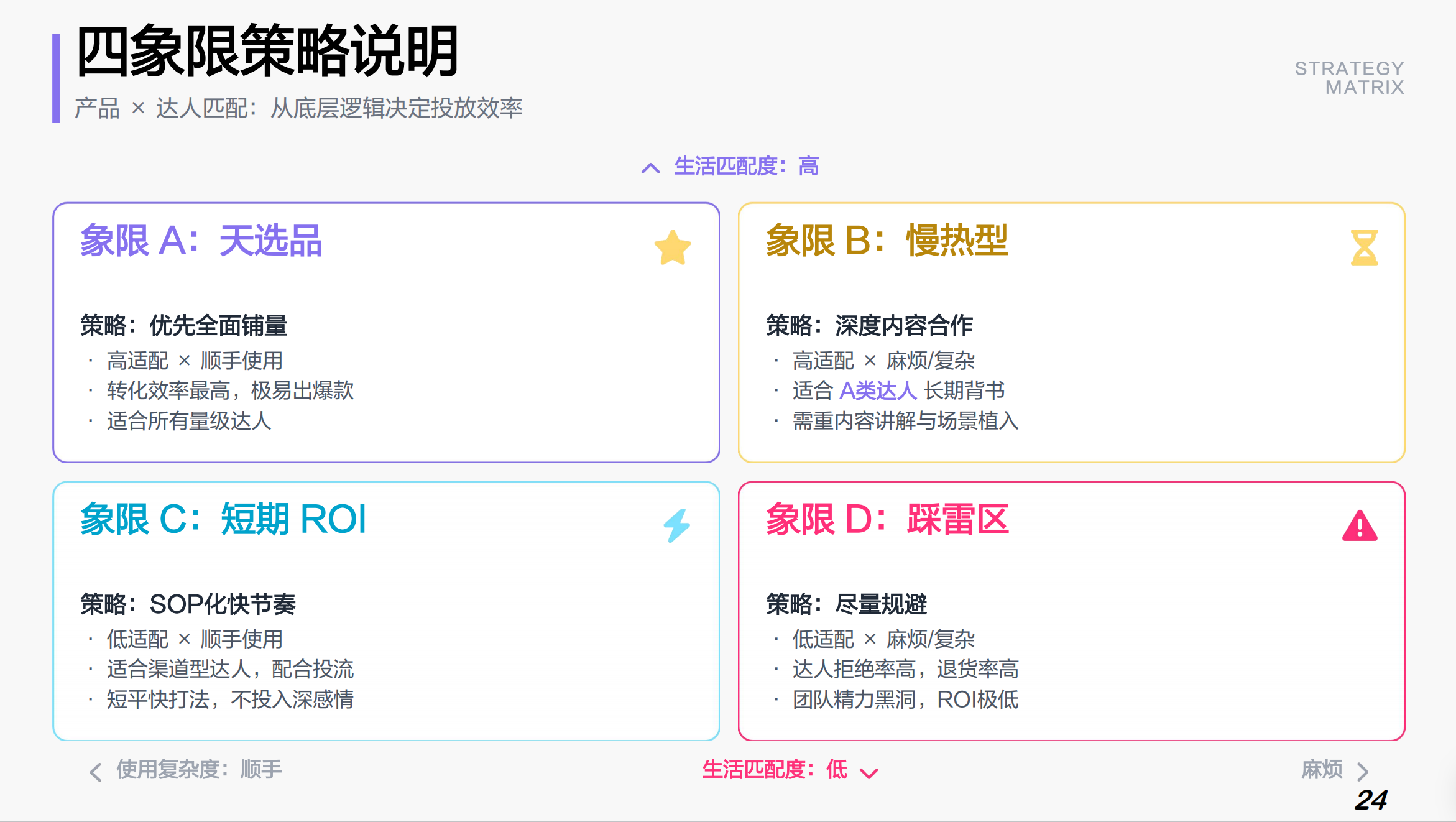
Gumamit ng dalawang linya upang hatulan:
- Horizontal axis: Ang pagiging kumplikado ng paggamit ng produkto (madali → nakakagulo)
- Vertical axis: kakayahang umangkop sa buhay (mataas → mababa)
Sa wakas, nabuo ang 4 na kuwadrante:
Quadrant A: High Adaptation × Smooth → Priyoridad para sa Kooperasyon (Mga Piniling Produkto)
- Kusina, paglilinis, mga alagang hayop, ina at sanggol, mga kategorya ng imbakan
- Magbabalik ng natural
- Pangmatagalang makabuo ng sales
Quadrant B: High Adaptation × Problema → Uri ng mabagal na pag-init (nangangailangan ng mas mahabang cycle)
- Mga gamit sa bahay, matibay na gamit, mga kategorya ng pag-install
- Kailangang maghintay ng content para sa panahon ng window ng expression
- Angkop para sa mga type A creator, hindi angkop para sa type C creator
Quadrant C: Low Adaptation × Smooth → Maaaring gamitin para sa maikling termino (C category creator investment ROI)
- Mukhang maganda ngunit gumagamit ng mahina na nauugnay na mga item
- Angkop para sa paggamit bilang isang "maikli, patag at mabilis na materyal na pool"
Quadrant D: Mababang Adaptation × Problema → Subukang huwag mamuhunan (talagang tumuntong sa mga minefield)
- Nangangailangan ng paliwanag, senaryo, at paghahanda
-Likas na tatakas ang lumikha
Maaari mong hilingin sa lahat ng bagong produkto ng team na dumaan sa four-quadrant diagram na ito bago mag-pitch para sa creator.
5. "Tatlong Hakbang na Pamamaraan ng Pamamahala" ng operator
Ang hanay ng mga pamamaraan na ito ay nagmula sa pangmatagalang kasanayan sa pangangalakal.
1. Suriin ang status ng tagalikha ng Class A araw-araw
Tingnan ang apat na bagay:
- Dalas ng pag-update sa huling 7 araw
- Kamakailang damdamin ng nilalaman (maluwag → mahigpit)
- Kamakailang kapaligiran sa lugar ng komento
- Kung natural na nabanggit ang produkto
Ang mga tagalikha ng Class A ay hindi tumitingin sa GMV, ngunit tumitingin sa "katayuan."
2. Suriin ang mga produkto isang beses sa isang linggo × matrix na tumutugma sa creator
Ang mga bagong produkto ba ay nakalagay sa maling kuwadrante?
80% ng mga pagkabigo sa pakikipagtulungan sa ilang mga koponan ay nagmula sa "maling pagpili ng lumikha", hindi sa hindi magandang pagpapatupad.
3. Magtatag ng A/B/C creator pool (ina-update linggu-linggo)
- Kung mas marami ang bilang ng mga kategoryang A, mas madali ito para sa koponan
- Ang Kategorya B ay ang focus sa hinaharap
- Ang Kategorya C ay hindi dapat tumagal ng masyadong maraming oras ng koponan
Pangwakas na Kaisipan
Sa mga nagdaang taon, sa mga merkado sa ibang bansa at creator collaboration, nakilala ko ang maraming uri ng tao at nakaranas ako ng iba't ibang paraan ng pakikipagtulungan. Nakita ko ang ritmo ng nilalaman ng libu-libong mga account at nalantad ako sa libu-libong mga collaborative na nilalaman. Ipapakita ng ilang creator ang kanilang potensyal sa unang araw ng pakikipagtulungan, habang ang ilang creator ay hindi biglang lalabas hanggang sa isang partikular na punto mamaya; mayroon ding ilang creator na hindi nakikita ang halaga sa simula, ngunit kalaunan ay naging mga asset ng content na talagang umaasa ang brand sa loob ng mahabang panahon.
Sa mga karanasang ito, unti-unting mabubuo ang isang mas matatag na paraan ng paghatol - anong uri ng manlilikha ang karapat-dapat sa pangmatagalang pamumuhunan, anong uri ng lumikha ang kailangan lamang upang mapanatili ang magaan na relasyon, anong uri ng tao ang angkop para sa paglinang, at anong uri ng tao ang panandaliang pagtatangka lamang. Ang batayan para sa paghatol ay hindi ang bilang ng mga tagahanga mismo, o isang tagapagpahiwatig ng data, ngunit ang kanilang paraan ng pagpapahayag, ang katatagan ng kanilang mga karakter, ang pagkakaugnay ng kanilang nilalaman, at ang hindi nakikita ngunit nakikitang tiwala sa pagitan ng mga tagahanga at sila.
Ang halaga ng isang creator ay palaging binubuo ng nilalaman at tiwala, at ang halagang ito ay hindi pantay na ipinamamahagi. Ang ilang mga creator ay magiging napakalakas sa hinaharap at maaaring magkaroon ng epekto sa brand na higit pa sa mga numerong nakikita ngayon; maaaring manatili lamang ang ilang creator sa maliit at matatag na saklaw magpakailanman. Ang kakayahang husgahan ang potensyal sa hinaharap ng isang tao sa maagang yugto ay isa sa pinakamahalagang kakayahan sa pakikipagtulungan, at ito rin ang pinakakapaki-pakinabang na pamumuhunan ng oras. Dahil ang isang tunay na potensyal na tagalikha ng stock ay kadalasang makakalikha ng pangmatagalang halaga para sa tatak na higit na lumalampas sa aktwal na pamumuhunan.
Ang buong nilalaman ay aking personal na karanasan lamang pagkatapos ng pangmatagalang pagmamasid sa mga nakaraang taon. Maaaring hindi ito tama o naaangkop sa lahat ng mga sitwasyon. Ngunit hangga't ginagawa mo ang creator affiliate marketing o creator collaboration sa ibang bansa, dadaan ka sa mga katulad na yugto, katulad na pagkalito, at mga katulad na counter-intuition. Kung mayroon kang iba't ibang opinyon o nakakita ng ilang bagong pattern sa iyong pakikipagtulungan, malugod kang makikipag-ugnayan. Ang pagsasama-sama ng iba't ibang pananaw ay kadalasang maaaring gawing mas malinaw ang industriya at gawing mas matatag ang isa't isa sa kumplikadong ecosystem ng tagalikha sa ibang bansa.
Saan Tayo Susunod
Kung nabasa mo na ito, malamang na mayroon kang ilang mga bagay na karaniwan:
- Nakipagkalakalan ka na sa TikTok / sa ibang bansa creator affiliate marketing,
- Alam mo na ang pagiging kumplikado ng bagay na ito ay higit pa sa "paghahanap ng grupo ng mga tagalikha upang ipadala ang mga produkto at makita ang epekto",
- Maaaring nararanasan mo rin ang: parami nang parami ang mga pakikipagtulungan, mas mahaba at mas mahahabang anyo, at mas maraming pagod na mga koponan.
Ang nakaraang 102 na sensasyon ng katawan ay halos lahat ay nagsasabi ng isang bagay:
Ang bahagi ng lumikha ay ganap na hindi nakaayos - ang katayuan ng buhay, mood, ritmo, at mga paraan ng pagpapahayag ay nagbabago lahat anumang oras;
Ang seller ay nangangailangan ng mga structured na bagay sa layuning ito - mga sample, pag-unlad ng pakikipagtulungan, ritmo ng nilalaman, attribution ng GMV, at paglalaan ng badyet.
Sa nakalipas na ilang taon, habang gumagawa ako ng mga praktikal na operasyon ng creator affiliate marketing sa ibang bansa, may ginagawa din ako na maaaring maging kapaki-pakinabang sa iyo:
Mahusay na Creator Marketing Products ay Nagsisimula sa Tunay na Pag-unawa sa Creator Business
Gumawa kami ng operation center para tulungan ang TikTok seller na "pamahalaan nang maayos ang creator collaboration", at ang pangalan ay allymatic.
Ipakilala natin ito sa madaling sabi:
Ang allymatic ay isang creator marketing operation platform para sa TikTok Shop seller, na tumutulong sa seller na sistematikong pamahalaan ang buong proseso ng creator collaboration.
Mula sa creator outreach, pamamahala ng sample, pagsubaybay sa pagtupad sa kontrata, pagsubaybay sa nilalaman, hanggang sa attribution at pagsusuri ng data ng transaksyon, isinasama ng allymatic ang orihinal na nakakalat at nakadepende sa manu-manong proseso ng creator collaboration sa isang malinaw at nasusubaybayang operating system.
Ang allymatic ay mas nag-aalala tungkol sa "pagpapatakbo ng creator marketing nang tuluy-tuloy at malinaw" sa halip na magpadala lamang ng ilang pribadong mensahe sa seller. Sa pamamagitan ng mas structured na proseso at pananaw ng data, tinutulungan nito ang mga team na bawasan ang mga gastos sa komunikasyon, pagbutihin ang kahusayan sa pakikipagtulungan, at patuloy na i-optimize ang mga epekto ng creator collaboration.
Ito ay angkop para sa mga brand at seller team na gustong magpatakbo ng TikTok creator collaboration sa mahabang panahon at sa malaking sukat.
Hindi nito malulutas ang problema ng "kailan ang lumikha sa isang magandang kalagayan" pansamantala. Maaari lamang itong umasa sa mga relasyon at paghatol;
Ngunit sa mga lugar tulad ng mga sample, ritmo, attribution, at pagsusuri, ang iyong team ay maaaring maging mas relaxed at magkaroon ng mas malinaw na isip.
Unawain ang produkto: Product Function · Presyo at Package
Mga Benepisyo para sa mga Mambabasa
- Mag-apply para sa libreng 7-day access sa lahat ng feature ng allymatic;
- Mag-apply na sumali sa maliit na peer group ng overseas creator marketing operators para sa praktikal na talakayan;
- Anyayahan ang mga teammate na sabay na matuto at magsagawa ng mga ideya.
Makipag-ugnayan sa May-akda

Pakitandaan kapag nagdadagdag ng: 30,000 salita
Tumutulong ang mga komento na kumpirmahin na ikaw ay isang mambabasa na pumunta sa opisyal na website mula sa mahabang artikulong ito, upang mabigyan mo ng priyoridad ang pahintulot at magpatuloy sa komunikasyon.

Maaari mo ring i-scan ang QR code upang sundan ang personal na pampublikong account ng may-akda na "CJ Global Expansion Practice". Ang praktikal na karanasan at pag-iisip ng overseas creator marketing ay patuloy na ia-update para sa sanggunian ng mga practitioner.
Umaasa ako na ang lahat ng mga kasamahan ay magiging mas mahusay at mas mahusay, at ang GMV ay tataas at mas mataas!