
30,000-Word Deep Dive: The Counterintuitive Truths of Global Creator Affiliate Marketing That 90% of Sellers Misunderstand
A long-term field guide for cross-border ecommerce founders, operators, and creator BD teams
Who I Am—and Why I Wrote This Long-Form Guide
First, a quick introduction—and a note on where the experience behind this guide comes from.
My name is Changjiang. For the past several years, I have worked in cross-border ecommerce and global creator marketing, primarily at the intersection of creators and sellers.
TikTok Shop has expanded rapidly in recent years, but sellers’ understanding of “overseas creator affiliate marketing” has become increasingly divided: some people regard it as the overseas version of Taoke, some regard it as an extension of content delivery, and some regard it as a shortcut for testing products. The understanding is different, the approach is completely different, and the result gap is very obvious.
My biggest feeling is: The vast majority of "traps" and budget waste actually have little to do with "execution ability". The bigger problem lies in the incorrect understanding of creators from the beginning.
This 30,000-word long article can be regarded as 102 counter-intuitive experiences after long-term friction with overseas creators, brands, and institutions in the past few years. There is no grand methodology (there is still a methodology about creator value judgment at the end of the article), there are only repeated details and commonalities. I hope it can help you push forward your understanding of "overseas creator affiliate marketing" a little bit.
The author also continues to update the practical experience and thinking of overseas creator marketing through his personal public account "CJ Global Expansion Practice" for the reference of practitioners.
Who This Guide Is For
- The person in charge, boss, and partner of TikTok in charge / overseas creator affiliate marketing;
- People who lead the BD/creator operations team hope to establish a cognitive bottom line for the team that is closer to reality;
- A team preparing to move from domestic live broadcasting and advertising distribution to overseas creator collaboration.
Who This Guide Is Not For
- Readers who need "SOP template that can be applied immediately"; if you want to view the details of SOP, you can continue reading "Operational Notes of Overseas Creator BD: outreach email, Title and First Round of Establishment";
- I only care about the short-term game of "Is the quantity available today?" "Is this creator ROI high?"
How to Use This Guide
- Treat it as a "fragmented notebook": you don't need to read it all at once, just read the volumes you care about most;
- Use it as team training materials: select 10 to 20 most resonant ones and make them into PPT for internal sharing;
- Use it as your own frame of reference for judging creators: Every time before working with a new creator, read through a few of them and compare them with your own intuition.
Preface
Volume 1 · Getting to know the creator: Life comes before cooperation
When you watch "cooperation", what they live is real life
This volume focuses on a core premise: The creator is first of all a person who struggles, chooses, and feels in real life, and secondly is your partner. How they understand the cooperation requirements, whether they are willing to pick up their mobile phones to take pictures, where the products are placed at home, and whether they will naturally appear in the camera are all based on life logic, not process logic. The creator’s life background, self-identity, and daily rhythm determine whether they accept or not, how they shoot, and to what extent they shoot. The reason why many cooperations cannot be pushed forward is not that the proposals are not professional enough, but that the brands simply do not understand the other party’s life configuration. A truly long-term cooperation usually comes when the product finds a reasonable position in the other person's life, and the creator feels that "this is something I would use" rather than "I have to perform it just for you." When the team learns to understand the creator first and then talk about cooperation, all subsequent actions will be much easier.
1. The longer a creator works with them, the more they can see the rationality of the brand in their lives
As the cooperation time gradually grows, it will be natural to see which creators and products are truly compatible. The fit is not because the content is well expressed, but because they originally need this thing in their lives. Some products seem natural in the lives of certain creators. Whether they are kitchen supplies, home appliances, toys, sporting goods or pet supplies, they can all find a place in their content. Such a creator will not deliberately design shots, but products will appear at different points in life. The subsequent user recognition brought about by this kind of appearance is very strong. Cooperation is not promoted by scripts, but by "whether life allows it to be seen."
2. The creator’s understanding of “cooperation requirements” is not based on the process, but on their usual expression habits
When working on creator collaboration in China, most creators can accurately understand the cooperation script and key points, but overseas creators will not absorb information in this way. The way they understand the need for cooperation is closer to "after reading it, they can formulate a general direction in their minds according to their own habits." If the cooperation requirements are too detailed, they will not know where to start. The freer the content given, the easier it is for them to find their own way of expression. Because of this, the actual videos received are often different from expectations, but it is not because the other party is not paying attention, but because the creator's content expression method has never been to "execute instructions", but to "maintain his own style." People who are accustomed to the domestic cooperation model can easily mistakenly think that the creator is perfunctory. In fact, they are just absorbing information in their own way and filming it according to the style of their own channel.
3. The creator’s lens habits determine where the product appears, not the brand’s needs
As the number of collaborations increases, you will increasingly feel that each creator’s camera habits are fixed. The way they shoot content is closely related to their personal habits, and many changes cannot be adjusted by the brand with just a word. Some creators are always used to shooting from the right side, some creators do not show their face in the lens, some creators do not like zooming, and some creators always cook from the top down. These habits are not designed for collaboration, but are natural patterns formed over a long period of shooting. Whether the product can be seen clearly in the picture, in many cases is not because the creator is unwilling, but because they are used to such an angle. They won't deliberately change the shot structure for a certain collaboration, because that would make it easy for fans to detect the change. As the cooperation progresses for a long time, we will become more and more understanding of the "stability of lens habits", and we will also know what kind of products naturally suffer more from certain creators' lenses.
4. The life background of the creator affects the way they understand cooperation
After long-term contact with creators from different countries, you will slowly discover the differences in their life backgrounds, which will directly affect their understanding of cooperation. Some creators come from relatively stable professional environments and respond quickly to collaboration emails; some creators are used to switching between freelance jobs, and life itself is not fixed, so cooperation is not so urgent for them; and some creators regard creation as a hobby and only shoot content when they are inspired. If the brand does not know the rhythm of life behind the creator when communicating, it is easy to misjudge their feedback method. In fact, their expressions are not confusing, but consistent with their backgrounds. After understanding this, communication with the creator will become looser, and you will be more able to accept various rhythm changes in cooperation.
5. A creator’s interest in cooperation often comes from real use rather than financial incentives
After working with overseas creator collaboration for a long time, you will gradually notice a phenomenon: some creators will be very willing to shoot even if the profit margin is not high; some creators will not be interested even if the profit margin is high. seller is often hard to understand at first, thinking that "the more you get the bigger the share, the more willing you will be to cooperate", but the creator's interests are very different. If the product itself is easy to use, they will naturally want to take pictures; if the product has complex functions or requires special posing, they will subconsciously avoid it. Whether there is a "real usage relationship" between the creator and the product can determine the direction of cooperation more than money itself. There are also creators who were silent for a while after receiving the product, and then suddenly sent a piece of content a few weeks later, saying that they found it useful recently. This kind of content is often more natural than those shot according to schedule. Real use will make the cooperation go longer and reduce a lot of communication costs. You can even see the creator himself actively mentioning the product.
6. The creator’s personal experience will subconsciously affect the willingness to cooperate
After communicating with overseas creators for a long time, you will gradually notice that their personal experiences often affect their attitude towards cooperation. Some creators have been questioned by fans because of too much commercial content, so they will be cautious later; some creators have encountered bad experiences in cooperation and will be more sensitive to brand emails; and some creators will be affected by the opinions of people around them and will be more cautious when choosing collaborations. This information may not necessarily be expressed directly, but it can be slowly felt during long-term interactions. A creator's attitude toward collaboration does not change randomly, but is shaped by their past experiences. After understanding this, it will be easier to accept some sudden hesitations and interruptions, because it is often not a problem for the brand, but to protect their own experience.
7. How long the product is kept at the creator’s home will affect how they express themselves later
An interesting detail in the cooperation is that the longer the product is kept at the creator's home, the easier it is for the content to show natural traces. When they first receive the product, they will tentatively explore how to use it and may not necessarily take pictures immediately, but as time goes by, the product may become more comfortable in their lives. Many creators will slowly find a place in their lives, such as placing them in a corner of the kitchen or a drawer in the bedroom, and then naturally capture them in the video inadvertently. Sometimes they forget about the collaboration itself, but they do have this thing in their lives, which makes the subsequent content more real. If a brand only looks at short-term results, it will ignore this process of "integrating into life"; but for creators, this process is more important than the terms of cooperation.
8. The same product will be presented completely differently in creator content in different countries
When cooperating across different countries, you will gradually see that creators from different cultural backgrounds have very different ways of presenting products. American creators pay more attention to the sense of life, and their usage and tone are looser; British creators are often more reserved and don't like to emphasize products; Australian creators like outdoor, and there are many action shots in the content; Southeast Asian creators will be more willing to try some light display methods. If a brand interprets all creators according to the content habits of a single country, it will be easy to make mistakes. Differences in expressions between different cultures are natural, and this difference also determines the way products are presented. Inconsistencies in expression must be accepted when collaborating across markets, because true expression itself carries cultural textures.
9. The creator’s self-identity will affect the style of cooperation
As cooperation increases, you will gradually see that the creator has a very clear positioning of himself. Some creators see themselves as life recorders, some see themselves as mom content creators, some see themselves as outdoor enthusiasts, and some define themselves as people who share experiences. Different self-identities will naturally filter out some expressions when they cooperate. For example, people who regard themselves as life recorders will not be willing to emphasize functions, and people who regard themselves as hobby bloggers will not be willing to take serious exhibitions. If brands don’t understand the creator’s self-identity, they will misunderstand their expression. A truly long-lasting collaboration is one where the creator expresses the product in his own identity, rather than changing his identity for the sake of the product.
10. Creators rarely use a "professional perspective" to understand cooperation. They use life experience to judge.
After working overseas for a long time, you will begin to realize that creators do not think from the perspective of "professional cooperation" like brands do when looking at cooperation. They often wonder, "Is this suitable for my current life?" "Would it feel awkward for me to shoot this?" "Would fans be uncomfortable seeing it?" These issues are completely unrelated to what the brand cares about. For brands, cooperation is a job; for creators, cooperation is a part of their lives. The more life-like a creator's judgment is, the more brands need to avoid using a task-oriented tone in communication. When cooperation goes most smoothly, it is usually when both parties regard the cooperation as a natural interaction rather than a transaction.
11. The sustainability of cooperation often depends on whether the creator feels that the product is meaningful to his or her life
After observing the cooperation trajectories of a large number of creators, it will become more and more obvious that the meaning of the product to the creator's life determines the length of the cooperation more than the cooperation itself. Certain creators like certain types of products, such as kitchen equipment, children's products, pet supplies, or outdoor gear. They use them not because of cooperation, but because these things themselves occupy a place in life. If the product is meaningful to their lives, they will naturally want to express it, show it, and recommend it. On the contrary, if the product is not relevant to life, it will be difficult to sustain even if the cooperation goes smoothly. If the brand can find a product line that matches the creator's lifestyle, cooperation will be much easier.
12. Many creators are not “order-taking machines”, their expressions are driven by life
In China, we are accustomed to the "professional" cooperation of creators. After arriving in the overseas ecosystem, many seller will instinctively expect that creators will also have this professional approach. But after a lot of cooperation, you will find that the expressions of overseas creators are more driven by life rather than mission-driven. Some creators are actively updating because their lives have been slack recently; some creators have paused updates because they have been too busy recently; and some creators will suddenly have periods of inspiration and take several photos in a row. These changes are difficult to explain with career models, because they are not creating with "work logic", but with "life logic". Understanding this will make cooperation more stable.
13. The creator’s understanding of “expression” is a spontaneous state, not a quantifiable action
If you stay with creator collaboration for a long time, you will find that their way of expressing themselves is very spontaneous. Not every shooting is prepared, and we don’t do scripts, planning, and lens design in advance like a professional team does. More often than not, they suddenly feel "it's okay to shoot" at a certain moment, and then they start. This expression may seem random, but it is actually the underlying rhythm of their content. Fans like their channel because the expression is not designed, but is very real. If the brand tries to ask the creator to turn the expression into quantifiable actions, such as "this sentence should be said more clearly" and "this scene needs to be shown again", the creator will feel that the traces of performance are too heavy. Once the expression is quantified, the original feeling of the creator will be lost.
14. The creator’s decision-making method is very simple: if you like it, shoot it, if you don’t like it, leave it alone
Many brands mistakenly believe that creators will consider various factors when choosing to cooperate, such as budget, workload, performance expectations, content difficulty, etc., but the actual situation is often much simpler. When creators look at a collaboration, they often only ask two questions: Do you like it? Is it smooth or not? Their decision-making is very intuitive. If a certain product arouses some interest in them, they will be willing to try it; if a certain cooperation seems too burdensome to them, they will silently let it go. It’s not that it’s unprofessional, but the creator’s way of working is inherently based on “feeling”. This feeling is not random, but a judgment system they have formed over many years as content creators, but the way of expression is more life-like.
15. Whether cooperation can advance depends on whether the creator has found his own outlet for expression
In cooperation, we often see that some creators quickly produce content after receiving the product, while some creators have been slow to make any progress after receiving it. Later, I gradually realized that this was not a matter of attitude, but that the "entry for expression" had not been found. Creators usually don't shoot hard, but wait until a natural scene appears in life that makes them feel "can put the product in". For example, when you are cooking one day and you suddenly need to use a certain tool, you take a photo of it; or when you are tidying up your room one day and you feel that this product is very useful, you take a photo of it. After the expressive entrance is found, shooting will be easy; but if the entrance does not appear for a long time, they will not force themselves to create. Once you understand this expression, you won't feel anxious about "waiting" in collaboration.
16. Creators do not regard every cooperation as an opportunity, they only regard cooperation that suits them as an opportunity
In the domestic creator ecosystem, many creators regard cooperation as a career opportunity; but overseas, creators do not think so. They will not think "the more cooperation, the better", nor will they think "this is an opportunity to increase exposure", but will ask themselves: "Is this something I am willing to express?" If the cooperation methods, products, usage scenarios and their channels cannot be connected, they will not regard it as an opportunity. They pay more attention to whether they can maintain the original expression of the channel and whether they can maintain the relationship established with fans, rather than the benefits brought by cooperation. Brands often think that creators are choosing opportunities, but creators are actually just maintaining their own boundaries of expression.
17. The more natural the collaboration, the more willing the creator is to use the product privately
During the cooperation process, some creators will suddenly take the initiative to shoot products without any cooperation arrangements, while others will naturally display products in their daily updates, live broadcasts, and stories. These contents are often not due to brand requirements, but because the creator himself actually uses this thing. The less the brand forces them, the more willing they are to use it naturally in their lives. On the other hand, if the cooperation process is full of pressure, even if the creator shoots the content, he will not be willing to continue to use it outside of cooperation. After long-term observation, we will find that those creators who eventually become "long-term brand assets" are often people who have formed a lifestyle habit for the product, and this habit has nothing to do with the intensity of cooperation, but is related to the looseness of cooperation.
18. The "sense of distance" between the creator and the product determines whether the final expression is smooth
In overseas cooperation, a very obvious rule is: the smaller the distance between the creator and the product, the more natural the content will be; the greater the distance, the stiffer the content will be. This sense of distance is not obtained through familiarity with the selling points, but is slowly shortened through the use process. For example, if a product is placed at home and easily accessible, the sense of distance will gradually become smaller; if the product must be found, unpacked, and reset, the sense of distance will be great. What creators rely on most when shooting is the feeling of convenience. If the product is not convenient, the expression will be interrupted; if the product is available everywhere in life, they will be very comfortable in expressing themselves. Brands often mistakenly believe that this is a matter of professionalism, but in fact it is just a matter of distance. Once the distance is reduced, the content will naturally flow.
19. The creator’s lens does not exist for cooperation, but for cooperation to happen just through the lens
Some seller will expect the creator to "design lenses for cooperation" when making overseas seller, but after long observation, you will understand that the creator's lenses have never existed for cooperation. They were filming their own lives, and the collaboration was just something that happened to pass through the camera. The lens structure, the rhythm of life, and the recording habits are all the ways of expression that the creator has already formed. If the collaborative content can fit through this lens, it will look very natural; if the collaborative content requires the creator to change their original shot structure, it will usually look awkward. Understanding this can reduce a lot of misunderstandings, because the key to cooperation is not "shooting ability" but "whether the lens is a part of life."
20. If the product makes the creator’s life more convenient, they will take the initiative to express it in the content
The key to many collaborations is not professionalism, but whether the product really improves the creator's life. Some creators will continue to use a certain product after the cooperation ends, just because it is really useful. They will naturally bring it to this product in subsequent vlogs, stories, and live broadcasts. These expressions are often more effective than formal cooperation. Creators do not regard this kind of content as commercial expression, but as a part of life. As long as products are truly integrated into life, they will express themselves naturally. If the brand can find this kind of product that can make the creator's life easier, the cooperation will be more long-term and natural.
Volume 2 · The generation mechanism of content, fans and trust
Hot sales are just fireworks, long-term trust is the foundation
This volume revolves around the fact that fans are never watching "drive sales Mission", but following a life narrative. When they pay, they are often not persuaded by the selling point, but because they agree with the creator’s lifestyle and temperament. Real usage scenarios, naturally reproduced products, visible "imperfections", and daily life with a sense of relaxation can activate purchasing impulses better than any exquisite script. Many conversions come from the creator's "unconscious actions": a casual placement, a casual mention of "I've been using this recently," or a child passing by and snapping into the camera. These signals form the basis of fans' trust. If brands are still obsessed with "content quality = picture sophistication", they will repeatedly misjudge in the overseas ecosystem. Long-term and effective cooperation is essentially borrowing the "emotional channel" accumulated by the creator and fans over the years, rather than forcing an advertisement into the timeline.
1. A creator who is willing to mention the product naturally is often more important than a big hit
When many seller make creator affiliate marketing overseas, they will focus on indicators such as "whether the playback is high" and "whether it can hit one song". But as the cooperation deepens, you will gradually see another kind of value: although some creators do not have outstanding data for each piece of content, they will continue to use the product in daily life scenarios. These naturally occurring clips are not as stimulating as the drive sales video, but they are more sticky among fans. Fans will gradually remember the brand in their minds when they see the same creator using the same thing at different points in time and in different behavioral scenarios. This method of influence is very slow, but substantial. Creators who can naturally relapse products will bring a "life-level presence" to the brand. This value is difficult to measure with short-term data.
2. Content quality is not directly related to ability to drive sales, reality is often more powerful
Many people who are doing overseas photography for the first time will think that if the content is clear, the lens is stable, and the rhythm is complete, they will be more capable.. However, during actual cooperation, you will find that the more exquisite the content is, the easier it is to be viewed as an advertisement by the audience, while videos where products appear naturally perform better. A fragment of life casually captured by a creator with a mobile phone can sometimes have more impact on the audience than a professionally shot video. The reason is not that viewers don’t care about content quality, but that they are extremely sensitive to “advertising traces”. As soon as it feels a bit contrived, it's quickly skipped. But when you see what a person uses in a real-life scenario, it will be easier to believe that it is a real need and not for business cooperation. What ultimately triggers a purchase is often not "how well presented" it is, but "it looks like everyday."
3. Fans’ trust in the creator is based on life, not on recommended skills
After working together for a long time, you will find that the reason why fans pay is not because they are convinced by logic, but because they agree with the creator's lifestyle. What appears in the creator's videos, how they live their daily lives, and what products they are used to using, these things are more important than any selling point. Fans are not judging whether to buy through analysis, but "joining a certain lifestyle". This is why some creators can make fans want to try the things they use even if they don't have any selling points and are just quietly cooking, tidying up the house, or taking care of the kids. For fans, the purchase behavior is to get closer to the creator, rather than being pushed by marketing words.
4. The way fans view the content determines how the creator uses it to shoot
After observing the comment sections of some creators, you will gradually realize that fans are not looking at "drive sales content", they are looking at "how is this creator doing recently", "what new things have been added in life" and "which thing seems suitable". Overseas fans are usually sensitive to commercial traces and don't like to see creators obviously change their content methods, so creators are very concerned about this. In order to prevent fans from feeling distanced, they will prefer to use ordinary expressions when filming cooperation content, and will not change backgrounds, equipment or scripts for cooperation. Fans can tell whether the creator maintains the rhythm of life, and the creator himself knows the importance of this, so the way it is presented in the cooperation videos is often more like "recording" than "showing".
5. "Real usage scenarios" in the content can trigger purchases more than any display
In overseas cooperation, a particularly obvious pattern is that fans react very strongly to "real scenes". As long as you see the creator using something smoothly in life, your trust will naturally increase. Not because the content is well done, but because the scenes in the footage don't lie. Real scenes can make people feel that the product is actually there, rather than being arranged into it. Some creators will inadvertently say "This thing is very commonly used recently". Such expressions have a great impact on fans; they are not being promoted, but seeing real objects in other people's lives. What ultimately leads to purchase is not “persuasion” but “being infected by life”.
6. The "way of existence" of the product in the content is often more critical than the presentation effect
When visiting creator collaboration overseas, it is easy to notice an interesting situation: purchasing behavior is often not because the content is well presented, but because the product appears in a reasonable position in the content. Some creators shoot content with very little information and don’t even mention their selling points, but fans can tell that they are actually using it. What fans see is life, not layout; what fans feel is "this thing is always there." This "reasonable existence" is easier to believe than a special display. In China, we are accustomed to emphasizing selling points, highlights, and neat display, but overseas, the content that can bring about the most conversions often does not have a deliberate display structure. The creator naturally uses the product in his own life, which is more acceptable to fans than any script. It is a way of presentation that is "recognized by life".
7. Fans’ long-term trust in the creator is more rare than any short-term conversion
In overseas cooperation, we often see a situation. The data of some creators have never been oriented toward hits, but fans have a high level of trust in them. Fans are willing to listen to their voices, follow their rhythm, and try the products they use in their lives. Trust is formed over a long period of time and does not rely on skills, scripts, or short-term stimulation. This trust slowly permeates into purchasing behavior, eventually forming stable conversions. Those creators who "don't look like drive sales" are often the real long-term assets of the brand. There is a lot of short-term explosive content, but there are very few creators who can stably affect the lives of fans. The more I do creator collaboration overseas, the more I realize that the foundation of the brand's long-term growth is actually based on the gentle and true trust between the creator and the fans.
8. Fans’ lifestyle towards the creator will subtly affect the conversion path of the product
As time goes by, it will become clearer and clearer how the creator’s lifestyle affects conversions. Some creator fans themselves are fans of home furnishings and are highly receptive to "life-improving products"; some creator fans like fast-paced content and are more responsive to display products; some creator fans are young students who are more concerned about price; and some fan groups are more likely to be interested in "small items with a strong sense of experience". Fans’ consumption behavior is not determined by the creator’s words, but by the lifestyle connection originally established between them and the creator. If brands can observe this "lifestyle-fan tendency" relationship, it will be easier to find the type of creator suitable for cooperation.
9. The slackness of the content itself will affect fans’ purchasing emotions
Many overseas creators’ content has a sense of relaxation, which comes from their pace of life, language and emotional state. After working for a long time, you will see that if the creator's mood is stable, the temperament presented by the content will be gentler, and fans will be more willing to stop, listen to a sentence, and take a look at the product. If the creator's life has been busy recently and the content seems rushed, fans' acceptance will also decrease. It’s not that the content gets worse, but that the emotional delivery affects the way the audience stays. Overseas, there is a strong correlation between purchasing behavior and sentiment. The relaxation of the creator will bring about the relaxation of the fans, and this relaxation will make people more willing to try something. If brands can grasp this emotional change, cooperation will be smoother.
10. Communication between creators and fans will change the way products are presented in content
Creators often receive messages from fans in the comment area, and these messages will affect their subsequent expressions. Sometimes fans express their liking for certain content, and the creator will continue shooting from that direction; sometimes fans feel that a certain presentation method is too deliberate, and the creator will quietly adjust it. Fans will even ask questions about the product, which will lead to a more natural response from the creator in the next piece of content. The interaction between creators and fans constitutes a subtle feedback mechanism, which allows content to be continuously adjusted rather than a fixed template. If a brand ignores the influence of fans, it will misjudge the creator’s expression trajectory. In fact, fan reaction has a huge impact on how a collaboration performs.
11. Creators’ hesitation in cooperation often comes from “not sure what fans will think”
When cooperation reaches a certain stage, you will often see a subtle hesitation in the creator's expression. This hesitancy isn’t a hesitation on the part of the brand, but rather uncertainty about their fans’ reaction. In the fan community, the creator's expression habits are a long-term tacit understanding. Any deviation will make the creator worry about whether it will upset this balance. They are willing to cooperate, but they don’t want fans to feel that the channel has suddenly become commercialized. Many creators' hesitation comes from this sense of uncertainty, not from the collaboration itself. Will fans accept it? Will fans think the content has changed? These problems may not be mentioned directly by the creator, but they will affect their speed of replying to emails and their naturalness when shooting content.
12. Some seemingly unexpected content often has better results than carefully prepared content
During the cooperation process, we often encounter videos shot by some creators that look casual or even slovenly, but their data performance is unexpectedly strong. If you observe carefully, you will find that these contents are usually taken when the creator is completely unguarded, and it is a very natural moment in their lives. At this time, they are not trying to express anything, but doing what they are used to doing. What fans see in such content is the true status of the creator, not the cooperative tasks. The more natural the expression, the easier it is to resonate and generate purchasing motivation. Many brands did not understand at the beginning why this kind of "casual shooting" resulted in better results than "careful shooting", but in the overseas ecosystem, this phenomenon is very common.
13. The creator’s expression is unstable, but their feelings for fans are stable
A very interesting phenomenon can be seen in the cooperation: the creator's content updates may be unstable, but their emotions towards the fans are very stable. This emotion is not expressed through specific actions, but a relationship that is maintained over time. Fans like to see the daily life of the creator, and the creator also gets psychological support from this relationship. When the cooperative content can be naturally integrated into this relationship, fans will give a natural acceptance; if the cooperative content destroys this relationship, the creator will notice it immediately. For creators, the emotional stability of fans is the underlying logic of the content direction, and they will not risk destroying it, which is why collaborative content must be "like normal content."
14. There are a lot of "unconscious actions" in the creator's expression, and these actions are more influential than the script
After working with creators for a long time, you will gradually notice some small actions in their content, such as casually placing products in a corner, putting an object into the daily process, or casually saying "I have been using this recently." These small movements are not deliberately designed, but are the traces naturally left by the creator during real use. Fans are very sensitive to these "little gestures" because they are signals that only appear in real life. Scripts, selling points, and displays are certainly useful, but many conversions come from these inadvertent moments. The creator's lifestyle itself is a kind of content logic. If brands can understand these subtleties, they will see more "unexpected good results" in cooperation.
15. Creator’s channels often rely on a “life narrative” with its own rhythm
After observing a large number of creators' channels, you will see that their content is not independent, but connected into a "life narrative". Fans are not watching a single video, but watching how the creator is doing recently, what is happening in his life, how good he is, and what his mood is. If the cooperation content can enter this narrative, it will appear natural; if it destroys this narrative, it will appear abrupt. The creators themselves are also very sensitive. They know that fans are tracking this status, so they will not let collaborative content destroy the continuity of the narrative. After understanding this, many questions that brands have about "why a certain piece of content cannot be shot" and "why a certain time is inappropriate" will be slowly explained.
16. Creators don’t like to over-explain products, they prefer to show logic in use
In the domestic creator ecosystem, explaining products is a common way of cooperation, but overseas creators usually rarely do so. They prefer to directly show the use process instead of saying "this function is very powerful" or "this selling point is very special". Fans watch the creator’s actions, not his words. The creator's logic is: as long as I use it, fans will understand the product; as long as I use it several times, fans will believe that the product is really easy to use. The explanation will be awkward, but the use will not be. If a brand forces a product explanation, it often makes the creator feel uncomfortable because it destroys their natural way of expression. Understanding the creator’s presentation method can help the collaborative content move towards a more realistic trajectory.
17. Fans’ trust is always an invisible influence, and brands must adapt to it instead of trying to control it
Fan relationships with overseas creators are often built on years of companionship and emotional resonance. This trusting relationship has a profound impact on collaboration. Fans are willing to buy a certain product because they trust the creator's judgment, not because of a certain selling point. Creators also cherish this trust very much and are unwilling to break it, which makes them more cautious when choosing to cooperate. This trust relationship cannot be manipulated by the brand, nor can it be obtained through strong stimulation. It is a personal relationship between the creator and the fans. What brands can do is not try to "influence fans", but enter into this relationship through the creator's natural expression. The final effect of cooperation is that fans trust the creator rather than the advertisement.
18. The "imperfection" that the creator retains in his expression is the source of fans' trust
There are often some "imperfections" in the content of overseas creators, such as screen shaking, unstable lighting, children suddenly breaking into the camera, the kitchen being a bit messy, and background noise. These imperfections do not affect fans, but rather enhance the sense of authenticity. The reason why fans like creators is often not the content standards, but the sense of life. If collaborative content attempts to smooth out imperfections, fans will immediately notice that the content is unnatural. The creator himself knows this, so he doesn’t deliberately modify it too much. If brands can accept these imperfections, content will be presented more loosely and trust will be stronger.
19. The best moments of cooperation always appear in expressions that are “least like cooperation”
After working overseas for a long time, I will gradually form a very deep feeling: the content that really has the best effect and can impress fans the most is often the one that is least like cooperation. Some creators' casual vlogs are better than all the carefully prepared content; some creators will be remembered by fans the moment they inadvertently use the product; some creators will only lightly mention "I have been using this recently" and the conversion will be very strong. These expressions are not performed, but happened. The more the brand tries to make the content "in line with the logic of cooperation", the more general the effect will be; the more the cooperation is like a normal expression in the creator's life, the more natural and lasting the effect will be.
Volume 3 · Rhythm, Uncertainty and Cooperation Window
Overseas creator collaboration, not "advance", but "step on the rhythm"
This volume talks about the time dimension: The default state of the overseas creator ecosystem is "inconsistent rhythm + uncertain results". Content performance is affected by life status, mood, the recent consistency of the account, and the current recommendation rhythm of the algorithm. Short-term data fluctuations are rarely attributed solely to "whether the creator has good intentions or not." The speed at which cooperation advances, the creator's quick and slow replies, sudden silence and reappearance all essentially reflect their current life stage and creative cycle. If brands still rely on "domestic standardized execution rhythm" to expect overseas creators, they will only continue to be disappointed in terms of response speed, scheduling, and stability. A truly mature trading idea will admit: I can't control the rhythm, but I can understand the rhythm and know when to wait and when to reach out to catch a cooperation window. Once you understand the rhythm, your mentality will be much more stable, and your budget will be spent more appropriately.
1. The rhythm of collaboration among creators is more affected by life status rather than project arrangements
After long-term contact with overseas creators, you will gradually notice that their rhythm and status when updating content have obvious traces of life. Whether the cooperation proceeds smoothly or not sometimes does not depend on the project itself, but on the creator's recent mental state and life arrangements. Some creators will stop updating when they have family issues, some will reduce posting when they are busy at work, and some will not want to turn on the camera when they are depressed. The time points given by the brand are not work tasks for them. They regard the channel as a part of their lives, so the frequency of updates depends entirely on "what is allowed in today's life and whether filming is allowed or not." Being accustomed to planned advancement at home, it is easy to feel anxious in the face of such uncertainty overseas. However, as the number of communications increases, it will become more and more obvious that this is not a matter of personal attitude, but the nature of this ecosystem.
2. Disappearance does not mean the end of cooperation. Many creators will return to the dialogue at their own pace
In the early stages of cooperation, one of the easiest things to misjudge is to regard the creator’s “no reply” as rejection. Later I learned that there was often no particular reason for their disappearance, it was just that higher priorities suddenly appeared in their lives, or they wanted to take a break from social media. Some creators will come back after a month and continue communicating as if nothing happened. Some people will even suddenly send a message after a few weeks of no news, saying that the product they sent last time has been used recently, and they also took a photo of it. Although this rhythm is very unfamiliar to domestic teams, from the creator's perspective, they do not define the existence of a relationship according to the cooperation process. The way cooperation exists is more like a connection, which will be cut off by life from time to time, but will be reconnected at the right time.
3. Creators will care whether their rhythm is disrupted by cooperation
The longer we work together, the more we can see that each creator has his or her own rhythm. This rhythm includes the frequency of updates, the rhythm of content, the arrangement of life and the fluctuation of emotions. Creators will be keenly aware of whether a certain collaboration is disturbing their original rhythm. If the cooperation requires too much, they will subconsciously want to stay away; if the cooperation content changes the atmosphere of their channel, they will feel something is wrong. Some creators’ channels have always been light-hearted, some creators are more focused on life records, and some have fixed themes. If the cooperative content disrupts this rhythm, the creator will feel uncomfortable and will start to cooperate less even if he does not say so. Understanding this "sense of rhythm" is a very important part of overseas creator collaboration.
4. The poor performance of some content is not because of poor shooting, but because the rhythm of the algorithm is not suitable
In cross-border content scenarios, we often see situations like this: the creator does a good job, but the streaming is not ideal. This situation is often not due to the content, but to various complex factors such as time, tags, recent video rhythm, and audience interaction. When creators realize that a certain piece of content is not performing well, they usually do not immediately blame the collaboration itself, but instead consider it from the perspective of their own creative status. This is obviously different from domestic creators. Domestic creators are accustomed to using data to judge the effect, while overseas creators use feelings more to judge whether the expression is smooth. It is crucial to understand this difference, because some people will instinctively attribute "low playback" to the creator, while ignoring the randomness and complexity of overseas platform algorithms.
5. Brands overseas must slowly accept that the pace of cooperation cannot be unified
After working overseas for a long time, I will gradually let go of one obsession, which is to hope that all creators will promote cooperation according to a unified rhythm. If you are used to a strong rhythm at home, you will naturally expect the same execution mode overseas. But overseas, the pace of cooperation is inherently fluid. Every creator has a different rhythm. Everything that happens in life will affect content release. Promotion of cooperation is a matter of "depending on the timing." Excessive pursuit of a unified rhythm will only make cooperation tense. On the contrary, the more you can accept the difference in rhythm, the smoother the cooperation will be. The earlier a brand realizes this, the easier it will be to find its place in the overseas ecosystem.
6. The timing of “life into content” will affect the quality of the content, not the terms of cooperation
The longer the cooperation lasts, the more we can see this pattern: creators often produce good content not because the terms of cooperation are clearly written, but because they happen to be in a state where they are willing to express themselves. Sometimes the content suddenly shoots particularly well. The reason may be that you were in a good mood that day, the lighting was just right, or you actually use the product in your life. Cooperation terms, scripts, and requirements do not determine the quality of the content. The state of life is the core. The content of creator is not "made", but "happened". This may not be intuitive to people who are accustomed to the domestic cooperation model, but it is the norm in overseas ecosystems. The better you understand this, the more you can find a true rhythm in your collaboration.
7. The effect of the same creator will change at different stages, which has nothing to do with the product
Many seller will be confused as to why creator performed well last month but suddenly fell flat this month. After actual observation for a long time, you will find that this change has little to do with the product, and more comes from the stage of the creator itself. Factors such as life status, posting frequency, fan engagement, recent content direction, and the way the algorithm recommends accounts will all cause fluctuations. Creators will not doubt the direction of their content because of a fluctuation. They will usually continue to maintain the original rhythm and wait for the state to get back on track. If the brand interprets short-term fluctuations as "creatorability to drive sales decreases", the judgment will easily be biased. Understanding this cyclical change will lead to a more stable collaborative mindset and less overreaction to individual content outcomes.
8. The basis of long-term cooperation is not the mechanism, but mutual understanding in rhythm
After the frequency of cooperation gradually increases, you will find that creators who can maintain a stable relationship for a long time have one thing in common, that is, they can match the rhythm between them and the brand. This rhythm is not set by rules, but formed naturally in long-term interactions. Sometimes the creator is slow to express, but the brand is willing to wait; sometimes the brand wants to push forward, and the creator happens to be in good shape. If this rhythm can be maintained, cooperation will be stable. If the rhythms of both parties are often inconsistent, the collaboration will repeatedly get stuck. The essence of long-term cooperation is not signing a contract, but the coordination of the rhythm between both parties. Being able to understand this rhythmic relationship is the key to whether a brand can go far in the overseas ecosystem.
9. If the brand can respect the rhythm of the creator, the creator will take the initiative to give back in many places
An interesting pattern can be seen in cooperation: when the brand remains patient in communication, does not rush to rush for content, and does not forcefully arrange time, the creator will feel this sense of relaxation. They will take the initiative to reply to messages, are more willing to share their experience of using it, and will also mention the product when appropriate scenarios arise. Some creators will suddenly use a product again after a long time, and then take a piece of content and send it to the brand. Some creators will put products into their own lists and then reappear when they need to use them. It's not because the brand gives more incentives, but because the creator feels relaxed and respected in the cooperation. On the other hand, if the brand presses too hard, the creator can easily close the reply window.
10. The content of the same creator sometimes suddenly enters a "low state", and brands need to understand this cycle
The content status of overseas creators often fluctuates. Some months are strong and some are flat. Sometimes it's not because there's something wrong with the content, but because the creator is tired recently, life has become busy, or his mentality is adjusting. The videos taken when the creator is in a low state are often more "conservative" and less likely to take the initiative to try new content directions. This is their self-protection mechanism. Fan interaction also declines during this phase, but this is just part of the normal cycle. If a brand loses patience with the creator’s content at this stage, it will miss the opportunity for them to regain their status. Long-term collaborators have generally experienced this cycle and understand that it takes a while to recover.
11. Changes in the creator’s life will directly affect the direction of cooperation, rather than the direction of cooperation affecting life
The longer we work together, the more I feel that the creator's life is changing faster than imagined. Some creators suddenly move, some change cities, some get promoted, some start taking their children to school, some suddenly start new interests, and some even just want to take a break from social media for a while. These changes will really change the direction of their content for the next phase. Creators do not plan their lives according to cooperative arrangements, but life determines what they are willing to express in the next period of time. If a brand tries to use cooperation to push the direction of the creator's content, it is easy to have the opposite effect; but if you follow the creator's recent life status to understand why they are willing or unwilling to shoot, many seemingly sudden changes will be easier to accept. Whether the cooperation can proceed smoothly depends not so much on whether the brand is promoted well, but whether the creator's life has entered a window period suitable for expression.
12. When cooperation reaches a certain stage, creators will use their own methods to silently leave space for the brand
In long-term cooperation, some creators will "leave a place" for the brand in their own way. They may not express it actively, but they will mention the product in their next vlog, or let the product appear naturally on the table in the footage of tidying up the room. Some creators will deliberately pick a suitable point to shoot a piece of product-related content when the update frequency slows down, as if to tell the brand: "I have not forgotten this." These behaviors are not business arrangements, but a way of relationship. Brands often ignore such "tiny expressions" in the overseas ecosystem, but these details often reflect the solidity of cooperation better than a single hot item.
13. Once the creator’s account rhythm is consistent, the cooperation effect will be significantly better
When observing the time trajectories of different creators, you will notice a kind of "coherence" in their accounts. As long as the recent content status is stable, the frequency of updates is normal, and fan interaction remains active, collaborative content can often be integrated more naturally. On the other hand, if the creator has been offline for a few days, updates have completely stopped, or the content direction has been switched, the cooperative content will usually not perform optimally. The consistency of content will affect recommendations and fan acceptance. This is not a problem with a certain piece of content, but whether the entire account has been running smoothly recently. If the brand can determine whether the creator's account is in the "continuity period", it will be easier for the cooperation to be in the correct window period.
14. The speed of cooperation depends on the creator’s recent life pressure
The life pressure of overseas creators is sometimes more obvious than that of domestic creators. While running their channels, many creators also have to take care of work, school, family, children, moving, bills, and daily affairs, which will directly affect the speed of cooperation. Some creators are in good shape during this period, and cooperation is progressing very quickly; some creators suddenly have family matters and will be suspended for a few days; and some creators will stop updating completely for a while when they are busy at work. If brands look at creators from the perspective of "professional execution", they will be confused by these changes. But if you understand it from a life perspective, you will find that these state changes are very natural. Whether cooperation can proceed smoothly depends more on whether the creator's life has been compressed recently, rather than their attitude towards cooperation.
15. The "pause period" in cooperation is not indifference, but the creator is waiting for a suitable opportunity
It is easy for many brands to misunderstand during the cooperation process, thinking that if the creator disappears for a few days, he is not active in the cooperation. But after being exposed to it for a long time, you will understand that the creator's "pause" is more of a natural rhythm. Some creators will not shoot content randomly until they find a suitable scene, some will wait for a certain weather change, some will wait for the children to calm down, and some will wait for the chaos of moving to be over. The creator will not forcefully shoot in order to complete the cooperation. Instead, he will wait for a "smooth" moment before shooting, which makes the content more natural. Many brands interpret this pause as negative, but in fact the pause is that they are waiting for "life to give an opportunity." Once the opportunity arises, their expression will be smooth.
16. The creator’s personal rhythm is more important than any process, and cooperation must follow this rhythm
After long-term cooperation, you will find that each creator has a rhythm of his own. This rhythm does not come from scheduling or algorithms, but from their lifestyle. Some creators shoot a little bit every day, some creators are only willing to pick up their phones when inspiration strikes, some creators shoot a whole day of content when the weather is nice and then distribute it over a few weeks, and some will stop updating entirely when they feel down. There is no "strategy" behind these rhythms, it is more a state of life itself. If a brand tries to get the creator to create according to a certain fixed rhythm, it is easy to hit a wall; but if the brand is willing to follow the creator's original rhythm, cooperation will be more natural. The real difficulty in overseas cooperation is not execution, but whether the rhythm can be matched.
17. If the content status of the creator is continuous and stable, cooperation will open more "natural windows"
After observing the timelines of different creators, you will find that their content status has obvious periodicity. Some creators suddenly enter a very smooth creative cycle at a certain period of time, updating for several days in a row, and every piece of content is very natural. At this time, their carrying capacity for cooperation will be very strong, and it will be easier for the content to appear in a "natural window", allowing the product to appear in the lens smoothly. In another period of time, the creator may update slowly, have less content, and be emotionally unstable, and the cooperation window will automatically shrink. Understanding the creator’s cycle allows brands to communicate at the right time, and can also reduce many “inopportune” advances.
18. A creator’s expression is often affected by the “ambience of the day” rather than by cooperation requirements
If you spend enough time with overseas creator collaboration, you will clearly see that their state when shooting content is very dependent on the atmosphere of the day. A person's mood that day, the weather, the light, the sound environment at home, whether the children are quiet, and whether there are trivial matters in life, these details will directly affect the content presentation. If the mood is relaxed that day, the content expressed will naturally be light; if there is pressure that day, the entire shot will appear tight. It’s not that the creators are unwilling to collaborate, but their expressions are so connected to the rhythm of life that it’s difficult to completely separate them. After understanding this, you will no longer be confused about "why the same cooperation arrangement, the results of the creator's shots on different days are so different." It's life, not the script, that really affects the content.
19. The emotional state of the creator will affect the content in very subtle ways
Through long-term observation, we will find that the content of the creator is very strongly affected by emotions. Sometimes even if the content seems acceptable, the underlying emotions will make fans feel that something is wrong. The content produced by some creators when they are emotionally exhausted is not inspiring; when some creators are in good condition, even if their expressions are light, they can still make fans feel the warmth. The content itself is not the product of quick decisions but the result of a flow of emotions. If the brand can detect whether the creator is in a state of expression recently, it will be easier to promote cooperation at the right time. The emotional state cannot be seen on the surface, but it can be felt in the content.
20. Cooperation requires establishing a rhythm, and this rhythm cannot be obtained by pushing
There is a pattern in overseas creator collaboration, that is, the rhythm of cooperation is not introduced, but grown. The first cooperation may be just to test the waters, the second cooperation may take time, the third cooperation may just get into the groove, and the fourth cooperation may be as natural as no cooperation. If the brand tries to use force to gain rhythm, it will often cause the creator to resent it, but if the brand is willing to let the cooperation develop naturally, the rhythm will slowly be established. Once the rhythm is formed, the creator will take the initiative to shoot, the brand will be easier to communicate, and the content will be more natural. Collaborative rhythm is a relationship outcome, not an execution outcome.
21. The creator’s content has a “personal rhythm” that cannot be copied, and brands can only respect it
No matter which country the creator comes from, there is a unique rhythm in their expressions. This rhythm may seem loose but is very stable. Some creators' rhythms are brisk, some are slow, some are a little casual, and some look very calm. Fans know them through this beat, not the content itself. If the collaborative content is consistent with this rhythm, fans will feel it is natural; if it deviates significantly, fans will feel it is inconsistent. The brand cannot change the rhythm of the creator, it can only follow it and let the product blend into this rhythm. The reason why many collaborations "don't look right" is because the rhythm is disrupted, not because there is a problem with the execution of the collaboration.
22. The cooperation window for creators is very short, but as long as you make the right move once, you can establish a long-term relationship
The cooperation window for overseas creators is very short, sometimes even as short as a few hours. It’s not because the creators are unprofessional, but because their life rhythm is inherently irregular. Sometimes they happen to be free, in good condition, and the light is suitable, so they are willing to take pictures; sometimes there is no suitable time for several days in a row. Once this window is missed, you need to wait until the next time your life situation becomes normal again. If a brand tries to treat the cooperation window as a controllable resource, it will be disappointed; but if it can keenly capture the most natural moment of the creator, cooperation will be much easier. Once you get the rhythm right in a certain collaboration, the creator will remember this sense of smoothness, and subsequent collaborations will become more natural.
23. Creators will not be affected by "bad data", they pay more attention to whether the expression is comfortable
Brands often look at the data after cooperation to judge whether the creator is suitable. But the creator himself rarely feels that cooperation is not good because the number of views is not high. They pay more attention to whether their expression feels smooth and whether the content conforms to the long-term rhythm of the channel. If the expression is comfortable, they will continue; if the expression is uncomfortable, they may not be willing to continue even if the data is good. This logic is completely different from the brand's logic and can easily lead to misunderstandings. The content of the creator does not serve data, but serves its own expression. This creative logic determines whether the cooperation can last.
Volume 4 · Communication Style and Psychological Safety
Less "sense of task" and more "sense of invitation" and security
This volume focuses on a very delicate but critical layer: The first thing a creator feels during cooperation is "tone" and "pressure", and then "price" and "process". Briefs written like a mission statement, emails full of requirements, and frequent urging follow-ups will directly penetrate their psychological safety boundaries and make people subconsciously retreat. On the contrary, clear but not verbose explanations, giving space for expression, and an attitude of not overly interfering will make the creator feel that "I can cooperate with you with confidence." Behind many so-called "relationships getting better" are actually "not forcing" many times, "understanding the poor state" many times, and "not forcing changes" many times. In overseas ecosystems, cooperation is more like long-term interactions between people, rather than KPI-driven execution links. Whoever can continue to provide a sense of security and predictability in communication will be more likely to obtain spontaneous expression, proactive feedback and long-term tacit understanding.
1. The more the collaboration is written like a task, the easier it is for the creator to feel a sense of distance
When communicating a lot of cooperation, you will gradually notice that the creator is very sensitive to the "sense of task". As long as there is too strong a sense of process in the email, or it feels like arranging work, they will naturally have some sense of distance. Their channel is essentially about self-expression, not a window for outsourcing. The more emphasis is placed on processes, requirements, and nodes, the less ideal the cooperation results are. On the contrary, when the communication method remains relaxed and natural, and avoids a coercive tone, the creator will be more willing to respond. Cooperation is actually a relationship, not a task list, which is very different from the domestic ecology. Domestic creators are accustomed to "tasking execution", while overseas creators are more accustomed to "expressing whether I am willing or not". Whether cooperation goes smoothly or not sometimes depends on whether it looks like "expression" rather than "execution".
2. Many creators need space to decide "how to shoot" instead of being assigned "what to shoot"
The expression of overseas creators is very dependent on their own living conditions, and they are used to deciding the direction of content by themselves. If the requirements for cooperation are too clear, they will not know how to start, but if the cooperation only provides some simple information, they can find a way within their own expression framework. Some creators will take the product to the kitchen to test it out for a few days and then find a comfortable angle before they are willing to take the photo; some creators will wait until a certain life scene happens before taking the product to take a photo. When brands try to force content structure, creators often feel constrained. Give them some space and more natural expressions will emerge. After working together for a long time, you will become more and more aware of the importance of "creator needs space". It is not a push-over, but a content habit.
3. Creators don’t like to be asked to repeat shots, they prefer to wait for the next time to happen naturally
In cooperation, we often encounter brands that want the creator to "reshoot a certain highlight" or "re-record a certain scene." Domestic creators can accept this request, but overseas creators are usually very resistant. They will not feel that reshooting is a "task", but will feel that it is a destruction of their own way of expression. Even if you are willing to cooperate, you will be more reserved and the content will appear unnatural. Many creators prefer to wait for a suitable scene to appear naturally in their lives next time, and then take a photo. This kind of waiting is very uncontrollable for the brand, but it is very important for the creator. Excessive demands for reshoots will strain the relationship and make the creator feel that the cooperation is too stressful.
4. Creators’ thinking in collaboration often revolves around “whether it’s comfortable” rather than “whether it’s effective”
In long-term interactions, you will gradually realize that when the creator decides whether to continue cooperation, he will first consider whether he is comfortable expressing himself, rather than how effective the cooperation itself can be. How they feel about the collaboration has a direct impact on how the next content is presented. If they feel that there is too much pressure from the brand, they will slow down in replying; if they feel that there are too many demands during the shooting process, they will also start to hesitate; but if they feel that this cooperation allows them to express themselves smoothly, they will continue naturally. Many creators will specifically mention "it feels easy" or "the way is natural" when expressing. What behind these words does not reflect skills, but that they care about their expression experience. Whether a collaboration can go far often depends on whether they feel they are expressing rather than performing tasks.
5. Behind many successful collaborations is the brand’s willingness to hand over “control” to the creator
In the domestic cooperation model, brands are accustomed to controlling content and even expression methods. But overseas, if the brand tries to control too much, the content will become rigid and the creator will lose the enthusiasm for expression. A particularly obvious pattern can be seen in cooperation: the more willing you are to leave the expression to the creator, the more natural the content will be; the more willing you are to let the creator find his own rhythm of expression, the smoother the cooperation will be. The creator will understand his channel better than the brand, and also understand how fans will accept it. The right of expression is in the hands of the creator, and the brand often gets not less, but more. This kind of "letting go" is not passive, but a necessary way of cooperation.
6. If the information given by the brand is too dense, the creator will not know where to start
When communicating and cooperating, some brands are accustomed to writing all details clearly, including selling points, presentation methods, shooting angles, script suggestions, etc. The original intention is to make the creator easier to understand, but the actual effect is often the opposite. When creators see overly long cooperation requests, they will feel a sense of "information congestion." Their habit of shooting content is to start from a simple starting point and then expand naturally according to their habits. If the collaboration requirements are too intensive, they will not know where to start or how to incorporate this information into their own expressions. The more information you give, the easier it is to cause lag. Many times, given a few words, the creator can find his own way. The longer we work together, the more I understand that creators don’t need instructions, but a space to expand.
7. The tone of the cooperation email determines whether the creator is willing to continue or choose to retreat
In communication with overseas creators, the tone of the email is very critical. If the language is simple, relaxed, and friendly, the creator will feel that cooperation is not burdensome; if the language is too formal, too process-oriented, and too task-oriented, the creator will quickly retreat. It’s not that the creator is averse to cooperation, but that he doesn’t want his channel to be framed by “tasks.” They are far more sensitive to tone than imagined. Some creators will give up replying directly when they see an overly serious cooperation email, but are willing to continue chatting when they see a relaxed email. Whether many cooperations go smoothly or not can actually be seen from the first email. The more natural the tone, the more likely collaboration will occur.
8. The creator’s response to “not forcing” will be more positive than the brand imagines
During communication, you will find that the creator is very sensitive to the brand's attitude. If the brand expresses a tone of "don't rush", "take your time" and "shoot when you are inspired", the creator will immediately feel the space. They will be more willing to take the initiative to communicate and express their true feelings of use. Some content even appeared because the creator felt this kind of relief and wanted to shoot it himself. Relaxation in collaboration is not a technique, but a way for the creator to feel understood. As long as the creator doesn't feel pressure, they will be more willing to express the product. This reaction has appeared in many collaborations and has basically formed a pattern.
9. Whether cooperation can be sustained often depends on whether the creator can maintain himself during the cooperation
After working overseas for a long time, I will become more and more aware of the fact that all creators who have long-term cooperation have a common characteristic, that is, they have never lost their own way of expression due to cooperation. They maintain the original language, rhythm, and atmosphere of the channel, allowing cooperation to be integrated into it. As long as they can remain themselves, cooperation can be maintained naturally; if a cooperation makes them feel "this is not like me," they will instinctively withdraw. The creator’s lens is not something that brands can shape at will, they must see “this is me” in their expression. The stronger that sense of self is, the stronger the partnership will be. This is why the more a brand wants to shape content, the easier it is to break off cooperation; and when the right of expression is truly returned to the creator, cooperation will slowly grow.
10. If the brand can understand the psychological safety of the creator, the cooperation will be much smoother than imagined
Creators rely heavily on psychological safety when creating. If they feel "free to express", their content will be loose; if they feel "a lot is required", their content will be tight. Psychological safety cannot be established in one sentence, but is accumulated through repeated communication. If the brand maintains a stable tone in messaging, does not make excessive demands, and does not turn cooperation into review, creators will be more willing to express real use. If the creator feels that "expression is safe," the entire partnership will be stable. Psychological safety is the basis for the natural flow of content and the key to sustainable cooperation.
11. Creators will use "whether they are asked to change themselves" to judge whether cooperation is comfortable
During collaboration, some creators may become hesitant when asked to adjust their expression. It’s not that they’re refusing to adjust, it’s that they don’t want to look like they’re pandering. They often ask themselves: "Is it still me when I shoot like this?" This kind of judgment is not expressed verbally, but is revealed naturally when the content is expressed. If the brand demands too much, they will feel like their image is being reshaped, which can make them very uncomfortable. In the overseas ecosystem, creators are much more sensitive to "maintaining themselves" than domestic creators. Once they feel that cooperation takes them away from their daily routine, they will naturally reduce their participation. The reason why cooperation can go on for a long time is because the creator feels that he has not been changed, not because the cooperation mechanism is perfect enough.
12. Creator’s understanding of business cooperation is closer to “invitation” than “task”
After working overseas for a long time, you will see more and more clearly that the creator's understanding of cooperation is "someone invites me to participate in something" rather than "I want to complete a task." They will judge whether they are willing to express based on their living conditions, channel atmosphere, current mood, and even the light outside the sky window. They care more about "whether this is something I am willing to join" than the requirements listed by the brand. If they feel pressure from the email or feel that the content has to be done a certain way, they will naturally back off. But if they feel free from expression and the collaboration doesn't seem to disrupt the channel's original rhythm, they will be willing to join. This "sense of invitation" is a very core point of overseas cooperation.
13. The tacit understanding between the creator and the brand is often established through "pressure-free interactions"
The longer we cooperate, the more we can see a pattern: the real tacit understanding is not formed during the advancement of the task, but appears in those seemingly inconspicuous small interactions. For example, when the creator sees the brand's relaxed reply, he will be willing to say a few more words; the brand does not push the creator when he is not in good condition, and the creator will remember this thoughtfulness; after the cooperation is over, the creator takes the initiative to share small fragments of his life, which shows that the relationship is becoming stronger. These details will not directly improve conversions, but they will bring cooperation into a healthy and relaxed state. The most valuable thing about long-term cooperation is not the "number of completed cooperation", but an invisible relationship foundation, and this foundation is often built on repeated interactions without pressure.
14. Many creators understand cooperation as a relationship between people, not a business contract
Through frequent interactions, it becomes more and more obvious that when many creators judge whether a cooperative relationship is comfortable, they do not look at whether the contract is clearly written, but whether the communication is smooth, whether the brand is considerate, and whether the brand is respected. Creators rarely regard cooperation as a cold business relationship. They prefer to view it as a person-to-person communication. If they feel that the other party is easy to communicate, patient, and will not force themselves, they will be more willing to continue to cooperate; if the communication method makes them feel that too much is being asked of them, they will naturally withdraw. Whether cooperation can be stable in the long term often depends on whether the sense of relationship is established, rather than whether the price is good enough.
15. Creators are more sensitive to "whether they are understood" than to budget
Many people think that the most important thing for creators is budget, but after long-term observation, you will find that this is a very typical misunderstanding. What creators are really sensitive to is often whether they are understood. For example, does the brand have patience, respect the way of expression, give them space when they are not in good condition, and communicate in an equal way? If the creator feels understood during the cooperation, they will naturally invest more effort; if they feel required, or feel that the brand does not understand their way of expression, they will slowly keep their distance. Budget is of course important, but what makes a creator willing to cooperate for a long time is not the budget, but the sense of security that comes from understanding.
16. A creator’s long-term judgment on cooperation often comes from repeated “not being disturbed” experiences
As the cooperation progresses for a long time, you will find that the creator's judgment of long-term partners comes more from the continuous feeling of not being disturbed. Some brands communicate very lightly and do not frequently urge or ask for additional content. In this relaxation, the creator feels a state of "you can safely cooperate with them." This feeling does not appear on the first day, but slowly accumulates after many smooth interactions. Creators know very well which brands make them nervous and which brands make them feel natural. As long as there is nothing uncomfortable in the interaction, this "lightness" will leave an impression on them. The stability of cooperation does not depend on big actions, but on these small experiences that flow slowly.
17. A creator's acceptance of cooperation often comes from a "sense of predictability"
Although the creator's expression is natural and relaxed, they still need a "sense of predictability." It’s not predictable in terms of process, but predictable in relationship. For example, brands won’t suddenly ask for too much, won’t make additional requests after content is released, won’t put pressure on them when they’re not doing well, and won’t suddenly change direction during a collaboration. This sense of predictability will make creators feel at ease when collaborating. As long as creators feel that the relationship is stable, they will let down their guard; once the cooperation becomes unpredictable, they will quickly retreat. This "sense of predictability" is not established by contract, but by communication methods.
18. The lighter the cooperation, the easier it is for the creator to express spontaneously; the heavier the cooperation, the easier it is for the creator to resist
What many creators fear most in collaboration is the "sense of burden". Whenever cooperation becomes too heavy, they will naturally keep their distance. Heaviness is a psychological feeling: too many requirements, too many processes, too many precautions, and too many repeated communications will make the creator feel that cooperation is a burden. But lightness is a state: brand communication is concise, does not rush, does not control expression, and does not interfere excessively. A light cooperation method will make the creator more willing to express and use the product naturally in life. The best content often does not come from strictly executed collaboration, but from content that the creator expresses spontaneously in a relaxed state.
19. Creators are very concerned about "themselves in the camera", so cooperation must follow their comfort zone
When overseas creators shoot content, they pay great attention to whether they appear natural in the camera. It's not to beautify or cater to fans, but the state they want to present is real. The relationship between fans and creators is based on this "real presentation". If the cooperation requires that they look like they are performing, they will notice it at the first time and immediately withdraw their willingness to express it. A creator's comfort zone is not fixed and will change with life conditions, but their sensitivity to "whether they look natural in the camera" always exists. If the brand tries to get them to behave in a certain way, they will appear restrained; but if the collaboration follows their original comfort zone, their expression will be very stable.
Volume 5 · Judgment Framework and Team Operation Suggestions
With a "human" perspective, reconstruct all your decisions on overseas creator collaboration
This volume is written separately for bosses and persons in charge: Help you consolidate the previous senses into a judgment framework that can be used for personnel selection, product selection, expectation management and team play. What is discussed here is how to avoid treating creators as “channels”, how to view response speed and rejection, how to understand the stability of different types of creators, how to select products based on “life suitability” rather than “functional selling points”, and why standardized processes frequently hit walls in overseas cooperation. You will see: price sensitivity is far lower than "sense of participation" and "understanding"; one rejection, one mediocre performance, and one pause do not mean the end of the relationship; those who are truly worthy of long-term investment are those who really like to use your products in their own lives and are willing to mention your brand even when there is no task. From the trading level, this volume gives you a basic idea: Reconstruct the entire creator collaboration system from the perspective of "long-term relationship assets" instead of just looking at the ROI report of each campaign.
1. The pain points perceived by the brand are often not at the same level as the creator
The more I communicate with the creator, the more obvious the gap becomes: brands focus on selling points, functions, prices, and differentiation, while creators pay more attention to "whether this thing is useful in my life." The highlights that the brand wants to highlight may not necessarily hold true from the creator’s perspective. Some products have clear logic, but the creator feels that it would look unnatural if placed in his channel; some products have strong selling points, but the creator feels that fans will not be interested in such things; there are also some products that brands think will be popular, but the creator feels that they are not that unique in life. There is no way to solve this gap through multiple scripts, because the benchmarks for their judgment are different from the beginning. For creators, the value of a product is "actual use experience", not "commercial selling point".
2. Creators who can continue to cooperate are usually not the type of people who perform well the first time
In the early stages of cooperation, many teams will focus on "who can achieve the best results when they work together for the first time." But in the long run, you will find that people whose content performs well the first time may not necessarily be able to cooperate in the long term; those whose content performs well the first time will slowly become long-term assets of the brand. The reason is simple: the former may just be a coincidence, while the latter is because the product has slowly entered life. The match between the creator's lifestyle, content style and products often only becomes apparent after the second or third collaboration. People who can really work together for a long time are those who can express the product naturally without scripts, and those who will continue to use the product in their lives.
3. Brands must slowly accept overseas: content is difficult to completely control
When I first started working on overseas creator affiliate marketing, I would naturally expect the content to be "completed as required." However, after actual promotion, I will understand that it is almost impossible for the content of overseas creators to be presented strictly as envisioned. It’s not because the creator is unprofessional, but because all their content is based on their own lifestyle and expression style. If they are forced to adjust, it will destroy the overall atmosphere of the channel. The overseas creator's channel is more like a person running his own life window, rather than a sales position. If a brand tries to “control expression”, it will only make the creator’s expression unnatural. The longer we cooperate, the more we can see it: the more we want to control the content, the more tense the cooperation becomes; the more we accept the freedom of the creator, the smoother the cooperation becomes.
4. People who are willing to take the initiative to communicate with brands usually have a more genuine interest in cooperation
In long-term cooperation, it is easy to tell which creators really like the product. Some creators will take the initiative to send messages asking for product details, or provide feedback on video effects, or even ask how to use a certain function. Some creators will send photos of their lives and say they are still using it recently. Sometimes they are not communicating, but expressing that they have indeed integrated this thing into their lives. Active communication does not mean asking for more rewards. More often, it just means "I am using it and I like it." This kind of expression will make cooperation easier and allow brands to see the real presence of the product in overseas life. People who take the initiative to communicate are often not the kind of creators who have the heaviest cooperation tasks, but the most natural ones.
5. sellerThe easiest thing to misjudge is to regard creator as a channel
Domestic people who make creator affiliate marketing often regard creator as a traffic channel and hope that cooperation can proceed as planned. However, overseas creators do not regard themselves as channels, nor do they understand cooperation according to channel logic. A creator's channel is part of personal expression and does not belong to the brand or platform. They will not change the naturalness of content for the sake of "channel flow", nor will they adjust their style for cooperation. Treating the creator as a channel will lead to constant deviations in communication, because the two parties’ understanding of cooperation is simply not the same language. As the cooperation deepens, this method of expression will slowly begin to change, no longer emphasizing tasks and execution, but paying more attention to the creator's lifestyle and expression. This switch will make collaboration smoother.
6. If the product goes against the creator’s channel atmosphere, they will instinctively avoid it
In a large number of cooperations, you will see that some creators are obviously unwilling to touch certain products, not because the products are not good, but because the products do not look right when placed in the channel. Creators are very sensitive, and they will judge whether placing this item in the camera destroys the original atmosphere of the channel. Some creators mainly focus on quiet content, and they are not willing to shoot things that are too bright or too exaggerated; some creators focus on life, and are not willing to shoot products that are too functional; some creators often shoot outdoors and are not willing to show indoor gadgets. It’s not that they are picky, but the channel itself has a style and fans are used to this atmosphere. As long as the atmosphere is inconsistent, the creator will feel "unsatisfied". Whether the cooperation goes smoothly or not often depends on the channel, rather than the product itself.
7. The long-term atmosphere of the channel determines the degree of product acceptance
After observing the channels of different creators, you will find that each channel has a fixed atmosphere. Some channels are relaxed, some are warm, some are slow-paced, and some are very interactive. Fans are very sensitive to this kind of atmosphere and expect the creator to maintain this way of expression. Any deviation will not sit well with fans. Whether a product can be accepted in the channel depends on whether it is related to this atmosphere. If a creator's content has always been "slow life records", it will be difficult for fans to accept that he suddenly starts to show a very powerful product. It’s not that the product isn’t good, it’s that the atmosphere of the channel doesn’t match it. Understanding the "channel atmosphere" will make the judgment of cooperation clearer. Because overseas, not all products are suitable to be placed on any channel, and the temperament between the product and the channel must match.
8. The creator’s “response speed” is a signal in itself and cannot be used as a performance measure
In domestic cooperation models, response speed is often used as an indicator of professionalism. But the response speed of overseas creators is more of a signal of living conditions. Sometimes it takes the same day, sometimes it takes a few days, sometimes it takes a week, and sometimes it disappears suddenly. Some creators reply late at night, some are used to reading messages only on weekends, and some may be busy with family or work. The speed of reply does not mean that they have a positive or negative attitude towards cooperation, but that they are handling things at their own pace. If brands misunderstand response speed as “whether they value cooperation,” they will misjudge the wishes of many creators. During long-term cooperation, you will understand that their rhythm is not for the brand, but a way of arranging their own lives.
9. Creators are not that sensitive to price, they are more sensitive to “whether there is a sense of participation”
In the process of cross-border creator collaboration, it will be obvious that the creator’s feedback on the share ratio or the price of a single cooperation is not as strong as expected. They will not change the way they express themselves just to gain a few percentage points, but they will be more willing to invest in content because they "feel respected", "have space for cooperation" and "the brand is willing to listen to their suggestions". A creator's level of involvement often depends on whether they feel they are participating in a collaboration rather than executing instructions. Many creators will take the initiative to share their thoughts on the user experience after cooperation, and some will also propose some small detail modifications. These behaviors are not to please the brand, but they regard this matter as their own expression. The greater the sense of participation, the more natural the cooperation; the more task-like it is, the weaker the sense of participation.
10. The creator's feelings towards the brand will slowly accumulate into a judgment of "whether he is willing to continue"
After working together for a long time, you will find that the creator’s judgment of the brand does not come from a certain cooperation, nor from a certain moment, but from the continuous accumulation of small fragments. Whether the email is easy to communicate, whether the content feedback is easy, and whether there is unnecessary pressure during the cooperation process, every detail will slowly form an impression. This impression does not have clear indicators like business cooperation, but is more like a vague but real feeling. When creators accumulate enough experiences of "easy collaboration", they will naturally put the brand in a higher position; if all they experience in cooperation is discomfort, they will gradually move back. The creator's judgment system is not black and white, but small details that are constantly accumulated, and these details have a huge impact in the long run.
11. Creators who can truly cooperate for a long time will suddenly start to "take the initiative" at a certain moment
When the cooperation goes smoothly, you will suddenly discover some proactive behaviors of the creator. It may be to take the initiative to tell the brand that a certain product happened to be used today, or it may be to suddenly shoot a piece of content not for the task, but because it happened to be suitable for the current scene. Some creators will casually mention products in their vlogs without any cooperation requirements; others will mention which products they like to use recently during live broadcasts. These proactive behaviors are not for exchange, but for the creator's own desire to express. They begin to regard products as part of their lives. When this relationship is established, cooperation will be stronger than any strategy.
12. A creator’s “rejection” is often a form of protection, not a denial
In overseas cooperation, if the creator refuses a certain cooperation, many people will naturally think that it is "not liking the product", but the real situation is often different. Many creators refuse because they want to protect the channel and not let fans feel that they are making too much commercial content; some are protecting their own way of expression and don't want the content to look forced; others are trying to protect the pace of life and don't want to make themselves too busy because of cooperation. The reasons behind rejections tend to be mild, not brand-specific but to maintain balance in your life and channel. If the cooperative relationship lasts long enough, you will see that the creator's rejection actually has a sense of boundaries and is very honest. Understanding this "protection" will make the cooperative mentality more comfortable.
13. Different types of creators show completely different stability in cooperation
In a large amount of cooperation, you will gradually see that the distribution of creator types is very clear. Some creators are very stable and have a fixed rhythm every month; some creators will suddenly disappear for a while and then come back; some creators maintain high-frequency updates for a long time; some creators are driven by interest and are only willing to shoot at certain times. Different types of creators have very different stability in cooperative communication. If a brand uses the same rhythm and communication method for all creators, it is easy to encounter setbacks. Understanding this type of difference will make cooperation strategies more flexible and reduce many unnecessary misjudgments.
14. The creator’s intuitive judgment of the product is often more accurate than the brand’s selling points
During the cooperation, you will find that the creator is very quick to judge whether the product is useful or not. They will not study product information or analyze selling points, but will form a very intuitive evaluation at the moment of actual use. Some product brands think the selling points are very strong, but the creator feels "it's not very comfortable" as soon as they get it; some product brands don't have much expectations, but the creator says "this is very suitable for me" as soon as they try it. The creator's intuition comes from their long-term life experience and is closer to real usage scenarios than the brand's commercial presets. Their intuition often affects content presentation more directly than selling points. The key point of many collaborations is actually the creator's "first feeling after getting started", which determines the direction of subsequent expression.
15. If the product troubles the creator, they will instinctively reduce their expression
The expression of overseas creators relies heavily on "simple" and "smooth". If a product is too complicated, requires too many steps to install, explain, unpack, and prepare, they will naturally use it less. This isn't laziness, it's just that the expression mechanism itself doesn't encourage complexity. The content rhythm of creators is usually relaxed, fast, and improvised. If a product can only be understood through a very complicated demonstration, they will instinctively avoid it. Many brands mistakenly believe that the creator’s reluctance to express is because they “don’t understand the value of the product.” However, the real reason is often just that the product interrupts the natural rhythm of their shooting. For the creator, anything that requires "preparation" adds to the mental burden rather than aiding expression.
16. The more a brand emphasizes functions, the easier it is for creators to ignore them
In cooperative communication, the brand usually gives a list of functions and hopes that the creator will express it in this direction. But when actually shooting, creators rarely shoot based on function. They are more accustomed to expressing things in ways that naturally appear in their lives. The more functions there are, the less they know where to start, and the easier it is for them to choose "only show the use and not explain the details". It’s not that creators are unwilling to show functions, but the logic they express is never based on “function sorting”, but on “I am using it”. As long as the content reflects real-life use, fans can understand the purpose of the product. The more the brand emphasizes function, the more the creator will return to the expression of life. This is a reflex adjustment.
17. The more natural the creator’s content, the more difficult it is for the brand to be measured with metrics
The content of overseas creators cannot strictly control the rhythm, beat, highlights, and structure like domestic creators, so the effect of cooperation often cannot be explained by a single indicator. Sometimes the playback volume is not high, but the conversion is very good; sometimes the playback volume is high, but the clicks and purchases are average; sometimes there is no obvious highlight, but the delivery is surprisingly stable. The more natural the content, the harder the data is to interpret by traditional logic. If a brand insists on using the domestic data structure to measure overseas creators, it is easy to make wrong judgments. The effects of overseas cooperation have many "life-related variables" and require a longer period of time to understand. Content that seems non-standard is often closer to the real conversion mechanism.
18. A creator's "refuse to cooperate" is often not because the product is not good, but because the way of expression is inappropriate
When many brands see the creator’s rejection, their first reaction is often that the product is not attractive enough. But this is not the case at all. Most rejections from creators come from inappropriate expressions. For example, the product is too big and you can’t find a clean background at home; the product is too functional, and the channel atmosphere is not suitable for emphasizing the selling point; the product does not fit into the scene naturally; the product is not visually beautiful enough, and the overall picture is ruined when placed in the camera. These reasons are rarely spoken, but are often at the heart. Creators will not change the tone of their channels for cooperation. They would rather refuse than let fans see unnatural expressions. Understanding this logic can avoid many misjudgments.
19. The more a brand relies on “standardized cooperation methods”, the more difficult it will be to promote overseas creator collaboration
In China, creator collaboration can be promoted by standardized processes: scripting, scheduling, shooting as required, and delivery according to nodes. But overseas creators do not work in this way. Their expression methods are not standardized, their life rhythms are not standardized, and their cooperation windows are not standardized. If brands use "standardized cooperation methods" to promote, they will basically encounter stuck points. Collaboration is difficult because the creator's mode of expression is inherently unstructured. If brands try to convert this unstructured into structured, they will find that all aspects are not smooth. But if brands are willing to follow the creator’s approach and treat cooperation as a natural communication, they will find that cooperation will be smoother.
20. Whether the product looks good or not will affect whether the creator is willing to put it into the camera
This detail is often overlooked by brands. The creator's lens style is usually formed by long-term habits. If the appearance of the product is very different from the visual style of the channel, they will feel that "it doesn't look good in it." This is not an aesthetic issue, but a coherence of the channel picture. Some channels focus on refreshing, some focus on nature, some focus on liveliness, and some focus on a sense of life. As long as the product is inconsistent with this atmosphere, the creator will have a feeling of "interrupted screen". The brand may not notice this detail, but the creator can feel at a glance whether the product destroys the structure of the picture. Appearance has a greater impact on collaboration than many people think.
21. Cooperation is not about turning the creator into a brand person, but about letting the product enter the creator’s life
After working overseas for a long time, you will naturally form an understanding: truly effective cooperation is not to let the creator express himself in the way of the brand, but to let the product find a reasonable position in the creator's life. Once the location is found, the creator will express it naturally; if the location is not found, it will be useless no matter how much you ask. The way the product enters the creator's life may be by placing it in the kitchen, in the child's room, in the car, on the table, or in the daily bag. As long as the product actually exists in life, it won't look out of place when it appears on camera. The more a brand tries to shape content, the harder it is to do this; the more a brand focuses on “letting products naturally enter life”, the better the collaboration will be.
Methodology: A Framework for Evaluating Creator Value
Why do some teams find it easier to work with the same budget, while others become more tired?
You need to establish a set of underlying models of "judgment + operation" instead of relying on feelings.
---
1. The real difficulty is not that the creator is uncontrollable, but that the team does not have a scientific "judgment model"
Overseas creator collaboration is highly unstructured:
-The creator status changes every day
- The content rhythm changes with life
- Expression cannot be quantified
- Slow feedback and short window period
- Data fluctuates erratically
But sellerThe goals are structured: samples need to be sent, content needs to be uploaded, GMV needs to be attributed, and BD needs to be rhythmic.
The reason why most teams collapse is not because the creator is "difficult to manage", but because:
- No creator layered model
- There is no rhythm judgment that adapts to the content cycle
- No product-creator matching list
- Manage all creators as "one type"
- Use overseas ecology as domestic ecology
Therefore, the boss must give the team a set of "judgment logic + management model + execution rhythm".
The following is the complete framework.
2. You must first accept a premise: creator is not a channel, cooperation is not delivery, and the rhythm cannot be unified
If you want to make creator collaboration into "traffic channel logic":
- Unified scheduling
- Unified script
- Uniform KPI
- Unified tracking
The result will only be a mess.
The underlying logic of the overseas creator ecosystem is: Cooperation is a "rhythm of relationship", not an "execution node".
Therefore, when judging the value of a creator, you cannot use ROI, GMV, and playback volume as the first indicators.
Use three:
3. "Three-factor model" (core framework) for judging creator value
Judge whether the creator is worthy of long-term investment = (Content continuity × Life suitability × Fan trust strength)
1) Content continuity
Determine whether the creator has the ability to "express things for a long time"
The key indicator is not "whether the data is high or not", but:
- Is the update consistent (not every day, but whether there is a long-term rhythm)
- Whether the content is "like himself" and whether it maintains the channel narrative
- Whether you can still express yourself naturally after 2-3 cooperations
- Does the content have an emotional "drying period" and recovery cycle?
- Can you see the content status "growing" for 30 consecutive days?
Whether this creator can continue filming is not whether it can explode.
2) Life adaptability
Determine whether the product can naturally integrate into his life
Key points:
- Will it be against the rules if this product is placed in his home?
- Can his shooting habits and lens style be able to carry this product?
- Are there any life scenes that he can express naturally?
- Does the product look "easy to use" or "troublesome"?
- Does the visual ruin the atmosphere of the channel?
If the product cannot enter daily life, it will never be possible to advance cooperation.
3) Strength of fans’ trust
Determine whether the content has "lifestyle penetration" for fans
Observation points:
- Is the comment area like chatting with friends, rather than "viewer comments"
- Will fans ask "where to buy" instead of "how much"
-Do fans project their emotions towards the creator’s lifestyle?
- Are fans willing to imitate the creator’s life choices?
- Are fans buying into "joining his lifestyle"
In the end drive sales is about trust, not presentation.
4) Creator value stratification (A/B/C model)
Using the three-factor model above, creators are divided into three categories.
This is a management model that teams can use every day.
| Classification | Features | Strategy | Management Focus |
|---|---|---|---|
| Category A: Long-term investment type (brand equity type) | Coherent content; high degree of life adaptability; strong trust among fans; products that will naturally come back; occasional active expression; low rejection rate but slow pace | Maintain relationships, not pressure; regularly send new products; do not chase KPI, chase rhythm; do "light data review" instead of "hard indicator review"; Team KPI: maintain the number of Category A, not Category A GMV | Asset thinking: long-term cooperation accumulation, relationship maintenance, brand mind occupation |
| Category B: Mid-term observation type (potential type) | The status fluctuates greatly; the content is good and bad; the life adaptability is medium; fans have good trust; there will be sudden explosions when the status is good | Light relationship maintenance; try with low cost (high cost-effective products); do not require scheduling; give the other party an "export", and then push forward if it goes well | Cultivate thinking: screen for potential, look at the window period, and invest moderately |
| Category C: Short-term usable type (channel type) | Stable content direction but weak fan trust; poor life adaptability; difficulty in expression (script required); suitable for staged drive sales | SOP | ROI |
5) Determine whether the creator is worth investing
| Judgment items | High value performance | Low value performance |
|---|---|---|
| Content continuity | Content rhythm is stable and narrative | Large fluctuations and longer breaks |
| Life adaptation | Products naturally appear in life scenes | Products need design to appear |
| Fans trust | The comment section is like a friend | The comment section is cold and mechanical |
| Emotional state | Relaxed mood, real picture | Tight mood, stiff camera |
| Level of initiative | Occasionally active expression/relapse | Requires frequent urging |
| Expression | Even casual shooting is effective | Rely on scripts and explanations |
≥4 items are Category A, 3 items are Category B, ≤2 items are Category C
Most seller treat category C as category A, and eventually the team will be exhausted.
4. Product × creator matching matrix
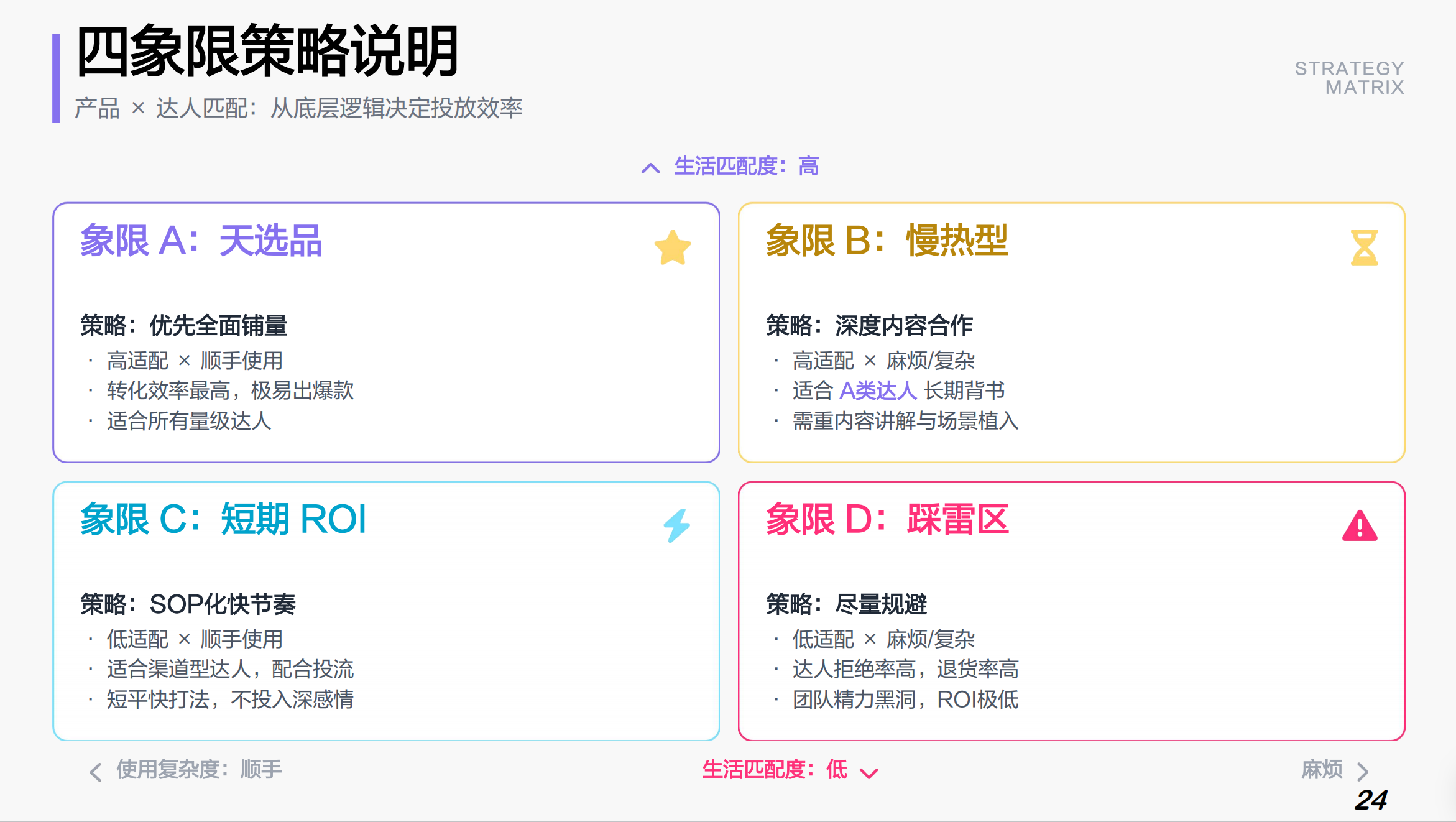
Use two lines to judge:
- Horizontal axis: Product usage complexity (easy → troublesome)
- Vertical axis: life adaptability (high → low)
Finally, 4 quadrants are formed:
Quadrant A: High Adaptation × Smooth → Priority for Cooperation (Selected Products)
- Kitchen, cleaning, pets, mother and baby, storage categories
- Will relapse naturally
- Long term drive sales
Quadrant B: High Adaptation × Trouble → Slow-heating type (requires longer cycle)
- Home appliances, durable goods, installation categories
- Content needs to wait for the expression window period
- Suitable for type A creators, not suitable for type C creators
Quadrant C: Low Adaptation × Smooth → Can be used for short term (C category creator investment ROI)
- Looks good but uses weakly related items
- Suitable for use as a "short, flat and fast material pool"
Quadrant D: Low Adaptation × Trouble → Try not to invest (basically stepping on minefields)
- Requires explanation, scenario, and preparation
-The creator will escape naturally
You can require all new products of the team to go through this four-quadrant diagram before pitching for creator.
5. operator’s “Three-Step Management Method”
This set of procedures comes from long-term trading practice.
1. Check Class A creator status every day
Look at four things:
- Update frequency in the last 7 days
- Recent content sentiment (loose → tight)
- Recent atmosphere in the comment area
- Whether the product is mentioned naturally
Class A creators do not look at GMV, but look at "status".
2. Review products once a week × creator matching matrix
Are new products placed in the wrong quadrant?
80% of collaboration failures in some teams come from "wrong choice of creator", not poor execution.
3. Establish A/B/C creator pool (updated weekly)
- The greater the number of A categories, the easier it is for the team
- Category B is the focus in the future
- Category C should not take up too much of the team’s time
Closing Thoughts
In recent years, in overseas markets and creator collaboration, I have met many types of people and experienced various ways of cooperation. I have seen the content rhythm of thousands of accounts and have been exposed to tens of thousands of collaborative contents. Some creators will show their potential on the first day of cooperation, while some creators will not suddenly break out until a certain point later; there are also some creators who cannot see the value at the beginning, but later become the content assets that the brand truly relies on for a long time.
In these experiences, a more stable way of judgment will gradually be formed - what kind of creator is worthy of long-term investment, what kind of creator only needs to maintain a light relationship, what kind of person is suitable for cultivating, and what kind of person is just a short-term attempt. The basis for judgment is not the number of fans itself, nor an indicator of data, but their way of expression, the stability of their characters, the coherence of their content, and the invisible but perceptible trust between fans and them.
The value of a creator is always composed of content and trust, and this value is not evenly distributed. Some creators will become very powerful in the future and can have an impact on the brand far beyond the numbers seen today; some creators may only remain in a small and stable scope forever. Being able to judge a person's future potential at an early stage is one of the most important abilities in cooperation, and it is also the most worthwhile investment of time. Because a real potential stock creator can often create long-term value for the brand that far exceeds the actual investment.
The entire content is just my personal experience after long-term observation over the years. It may not be correct or applicable to all scenarios. But as long as you do creator affiliate marketing or creator collaboration overseas, you will go through similar stages, similar confusions, and similar counter-intuitions. If you have different opinions or see some new patterns in your cooperation, you are welcome to communicate. Putting different perspectives together can often make the industry clearer and make each other more stable in the complex overseas creator ecosystem.
Where to Go from Here
If you’ve read this far, you probably have a few things in common:
- You already manage TikTok or global creator affiliate marketing programs,
- You know the work is far more complex than “sending samples to a group of creators and seeing what happens,”
- You may also be seeing more partnerships, longer spreadsheets, and a team carrying an ever-heavier workload.
The 102 observations above point to one central tension:
The creator side is completely unstructured - life status, mood, rhythm, and expression methods all change at any time;
Sellers, by contrast, need structure: samples, collaboration status, content cadence, GMV attribution, and budget allocation.
In the past few years, while I was doing overseas creator affiliate marketing practical operations, I was also doing something that might be useful to you:
Only People Who Understand the Creator Business Can Build Great Creator Marketing Products
We have made an operation center to help TikTok seller "manage creator collaboration well", and the name is allymatic.
Let’s briefly introduce it:
allymatic is a creator marketing operation platform for TikTok Shop sellers, helping sellers to systematically manage the entire process of creator collaboration.
From creator outreach, sample management, contract fulfillment tracking, content monitoring, to transaction data attribution and review, allymatic integrates the originally scattered and manual-dependent creator collaboration process into a clear and traceable operating system.
allymatic is more concerned about "making creator marketing run steadily and clearly" rather than just sending a few more private messages to sellers. Through a more structured process and data perspective, it helps teams reduce communication costs, improve collaboration efficiency, and continuously optimize creator collaboration effects.
It is suitable for brands and seller teams that want to operate TikTok creator collaboration in the long term and on a large scale.
It cannot solve the problem of "when is the creator in a good mood" for the time being. This can only rely on relationships and judgment;
But in areas such as samples, rhythm, attribution, and review, your team can be much more relaxed and have a clearer mind.
Explore the product: Product Features · Pricing and Plans
Reader Benefits
- Apply for complimentary access to all allymatic features for 7 days;
- Apply to join a small peer group of overseas creator marketing operators for practical discussion;
- Invite teammates to join, learn, and put the ideas into practice together.
Contact the Author

When adding the author on WeChat, please include: “30,000 words”
This note helps confirm that you reached the official website through this guide, so we can prioritize access and continue the conversation.

You can also scan the QR code to follow the author's personal public account "CJ Global Expansion Practice". The practical experience and thinking of overseas creator marketing will be continuously updated for practitioners' reference.
Wishing every practitioner steady progress—and ever-stronger GMV.