LIVE Is No Longer a Side Channel: TikTok Shop Is Turning It Into an Event-Commerce Operating System
If your team still treats TikTok LIVE as a side activity you run when there is spare time, the latest round of official updates is enough to show that this assumption is no longer defensible.
From TikTok's March 2026 rollout of LIVE Shopping Ads under GMV Max, to early June documentation for Countdown Bidding, to the platform's latest policy language requiring auctions to use official LIVE tools, to Community Fest 2026 launching on June 11 and TikTok Shop's four new European markets going live with LIVE shopping built into the launch narrative on June 15, the direction is increasingly clear: LIVE is no longer just a conversion scene. TikTok is shaping it into an operating surface with tools, traffic systems, event mechanics, and creator-supply development.
That matters for brands and TikTok Shop teams because once LIVE moves from optional tactic to platform-backed operating structure, scheduling, inventory, creator planning, ad buying, and room execution all need to be managed differently.
TikTok is not just encouraging more livestreams. It is standardizing interactive commerce
One of the strongest recent signals is that TikTok is turning the most conversion-sensitive LIVE interactions into official infrastructure.
Countdown Bidding is the clearest example. In TikTok Shop's early June guidance, LIVE auctions are no longer framed as improvised host tactics. Sellers and creators can use countdown bidding from desktop LIVE Manager or the app. They can run fixed auctions, extended auctions that reset the timer when bids arrive late, temporary listings for one-off events, reusable auction listings, and even surprise-based product pools.
The significance is not simply that TikTok introduced another feature. The platform is formalizing what used to feel like a high-energy room tactic into a configurable, reviewable, platform-governed commerce mechanic.
TikTok's recently updated content policy pushes this further. The policy now states that all live bidding must be conducted through TikTok's official Countdown Bidding feature, and auction-like activity outside that system is not allowed. That is an important structural change. TikTok is not asking for more noise inside livestreams. It is building more controlled, fair, and repeatable forms of high-intent interaction.
For sellers, the practical takeaway is simple: stronger LIVE rooms will increasingly be the ones that combine urgency, product structure, interaction design, and room discipline instead of relying only on spontaneous selling energy.
Traffic has also changed: LIVE is becoming a media objective, not just an organic room
If Countdown Bidding shows how TikTok is rebuilding interaction inside the room, LIVE GMV Max shows how it is rebuilding traffic outside the room.
TikTok's March 2026 help documentation for LIVE Shopping Ads and LIVE GMV Max makes the logic explicit: a livestream is not just a content event. It is a commerce destination that can be optimized as a campaign objective. TikTok allows sellers to drive viewers from videos into a LIVE session and also to amplify an active LIVE directly, with the system automatically allocating between video-to-LIVE and LIVE-to-LIVE creative types.
That is a meaningful shift. Many teams still run livestreams as if success depends mainly on organic recommendation, basic pre-heating, and whatever conversion happens after the room starts. TikTok is signaling a different model. LIVE traffic can now be budgeted, optimized, and evaluated through dedicated commerce logic tied directly to liveroom revenue.
Once a surface gets its own ad product, optimization framework, and revenue target, it is no longer a peripheral content lane. It is moving toward core operating status.
That means brands need more planning discipline before the stream even begins. Product priority, teaser creatives, paid budget, host or creator roles, incentive rhythm, and room structure should be decided during campaign design, not patched together the night before.
TikTok is not only giving sellers tools. It is actively training LIVE creator supply
Another point many teams underestimate is that TikTok's recent LIVE push is happening on both the merchant side and the creator side.
Community Fest 2026, announced on June 8 and beginning June 11, is not merely a community celebration. TikTok describes it as a global sequence of LIVE education, creator participation, in-app missions, and growth milestones. Through Creator Academy and related LIVE accounts, TikTok is teaching creators how to build community, improve engagement, and operate better LIVE sessions over time.
That is a strong ecosystem signal. The platform is not simply hoping more people will go live. It is systematically developing a more stable pool of creators who understand how LIVE works as both content and commerce.
This matters for sellers because livestream performance does not depend only on whether the brand itself can host. It also depends on whether the platform has enough creators who can retain attention, create trust, and sell in real time. Community Fest and similar programs are infrastructure investments in that supply layer.
TikTok is effectively working both sides of the market at once: more tools for merchants, more training for creators. That is how LIVE stops being an isolated opportunity and becomes a more mature operating ecosystem.
In new markets, LIVE is already part of the default selling model
An equally important signal comes from TikTok Shop's latest European expansion.
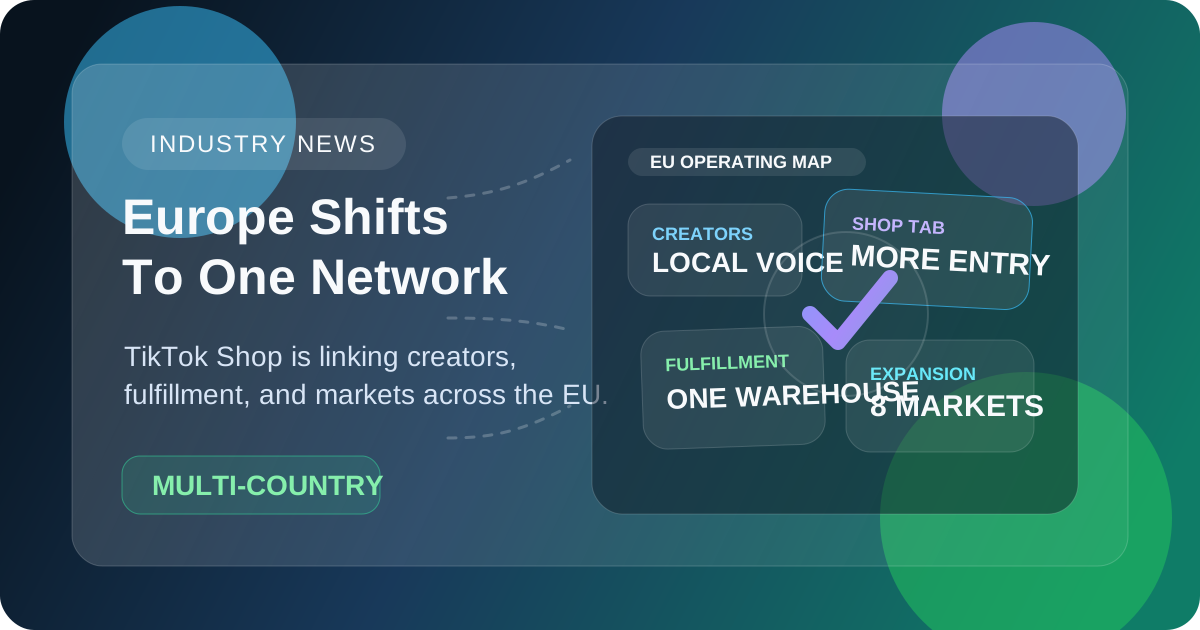
In TikTok's late May 2026 announcement, Austria, Belgium, the Netherlands, and Poland were introduced as new TikTok Shop markets launching on June 15. The notable detail is how TikTok described the commercial stack. LIVE shopping was not presented as an advanced tactic to explore later. It was positioned immediately alongside in-feed video as a core shopping format.
That tells us something important about TikTok's own market-entry logic.
LIVE is no longer being treated as a mature-market add-on. It is part of the default discovery-commerce model from the beginning. When TikTok Shop enters a market, content discovery, shoppable video, creator affiliate activity, and LIVE shopping are increasingly expected to work together from day one.
For cross-border teams expanding across markets, that changes the order of operations. The old sequence of "open the shop, upload products, wait for some organic traction, then maybe experiment with livestreaming" is becoming less relevant. TikTok's model is moving toward a different launch order: prepare content, creator relationships, LIVE readiness, and traffic support early, then let video, affiliate, marketplace, and LIVE work as one conversion loop.
When LIVE is embedded in the default market structure, it is no longer a bonus channel. It is part of the main route.
The real adjustment for brands is operational scheduling
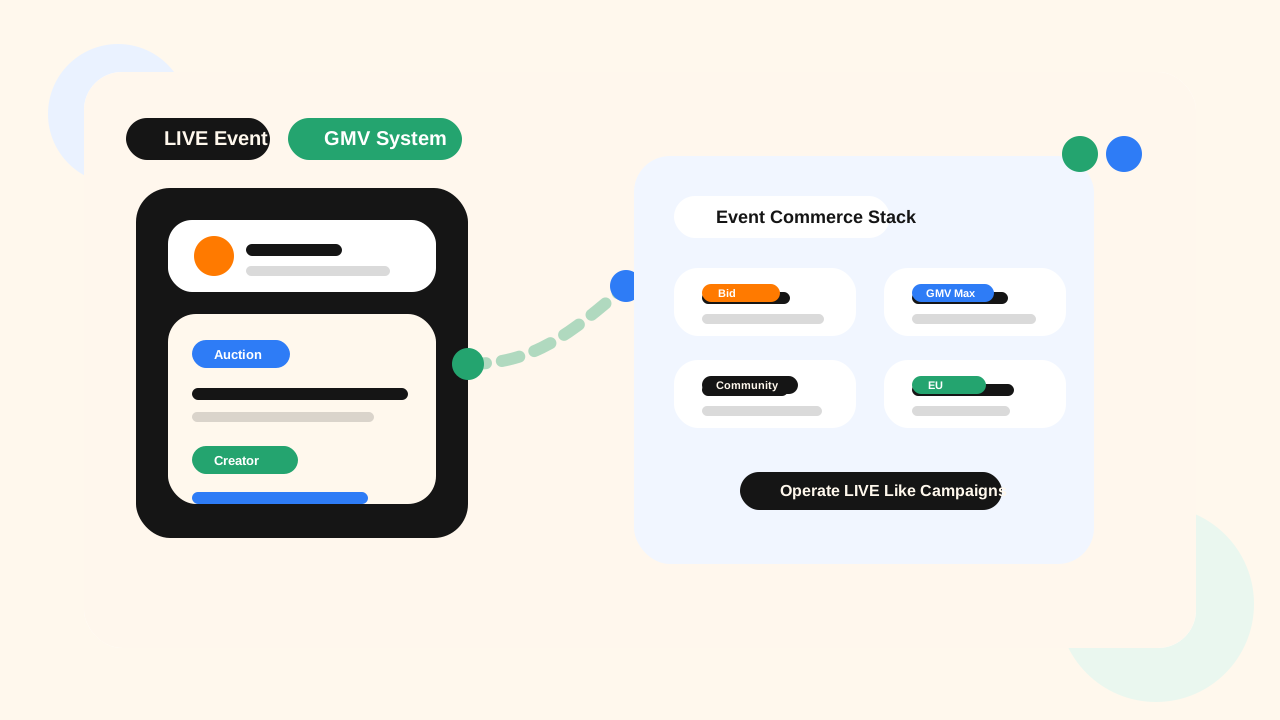
Taken together, these moves point to one consistent conclusion: TikTok is not pushing a single livestream feature. It is building LIVE into an event-commerce system.
At least four structural layers are visible now:
- An interaction layer. Auctions, countdowns, giveaways, flash-sale logic, and similar mechanics are becoming more standardized.
- A traffic layer. LIVE Shopping Ads and LIVE GMV Max show that livestream demand can be bought and optimized systematically.
- A supply layer. Community Fest and Creator Academy keep training creators who are better suited for LIVE commerce.
- A market layer. New TikTok Shop markets now treat LIVE as part of the default shopping capability set.
That means teams should stop treating LIVE as a last-minute execution slot and start placing it inside the operating calendar.
In practical terms, brands should decide earlier which SKUs belong in routine education-driven livestreams and which belong in scarcity-driven moments such as auctions or event pushes. They should separate creators who are good for short-form product seeding from those who are strong at long session retention and real-time conversion. They should define earlier how much time is needed for samples, scripts, promotions, inventory, teaser videos, moderators, and paid distribution. And they should know whether a given stream is meant to clear stock, launch a new SKU, drive GMV, or recover creative and creator assets for reuse.
If those decisions are still scattered across chats, spreadsheets, and personal memory, stronger platform tools will not create stronger execution. The real efficiency gain comes when the team finally runs LIVE like a full campaign instead of a temporary room.
How allymatic reads this shift
From the allymatic perspective, the key signal is not that livestreaming is hot again. It is that TikTok is turning LIVE from a content scene into an operating object.
Official interaction tools, dedicated media optimization, creator training, and synchronized market expansion are now moving together. Once those four layers align, brands should no longer treat livestreaming as an experimental side motion. The stronger interpretation is that TikTok Shop is building LIVE into a shared event-commerce operating surface for brands, creators, and the platform itself.
The teams with the strongest advantage next will probably not be the ones that improvise best in the room. They will be the ones that connect pre-LIVE planning, creator scheduling, paid amplification, inventory control, and post-event review into one system first.
The barrier to LIVE has not disappeared. It has simply become more operational.