TikTok Shop New Markets Do Not Start with Seller Access: Ireland Offers a More Realistic Launch Sequence
When many teams look at a new market, the first questions are still seller-side questions: When does registration open? When can more merchants join? The assumption is that once seller access expands, growth will naturally follow.
Ireland suggests something more important.
On the surface, the recent shift looks like a standard expansion move. TikTok Shop Ireland is moving beyond a tighter invite-only setup and opening access to more domestic businesses across the market. More sellers, more categories, more competition. But if that is the only way we read it, we miss the more useful operating signal.
What matters is this: before broadening seller access, TikTok Shop had already spent time proving that creator commission, shoppable video, LIVE education, local brand storytelling, and local identity content could actually convert inside this market.
In other words, broader merchant access is not the true beginning. It is what happens after the content conversion model is already working.
Ireland is not just opening applications. It is revealing platform sequencing
The recent signals from Ireland do not point to a single isolated product update. They point to a content-commerce loop becoming mature enough for the platform to scale the seller side with more confidence.
TikTok Shop Ireland has clearly moved from a more restricted merchant model toward a more open local-business platform. At the same time, the supporting numbers are striking: the number of active creators in the market is reported to be up 600% since launch, more than EUR 2 million has already been paid out to creators through commission, and creator-led shoppable video and LIVE Shopping sales have continued to grow at double-digit rates over the past six months.
Those numbers matter because they suggest TikTok is not saying, "Let more sellers in and then see what happens." It is saying, "The creator-content-commerce engine is already proving itself, so now the market can absorb more seller supply."
And this is not just a platform narrative. Brand examples on the ground make the point more concrete.
Fior Jewellery, a local Irish brand, has said TikTok Shop now contributes a meaningful share of its annual sales. Elave, a much older skincare brand, has said that online sales doubled after joining TikTok Shop. The first example shows how newer brands can scale through creator-led discovery and in-platform demand capture. The second shows that established brands can use TikTok Shop to reconnect with younger audiences rather than treating it as a side channel.
That is the real industry signal from Ireland. The story is not simply that there is one more market where sellers can open shops. The story is that TikTok Shop is increasingly using a validated local content-conversion loop to determine when a market is ready for its next phase.
What TikTok seems to validate first is whether content can carry transactions
If we line up the details from Ireland, the test does not look like "Do we have enough merchants?" It looks more like "Can content repeatedly generate trusted transactions?"
The first layer is creator commission.
TikTok keeps emphasizing the Creator Affiliate Programme not just because it gives creators an income story, but because it gives brands a lighter-weight route to market entry. A brand does not need a fully built ad machine or a heavy campaign calendar on day one. It can start by letting local creators explain the product in a local tone and test whether product-message-content fit exists at all.
The second layer is LIVE as education, not just promotion.
The brand examples coming out of Ireland do not describe LIVE as a narrow discount tactic. They describe it as product explanation, Q&A, community interaction, and repeat attendance. That matters because in many new markets, what stands between a user and a first order is not simply price. It is understanding and trust. In that sense, LIVE becomes a conversion translator before it becomes a conversion accelerator.
The third layer is local-identity content.
Signals such as the growth of tags like `#ShopIrish` and `#Claddagh` suggest that local identity, local story, and local cultural context are not side notes. They are part of the path to conversion. In practice, that means new-market growth on TikTok Shop does not always begin with the cheapest offer. It can begin with the strongest sense of local relevance.
For cross-border brands, this is an especially useful reminder. The first thing that often needs localization is not the storefront design. It is the narrative environment in which the product gets explained and recommended.
This is different from how many brand teams still plan launch
Many cross-border teams still assume a fairly linear operating sequence: open the store, list products, start ads, add content, recruit creators, then build LIVE. In that logic, creators and content are downstream scaling tools.
Ireland points in the other direction. In TikTok Shop, some markets do not wait for a fully broad seller ecosystem before content proves it can drive commerce. Instead, the content layer proves it can create reliable transactions first, and seller-side expansion follows.
That changes what brands should prioritize internally.
- If you treat market access as the start of preparation, you will prepare too late.
- If you build local creator relationships, commission logic, sample pacing, LIVE teaching structure, and content-tag strategy earlier, then when the market opens up you are not starting from zero. You are receiving scale on top of a working system.
This also helps explain why TikTok's recent official messaging across markets keeps reinforcing creator training, seller-creator matching, community education, and discovery e-commerce. The platform is not just teaching merchants how to use tools. It is thickening the content-conversion layer before widening supply.
What brands should build ahead of a new-market launch
If Ireland is a useful reference point, then brand teams preparing for new TikTok Shop markets should move at least four things earlier.
First, do not only prepare seller documentation. Prepare who will tell your story.
Many teams plan product, pricing, shipping, and operations in detail, but still enter the market without a strong first layer of local creators or a clear sense of how the product should sound in local content. The result is a store that is technically open but commercially quiet.
Second, do not treat LIVE only as a clearance or promo tool. Treat it as an education surface.
In categories such as beauty, wellness, home, and parenting, the main value of LIVE is often explanation. The teams that build stronger explanatory power in LIVE are usually the teams that convert unfamiliar traffic into familiarity faster.
Third, do not judge readiness only by creator volume. Judge whether the content actually feels local.
Some content gets views and can still be commercially weak because it does not feel native to the market. The best-converting material often makes users feel that the product is being discussed in their world, not merely exported into it. The growth of local-identity tags in Ireland is a visible expression of that principle.
Fourth, do not treat TikTok Shop as a fully self-contained system. Plan how off-platform assets will capture value.
Third-party reporting also points out a familiar limitation: platform commerce can be strong while brands still do not receive the same depth of customer data they would get through their own channels. That means TikTok Shop can be an efficient front-end demand engine, but brands still need clarity on how site traffic, retention, repeat purchase, and owned audiences will be built around it.
How allymatic reads this shift
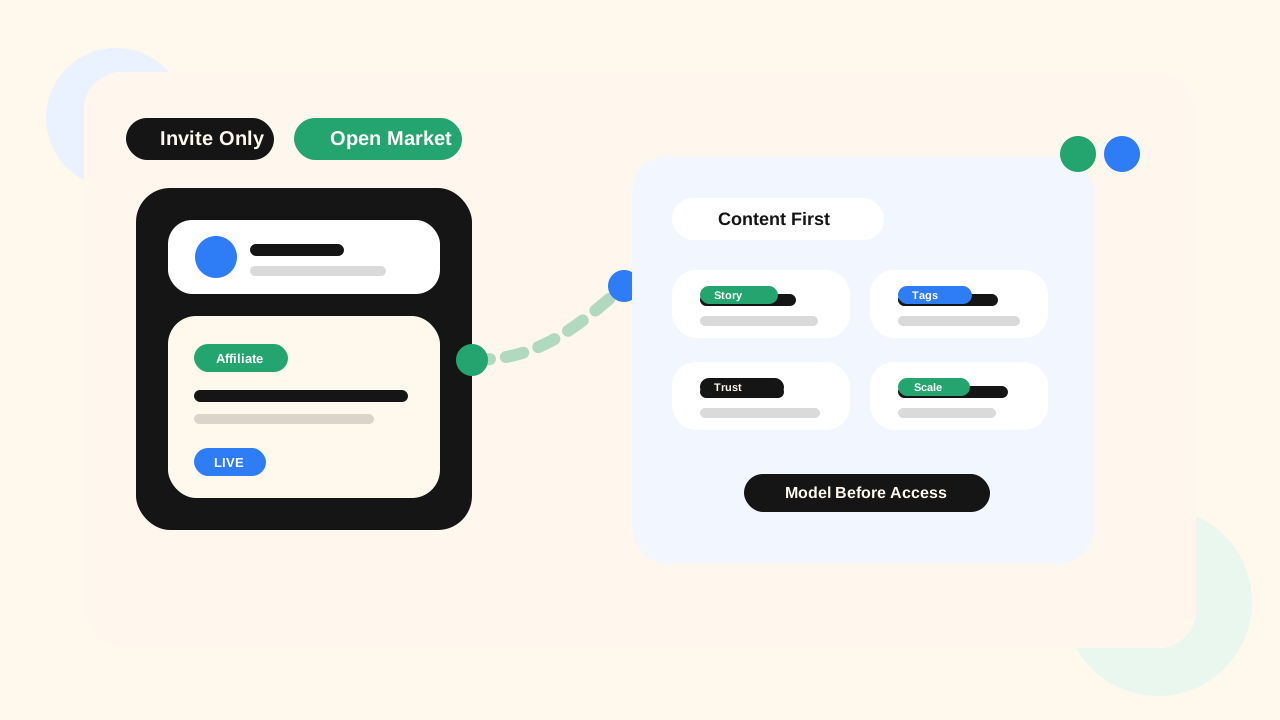
From the allymatic perspective, the most important lesson from Ireland is that TikTok Shop's new-market expansion increasingly looks less like "open merchant access first, build content later" and more like "prove the content-conversion model first, then scale merchant supply."
That changes which capabilities deserve early investment.
The first things to build are not only the storefront and the catalog. They are the local creator pool, sample follow-up rhythm, commission logic, LIVE scripts, content tags, local storytelling angles, and the shared workflow behind those moving parts.
The team that connects those layers earlier will not feel like a beginner when the market fully opens. It will feel like a team already positioned to scale.
So when evaluating the next TikTok Shop market opportunity, the better question may no longer be "When can we open the store?" It may be "Before the store scales, is our content conversion model already ready?"