Fix the Listing and Claims Before Scaling Creators: TikTok Shop Is Moving Compliance Upstream into the Growth Stack
If your TikTok Shop team still treats compliance as a last-minute checkpoint before launch, the official updates released across June 2026 are enough to show that the order of operations has changed.
Since late May, TikTok Shop has pushed product recall handling, listing quality, pricing transparency, ingredient disclosure, and creator-content rules back to the center of day-to-day operations. The Content Policy updated on June 16 now puts LIVEs, videos, covers, titles, spoken claims, on-screen text, props, and demonstrations inside one policy surface. The refreshed Product Listing guidance goes deeper on images, titles, descriptions, categories, pricing, and PDP accuracy.
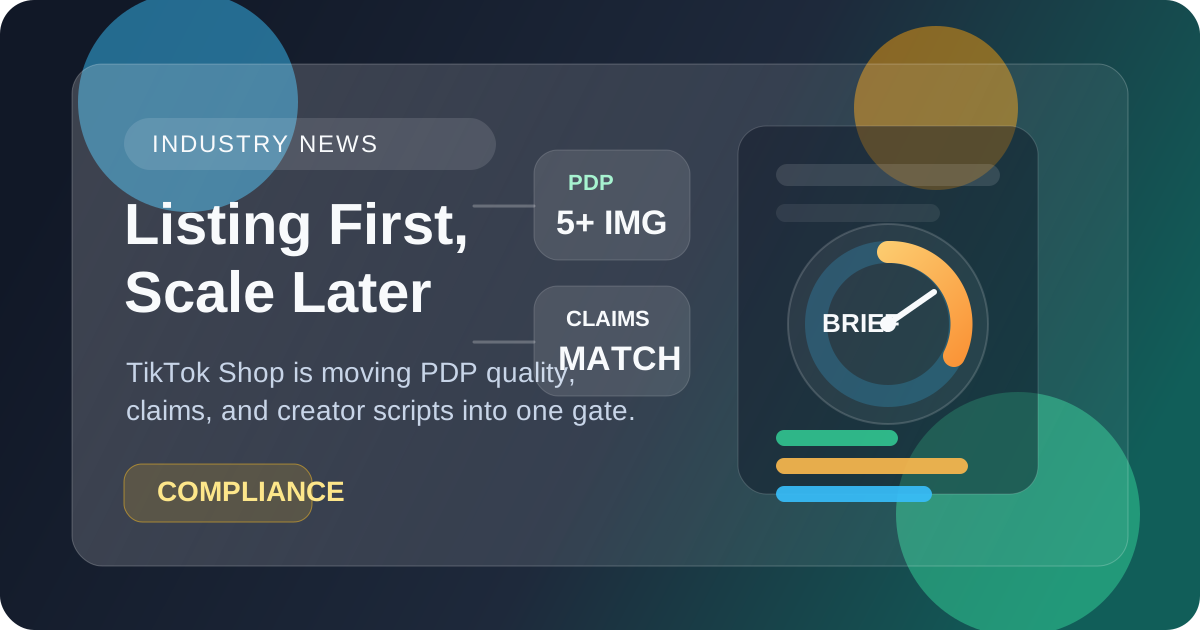
Taken together, these changes do not simply mean "more rules." They signal something more operational: TikTok Shop is moving listing quality, claim discipline, and content compliance upstream into the base layer of creator affiliate growth.
For brands and TikTok Shop operators, the next priority is not sending another large round of samples. It is tightening what can be said, what can be shown, and how the product page itself should be structured before scale begins.
The product detail page is no longer just a listing page
Many teams still treat the PDP as a page that only needs to exist. The title is close enough, the images are good enough, the description can be cleaned up later, and deeper optimization can wait until orders arrive.
That is no longer how the platform is framing it.
The newer Product Listing guidance treats the product detail page as the first place where buyers make trust judgments. Titles, images, descriptions, variations, brand information, and pricing all need to be accurate, clear, and consistent with what the customer will actually receive. TikTok Shop is also more explicit that sellers must avoid exaggerated or unsupported functional claims, avoid promotional clutter in the first image, and avoid major edits that effectively turn one listing into a different product.
The implication is straightforward: the PDP is no longer just a traffic landing page. It is one of the first signals the platform uses to decide whether a shop is reliable enough to surface and support.
TikTok Shop is joining "how you sell" with "how you talk about it"
The deeper change is that TikTok Shop is no longer managing listing compliance separately from creator communication.
The June 16 Content Policy defines promotional content broadly: LIVEs, short videos, cover images, titles, spoken statements, captions, props, gestures, usernames, and product demonstrations all fall within scope. In practice, that means the promise written on the PDP, the script used by a creator, and the demonstration shown during a LIVE increasingly have to align as one system rather than three disconnected workstreams.
This matters because many teams still operate with fragmentation by default. The product page says one thing, the performance team rewrites it for paid assets, and the creator interprets it again in their own style. The result is often inconsistency at the exact moment a customer is trying to decide whether to trust the product.
TikTok Shop's recent direction is effectively shrinking the space for that kind of mismatch. Once the listing message, the spoken claim, the visible demonstration, and the delivered product stop lining up, the cost is not limited to one weak piece of content. It can spread into appeals, listing removals, feature restrictions, or wider account friction.
Creator teams now need a usable claims sheet before they need more samples
This shift changes creator affiliate execution directly.
In the past, sample shipments were usually prepared around rate cards, commission, address collection, and content direction. Going forward, one of the highest-leverage documents may be a clear claims sheet.
That sheet should define at least four things:
- which product claims are already verified and approved for use,
- which product demonstrations must be shown physically or explained clearly,
- which category-specific disclosures, ingredient notes, risk warnings, or fulfillment explanations must be included,
- and which price anchors, bundles, gifts, or promotions are allowed only through approved TikTok Shop tools and compliant wording.
The value here is bigger than violation prevention. Once the PDP, creator brief, paid asset, and customer-support explanation all use the same language, the entire commerce chain becomes more stable. That matters even more for teams running affiliate creators, target collaboration, and owned content at the same time.
Recalls, documentation, and pricing transparency are raising the bar together
It would be a mistake to read this only as a content-quality story.
The Product Recall Notices and Compliance Requirements document published on May 26 formalized recall handling as an operational responsibility. If a product is affected, sellers are expected to stop selling, remove listings, halt fulfillment, and follow platform instructions. The May policy roundup also reinforced fair-pricing transparency and introduced clearer ingredient-disclosure expectations for new food and beverage listings.
That is a broader signal: TikTok Shop is shifting from a model where risk is handled after something goes wrong to a model where risk is expected to be visible and controlled before scale.
For brands, that means category operations, product teams, creator managers, and content owners cannot keep maintaining separate versions of product truth. A healthier workflow is to run a SKU-level readiness review before affiliate scale starts: Is the PDP accurate? Are the images compliant? Are the claims defensible? Are there category-specific requirements? If the listing is reviewed, appealed, or recalled, can the team produce the right documentation immediately?
The better sequence is to fix the base layer first, then scale
From the allymatic perspective, the most important takeaway is that TikTok Shop is turning compliance from a legal or moderation issue into a growth issue.
An unclear PDP, a loose claim, an unrealistic demo, or incomplete category documentation may look small in isolation. But once a team adds creators, LIVEs, paid traffic, and more sample volume, those small weaknesses can scale into a wider operating problem.
The stronger sequence now runs in reverse:
First stabilize the PDP and the approved claims surface. Then let creators build content within that shared range. First standardize category documents, promotion mechanics, and price expression. Then expand campaign scale and sample distribution.
In the second half of 2026, TikTok Shop competition may depend less on who can find creators the fastest and more on who can connect product truth, creator messaging, and compliance into one operating base. The teams that build that base first will have a much better chance of turning creator affiliate into repeatable growth.