How to Use TikTok One Creator Score Without Mistaking Reliability for Performance
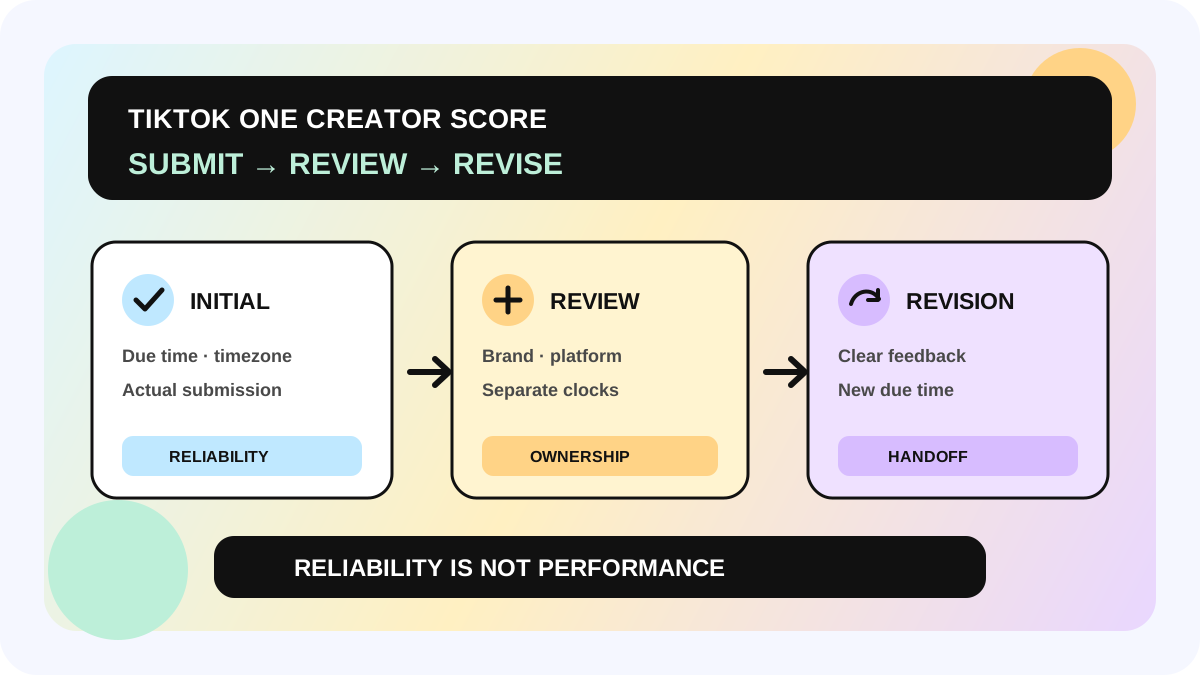
TikTok One Creator Score does not answer “How many views or sales will this creator generate?” It answers a narrower operational question: Does the creator submit initial and revised videos on time? TikTok says an on-time initial submission increases the score, while a late initial or revised submission decreases it. The score does not expire or decay after inactivity, and it affects eligibility for collaboration opportunities.
That makes Creator Score a useful delivery-reliability signal, not a complete creator ranking. Brands should place it beside brief fit, content quality, audience relevance, review speed, and project outcomes in a creator collaboration system. This guide is for brands, agencies, and creator operations teams running Creator marketing projects in TikTok One. Feature availability, labels, and project flows can vary by region or rollout, so confirm the current TikTok One interface before turning the workflow into policy.
Separate the four dates teams often mix together
| Date or state | What it means | Direct Creator Score rule | What the team should capture |
|---|---|---|---|
| Initial video due | Agreed time for the creator's first submission | On time raises the score; late lowers it | Due time, actual upload time, evidence link |
| Revised video due | Time for a new upload after requested changes | A late revision lowers the score | Feedback time, new due time, resubmission time |
| Expected post date | Optional expectation set during project creation | TikTok says a different actual post date has no penalty | Planned and actual publication dates, separately |
| Advertiser/platform review | Review after a creator uploads | Official score guidance does not assign review time to the creator | Current status, review owner, response time |
The critical distinction is that a submission deadline is not the Expected post date. Treating “initial video on time” as “the post must already be live” mixes creator production, advertiser review, and platform review into one deadline.
What Creator Score can and cannot tell you
Creator Score can help a team identify delivery risk. It may support a decision to add an earlier reminder, keep a backup creator for a fixed launch, or review whether a creator regularly moves work into the next stage on time. TikTok also says inactivity does not make the score expire or degrade, so a quiet period alone is not evidence that reliability has worsened.
The score does not, by itself, establish:
- whether the creative fits the brand, product facts, or local advertising rules;
- whether the creator's audience fits the target market and category;
- whether the video will pass platform review or whether a requested edit is reasonable;
- how many views, conversions, or sales the published video will produce;
- whether the brand delivered the brief, product, feedback, or payment on time.
For creator sourcing, pair this guide with the TikTok One invitation-mode workflow. For creative and outcome evaluation, use the creator collaboration measurement scorecard and the Project Reporting review guide.
A six-step submission reliability workflow
1. Lock an executable brief before inviting creators
Confirm the region, project type, video requirements, anchor, content boundaries, initial submission deadline, and expected publication date. TikTok One's Expected post date is an optional expectation, not a substitute for an initial-submission commitment. If the first upload matters to your schedule, state that date separately in the project communication.
2. Track initial, revision, and publication as separate states
Your shared tracker or CRM should have at least `initial due`, `revision due`, and `publish plan` fields. Do not keep one generic “deadline.” For every state, record the timezone, owner, actual completion time, and current TikTok One status. Regional teams should not interpret another market's due date using an unrecorded local midnight.
3. Request edits only when there is a clear reason
For a Creator marketing project, TikTok says an advertiser may make up to five edit requests based on reasonable requirements after a video passes platform review. A limit of five is not a target. Separate mandatory factual or compliance fixes from non-negotiables already stated in the brief, and consolidate subjective preferences rather than changing direction in several rounds.
4. Give every revision a clear new due time
Late revised videos can reduce Creator Score. When sending feedback, provide one consolidated version, name the exact changes and priorities, set a new deadline, and confirm the creator received it. “Please revise soon” is not a manageable due time and should not become an internal late-delivery label.
5. Remove brand and platform waiting time from creator working time
After upload, a video goes through advertiser and platform review. If changes are requested, the creator can see the requested edits and upload a new version, which returns to review. Track `creator working`, `brand review`, and `platform review` separately. Otherwise a two-day brand delay can be incorrectly recorded as a creator delay.
6. Close the project with reason codes, not just a score
At closeout, record whether the initial and revised videos were on time, the number of edit rounds, advertiser response time, platform review state, and the final creative result. Creator Score is a platform signal; internal reason codes tell you whether the next project needs a clearer brief, earlier product delivery, a different owner, or a backup creator.
Design a collaboration board that supports action
A useful board should include:
- creator, project, region, and invitation method;
- initial due time, actual first upload, and on-time status;
- each edit request, revision due time, and actual resubmission;
- production, submitted, platform review, brand review, revision, and ready-to-publish states;
- Expected post date and actual publication date as separate fields;
- advertiser response time, platform waiting time, and exception reason;
- content quality, audience fit, and performance metrics outside Creator Score.
These fields can connect to the creator outreach workflow: the outreach owner can see delivery risk, the content owner can see review tasks, and the reporting owner can explain where time was actually spent.
Pre-launch checklist
- [ ] Confirm the current TikTok One region and project type.
- [ ] Record initial due, revision due, and Expected post date separately.
- [ ] Add a timezone, owner, and evidence link to every deadline.
- [ ] Consolidate edit requests and assign a new revision due time.
- [ ] Keep advertiser review and platform review out of creator working time.
- [ ] Use Creator Score for submission reliability, not as a substitute for quality, fit, or performance.
- [ ] If the live product differs from the official guidance, pause automated decisions and verify the current regional interface.
The allymatic view: reliability comes from handoffs, not a label
A score can surface risk, but it cannot execute the handoff. A repeatable system turns every initial upload, feedback round, revision, and publication into a state change with an owner, deadline, and evidence. That protects reliable creators from unclear briefs and prevents a lower score from becoming a permanent, context-free ban. The team can distinguish a one-off delay from a process failure or a recurring delivery risk.
At allymatic, we recommend using Creator Score as an external signal and your own milestone history as actionable evidence. Together, they improve on-time collaboration without exaggerating what a platform score proves.
FAQ
Is TikTok One Creator Score a content-quality score?
No. TikTok describes it as a scoring system that helps brands collaborate with creators who have high submission rates. Its published rules focus on whether initial and revised videos are submitted on time. Evaluate creative quality, audience fit, and commercial outcomes separately.
Does the score decrease when a creator has no projects for a while?
No. TikTok says the score does not expire or degrade after a period of inactivity.
Does missing the Expected post date directly lower Creator Score?
TikTok's Creator marketing project guidance says the Expected post date is optional and that there is no penalty when the actual post date differs. Do not confuse it with the initial or revised video submission deadline.
How many edits can an advertiser request?
For Creator marketing projects, TikTok says an advertiser may provide up to five edit requests based on reasonable requirements after the video passes platform review. Operationally, consolidate feedback and set a clear due time for each revision.
Official Sources
Official Sources
Primary references used for this article.