How to Use TikTok Shop Affiliate Partnerships Overview for Agency Performance Reviews
TikTok Shop Affiliate Partnerships Overview is for US sellers already running campaigns with Affiliate Partners or TAP agencies. It brings agency, product, campaign, content, and creator indicators into one partnership view so a team can see which agencies generated settled business and which products or content deserve another cycle. It is not a live-monitoring screen, a replacement for shop-wide Affiliate Analytics, or a profit statement.
This guide uses TikTok Shop Seller Academy documentation published in May 2026. The page currently applies to the United States. Availability, menu names, and fields may vary by market, account permission, and product release, so confirm the live workspace. TikTok states that the page can look back up to one year and updates daily with the previous day's data; real-time data is not available.
Direct answer: which four groups should an agency review start with?
| Layer | Start with | Ask next |
|---|---|---|
| Revenue | GMV, Paid Orders, Settled Orders | How mature are the orders and how much changed after returns? |
| Commission | Estimated and Actual Commission | What explains the gap between provisional and settled cost? |
| Supply | Products in campaign, Products with sales, 14-day content post rate | Did approved supply turn into content and sales? |
| Content | Videos, LIVEs, Video VV, Creators with content and sales | Is performance repeatable or concentrated in one hit? |
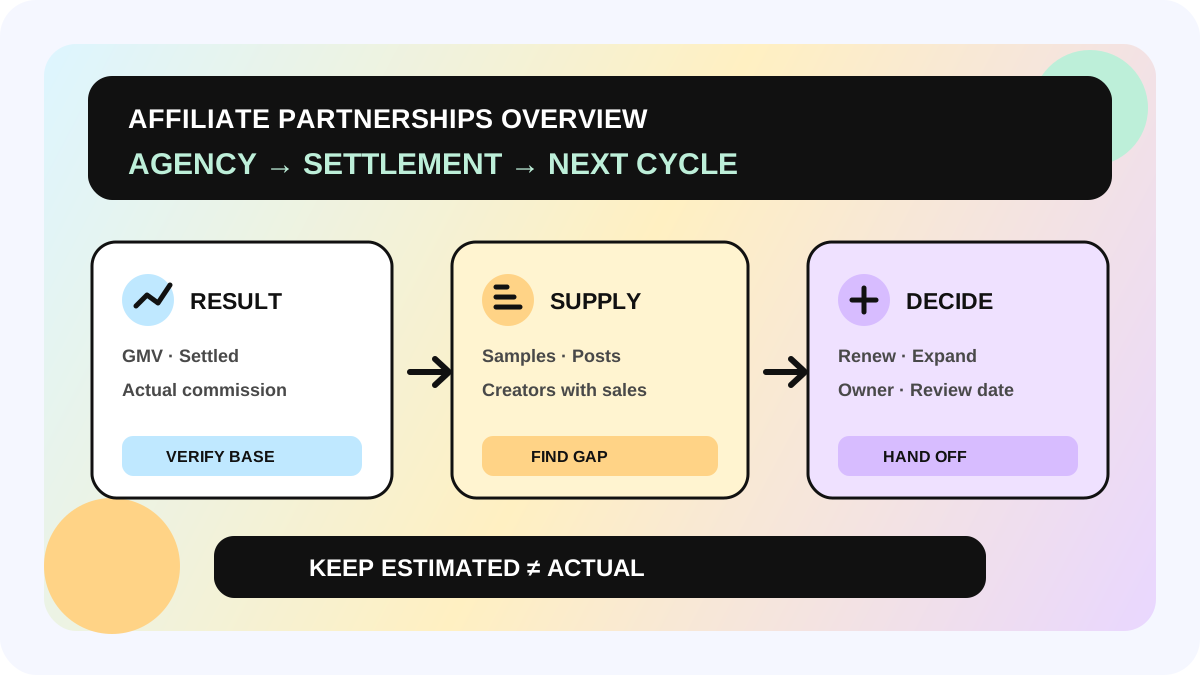
In TikTok's definitions, GMV is the amount paid for orders and includes returns and refunds. Settled Orders exclude returns and refunds. Estimated commission base uses paid-order sales that still include returns and refunds, while Actual commission base uses settled sales after those adjustments. Keep estimated and actual values in separate columns; a GMV leaderboard is not a final agency ranking.
Separate three workspaces before comparing performance
1. Partnerships Overview evaluates the agency portfolio
The path is Affiliate Center → Work with Partners → Affiliate Partnerships Overview. Key metrics groups the overall view into Revenue & Agencies, Products & Campaigns, and Content & Creators. Performance by agency lists the TAP agencies you have worked with and sorts them by Est. Commission by default.
2. Affiliate Analytics runs the shop's day-to-day view
Affiliate Center → Analytics → Performance is the broader view for shop GMV, orders, creators, products, videos, and LIVEs, including a Today view. Partnerships Overview only receives the previous day's update, so it should not be used to steer a launch or LIVE in real time. For shop-level creator detail, use the affiliate GMV by creator review guide.
3. Finance records decide profit and final cost
Platform GMV and commission fields do not include your complete margin, sample, fulfillment, refund, media, and service-cost picture. Even Actual Commission is not the entire partnership cost. Use the refund and commission reconciliation workflow when paid and settled numbers diverge.
A five-step agency performance workflow
Step 1: lock the period and collaboration scope
Record market, shop, date range, agency, campaign, and export time. The page can look back no more than one year. If the selected period contains no campaigns with Affiliate Partner agencies, the page may be empty. An empty state is not zero performance until the collaboration history and filters have been checked.
Step 2: read the supply funnel before ranking agencies
Start with Products in campaign, then Products with sales. Follow the creator path from Creators with samples to Creators with posted content and Creators with sales. This locates a bottleneck in sample receipt, production, posting, or conversion.
The 14-day content post rate is specifically the share of samples received by creators in the last 14 days that produced a LIVE or video. It is not a lifetime sample-posting rate. Product GPM is average revenue per 1,000 product views; Product video GPM narrows that scope to video product views. Preserve the full field name and tab before comparing them.
Step 3: treat Top 20 as a lead, not the complete population
The page ranks Top 20 videos, products, and campaigns by GMV by default. A video card also shows the agency, Video GMV, Video Views, and featured product. This is useful for finding a strong hook or offer quickly, but it hides the long tail. Export the Excel file to review all collaborated videos, products, and campaigns rather than only the Top 20.
When reviewing a high-GMV video, preserve its product, creator, publish date, format, stock position, and commission context. Connect the creative judgment to a creator collaboration scorecard, without letting one score hide order maturity.
Step 4: place each agency on a result-by-supply matrix
| Observation | Next move | Do not conclude yet |
|---|---|---|
| High GMV, stable Actual Commission, steady content supply | Discuss more products, an exclusive offer, or a new target | “Every product fits this agency” |
| High GMV, large Paid-to-Settled gap | Wait for maturity and inspect refund or product issues | “Final ROI is already proven” |
| Many samples, little posted content | Audit receipt, brief, deadline, and creator follow-up | “Sending more samples will fix it” |
| Plenty of content, few Creators with sales | Review product fit, angle, PDP, and price | “High views equal a successful partnership” |
The default agency order is based on Estimated Commission, not final profit. Before renewal, review at least Actual Commission, Settled Orders, Products with sales, Creators with sales, and the consistency of content delivery.
Step 5: export, assign an owner, and schedule the next check
Keep the original Excel export read-only. Alongside it, record the metric definitions, as-of date, and filters. Build the cleaned working table at agency × campaign × product level, with Decision, Owner, Next action, and Next review date. Put those tasks in the creator marketing management system so the review does not end as a screenshot in chat.
Weekly review checklist
- [ ] Feature availability is confirmed for the market and account
- [ ] Market, shop, date range, agency, and campaign are locked
- [ ] Previous-day data is not treated as real time
- [ ] GMV/Paid Orders are separated from Settled Orders
- [ ] Estimated commission is separated from Actual commission
- [ ] The denominator for 14-day content post rate is documented
- [ ] The full Excel export supplements the Top 20 view
- [ ] Margin, refunds, inventory, media, and service fees are checked elsewhere
- [ ] Every action has an owner and review date
The allymatic view: review repeatable supply, not only the GMV leaderboard
One high-GMV result can come from a single product, video, or promotional window. The more useful question is whether an agency repeatedly moves approved products through sample receipt, content publication, sales, and settlement. allymatic recommends preserving Agency, Campaign, Product, Sample status, Content posted, Creators with sales, Settled Orders, Actual Commission, Decision, and Owner. That evidence explains why a partnership should continue instead of merely showing who ranked first.
Start with a 30-day audit of three agencies. For each one, identify one high-GMV asset, one supply bottleneck, and one number that still needs settlement time. Once those three points are clear, the team can discuss budget or product expansion without pretending provisional data is final.
FAQ
Is Affiliate Partnerships Overview real-time?
No. TikTok says it updates daily with the previous day's data. Use Affiliate Analytics Today for same-day launches or LIVEs, and manually refresh that live snapshot.
Why is there no data in Partnerships Overview?
The shop may not have worked with an Affiliate Partner agency, or the selected period may contain no agency campaigns. Verify collaboration history and the date filter before recording zero performance.
How far back can I review agency collaboration data?
TikTok states that the page covers up to the past one year.
Should the agency with the highest GMV automatically be renewed?
No. GMV includes returns and refunds, and the default agency sort uses Estimated Commission. A renewal decision should include Settled Orders, Actual Commission, product and content supply, creator sales coverage, margin, and service cost.
Official Sources
Official Sources
Primary references used for this article.