Why TikTok Shop Earnings Analytics Shows One GMV: Reconcile Paid Orders, Estimates, and Payouts
When TikTok Shop commission data looks “inaccurate,” the first problem is often not a bad calculation. It is a comparison between paid-order GMV, Estimated commission, order status, and final payout as though they were the same number. In September 2026, TikTok Shop updated US Creator Center Earnings Analytics: Data Compass now shows one GMV based on paid orders, the old Commission tab is gone, and Estimated commission remains.
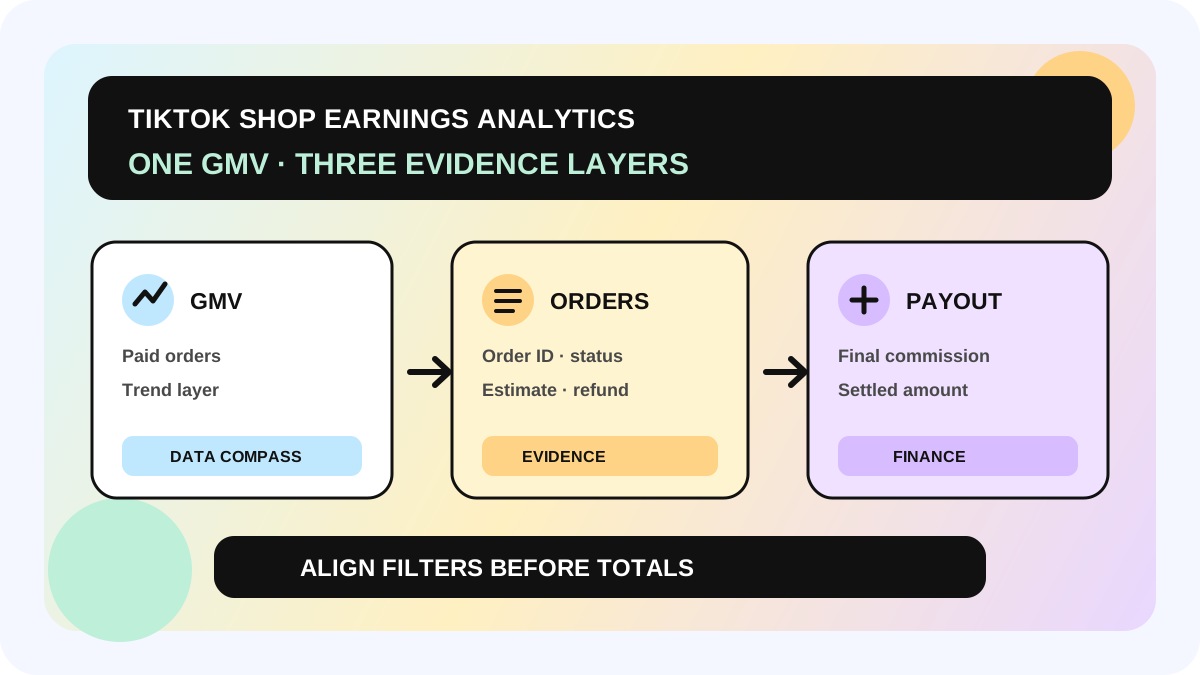
The practical answer is to use Data Compass for paid-order performance, Affiliate Orders for order-level evidence and estimated payout dates, and settled/final commission for finance reconciliation. All three layers need the same date, market, timezone, and content-type filters. This guide is for creators, MCNs, and brand creator-operations teams. The cited product guidance applies to the United States; navigation, status labels, and settlement timing may differ elsewhere.
Put the four numbers back in their proper layers
| Number | What it answers | What it does not prove |
|---|---|---|
| Data Compass GMV | How much eligible paid-order GMV appears in the selected period | Commission already available to withdraw |
| Estimated commission | What the current order value and rate may earn | Final amount after returns, disputes, and settlement |
| Affiliate Orders status | Where each order sits in pending, settled, refunded/ineligible, or risk review | The full-period performance trend |
| Final/settled commission | What was confirmed after after-sales and settlement conditions | Creative quality, views, or conversion strength |
One GMV aligns Data Compass with the paid-order population behind Earnings and Affiliate Orders. It does not turn GMV into cash. Gift and sample orders and the shop's own sales are excluded from creator-earnings GMV; refunds, partial refunds, disputes, and seller settlement timing can still change the final commission.
What the Earnings Analytics update changed
TikTok says Data Compass now uses one GMV number across its pages, based on paid orders from which a creator can earn. The old Commission tab or Commission GMV was removed. Overview still includes GMV, items sold, product views, product clicks, and Estimated commission. The same paid-order GMV also contributes to Creator Level.
Affiliate Orders remains the evidence layer. Creators can search by order ID, product, or content; filter by market, content type, and date; inspect the estimated payout date; and download up to 15,000 records. Available earnings history starts on January 1, 2025. TikTok recommends four quarterly exports for a full year.
TikTok also documents a small timing exception: an order placed near midnight but paid after midnight may land on a different day. Before calling it missing, compare adjacent days and match the order ID.
A five-step paid-order and commission reconciliation workflow
1. Lock market, dates, and timezone
Use the same market, content type, date range, and timezone in Data Compass and Affiliate Orders. Do not compare an order-created date with a payment date, and do not import US settlement assumptions into another market. Test adjacent days for midnight timing differences.
2. Move from Estimated commission to the order detail
Estimated commission is a drill-down point, not final income. Capture order ID, product, content source, paid time, estimate, expected payout date, and current status. Teams managing several creators should connect those fields to their creator affiliate workflow rather than copying only a dashboard total.
3. Assign a reason code to every difference
Use at least: `midnight timing`, `not settled`, `partial refund`, `full refund/not eligible`, `dispute or return open`, `risk review/frozen`, `market or content filter`, and `commission source/rate`. Reason codes stop the team from labeling every variance “platform underpayment.”
4. Recalculate with the official commission logic
TikTok's standard formula is Commission = (Revenue - Refunds) × Commission rate. The estimate appears after payment. With no refund, final commission normally matches the estimate; a partial refund reduces commissionable revenue, and a full refund produces zero commission. A zero actual commission on an unsettled order is not automatically a lost earning.
5. Send only settled amounts to finance
US guidance says creators typically receive commission on day 15 after delivery. Timing can be longer when the seller has a longer settlement period or when a dispute, refund, or return remains unresolved. Operations can use paid-order GMV and estimates for trends; finance should reconcile receivables and withdrawals using settled/final commission.
Normal variance versus an issue that needs escalation
First wait or recheck when the variance comes from midnight timing, a newly paid order that has not appeared yet, processing delays during a major promotion, a pending/not-settled status, or an open after-sales window. Put it into a dated review queue instead of immediately changing creator performance.
Escalate when an order-level export repeatedly omits a known order ID under identical filters; a status and expected payout date stop moving without explanation; the refund, rate, or earning source cannot explain the amount; or a settled order does not match the withdrawal record. Include market, date, timezone, order ID, content link, export, and screenshots. A total-only complaint is difficult to investigate.
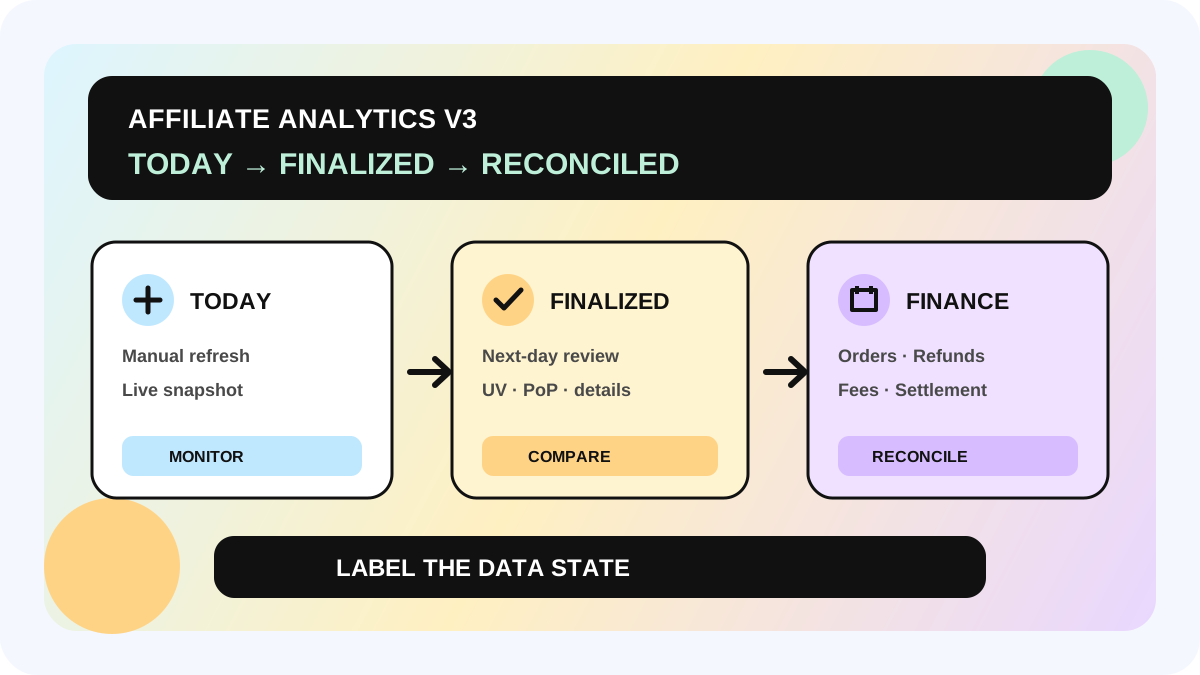
To analyze contribution by creator, use the Affiliate GMV by creator reporting guide. If the seller-side Today view changes overnight, use the Affiliate Analytics snapshot handoff. For commission-rate investigation, use the commission discrepancy workflow.
Minimum reconciliation ledger
- market, timezone, date filter, and content type;
- creator, order ID, product, content link, and paid time;
- paid-order GMV, Estimated commission, and applicable rate;
- order status, expected payout date, final commission, and settled time;
- refund, return, dispute, or risk-review evidence;
- owner, next review date, and escalation outcome.
This ledger does not replace TikTok Shop records. It gives the creator collaboration review one evidence layer so creators, operators, and finance do not debate unrelated screenshots.
Pre-review checklist
- [ ] Confirm whether the current market has the one-GMV experience.
- [ ] Match market, date, timezone, and content type across both surfaces.
- [ ] Do not treat paid-order GMV as withdrawable commission.
- [ ] Keep Estimated and final commission in separate fields.
- [ ] Give refunds, disputes, risk review, and midnight timing reason codes.
- [ ] Split annual downloads into quarters and stay within 15,000 rows per export.
- [ ] Reconcile cash only with settled/final commission.
The allymatic view: align the evidence layer before debating accuracy
A lower total may mean a filter changed or an order moved from estimate to settlement. The useful question is not “Which screenshot is true?” but “Which layer owns this decision?” Data Compass owns trends, Affiliate Orders owns order evidence, and settled earnings owns financial confirmation.
At allymatic, we recommend using order ID as the key between creator, content, commission, and settlement, with a reason code and next review date in the same workflow. That prevents a normal refund from becoming an unfair creator judgment and gives the team complete evidence when a real missing-order or payout issue needs escalation.
FAQ
Why does Data Compass now show only one GMV?
TikTok Shop's US experience now shows one GMV based on paid orders so Data Compass aligns with Earnings and Affiliate Orders. The old Commission tab was removed. The creator's underlying performance did not change merely because the display changed.
Are GMV and Estimated commission the same?
No. GMV is eligible paid-order sales value. Estimated commission applies the current rate to the order value; refunds, disputes, and settlement conditions can change the final commission.
Why can Data Compass and Affiliate Orders still differ by day?
TikTok notes that an order placed near midnight and paid after midnight can fall on different dates. Match the filters and compare order IDs across adjacent days.
When should commission be recognized as received?
Confirm it after the applicable delivery, after-sales, and seller settlement conditions are complete and Earnings/Affiliate Orders shows a settled or final amount. An estimated payout date is not a guarantee.
Official Sources
Official Sources
Primary references used for this article.