TikTok Shop Affiliate Center Collaboration Changed: How to Choose Open, Platform Campaigns, or Target
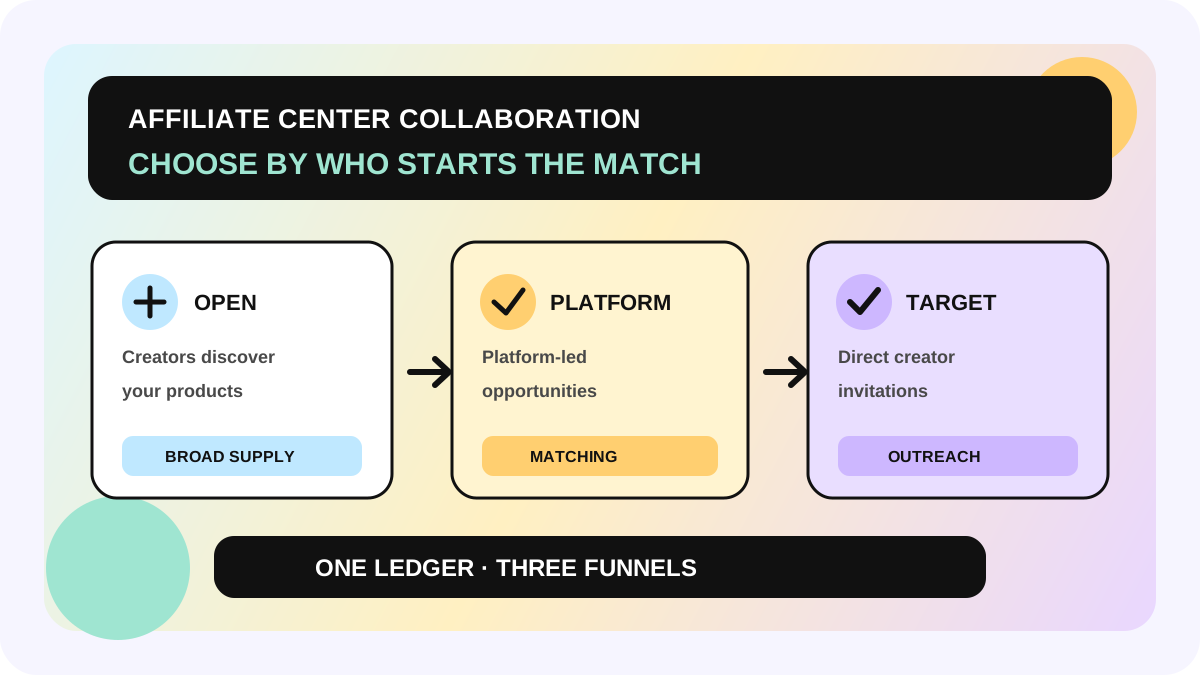
TikTok Shop's US Affiliate Center now groups Collaboration by who starts the partnership. Open Collaboration lets creators discover products, Platform Campaigns collects opportunities where the platform participates in matching or support, and Target Collaboration is the seller's direct-outreach workspace. Some Southeast Asian markets may also show Seller Funded Campaign.
The practical answer is not to memorize another menu. Ask three questions: Should the product be broadly discoverable to creators? Is there a platform-led opportunity available? Does the team already know which creators it wants to invite? This guide is for TikTok Shop sellers, creator BD, and affiliate operations teams. The official pages are marked for the United States; labels, permissions, regional entries, and rollout can differ, so the live Seller Center or Affiliate Center remains authoritative.
Direct answer: what each collaboration entry is for
| Entry | Who starts | Best-fit job | It does not mean |
|---|---|---|---|
| Open Collaboration | Creators discover products | Broaden product availability and maintain public product and commission settings | Every creator will select or post the product |
| Platform Campaigns | TikTok participates in the opportunity | Review recruitment, targeted campaign, or private collaboration opportunities | The platform guarantees creator volume or GMV |
| Target Collaboration | Seller invites named creators | Reach selected high-value creators with commission, flat-fee, or mixed offers | Sending an invitation equals acceptance or content delivery |
These entries are not mutually exclusive. A product can use both Open and Target Collaboration, but the team should preserve collaboration source, active commission version, and ownership instead of merging public supply and priority outreach into one funnel.
What changed, and what did not
TikTok Shop's October 16, 2026 guide says the former Open and Target split has been reorganized into one Collaboration area. Open Collaboration is now a standalone entry. Platform-involved recruitment, targeted campaigns, and private collaborations are grouped under Platform Campaigns. Target Collaboration keeps the seller-led invitation workflow. Exposure optimization actions move into the relevant workspaces instead of living on a separate page.
The collaboration types were reorganized, not removed. That distinction matters when an internal SOP says “Open and Target disappeared.” The team may be looking at an old navigation map, a different rollout, or a market with different availability. Preserve the business intent and current account evidence before rewriting the process.
A five-step selection and handoff workflow
1. Confirm the market, account, and live entry
Record shop, market, account permission, visible labels, and the date checked. TikTok says the structure launches in the standalone Affiliate Center and is intended to carry over to Seller Center later. Accounts may not move at the same time. If a Southeast Asian shop shows Seller Funded Campaign, record it as a regional entry rather than assuming it exists elsewhere.
2. Choose by who should initiate the match
Use Open Collaboration when the team wants eligible creators to discover available products. Use Platform Campaigns when the account has a relevant platform-led opportunity. Use Target Collaboration when the team already has a qualified creator list and needs direct invitations.
Do not use Target merely because it feels more controllable if the list has not been screened. Do not leave a strategically important creator only in Open and hope they discover the product. Route the product and creator according to the job that needs to be done.
3. Run a supply check before publishing or inviting
Confirm product availability, inventory, commission source, sample strategy, deliverable, contact, and expiry. In Open, keep visible products, commission settings, and auto-enrollment current. In Target, specify creator, product, offer, expiry, deliverable, and any flat-fee or mixed structure.
TikTok's collaboration setup guide says a product can be in multiple collaborations and that Target standard commission takes priority over Open standard commission for the same creator and product. Do not rely on a copied rate. Check the live commission history and active period before explaining a payout or changing an offer.
4. Keep three funnels separate
- Open: product visible → creator adds product → content posted → orders.
- Platform: opportunity visible → eligibility or match confirmed → joined or accepted → execution and settlement.
- Target: creator qualified → invitation sent → accepted → product added or sample received → content posted → orders.
“Invitation sent,” “matched,” and “product added” are not content-delivery statuses. Each stage needs a timestamp, owner, evidence, and next action. Send creator and content evaluation into the creator collaboration scorecard, and keep invitation execution in the creator outreach workflow.
5. Review performance by entry every week
Compare eligible products, active creators, acceptance, posting, order status, and settled results by entry—not only total GMV. Open shows whether supply is being selected organically. Target tests list quality, pitch, and offer design. Platform Campaigns needs its own record of the platform's role, eligibility, and opportunity window.
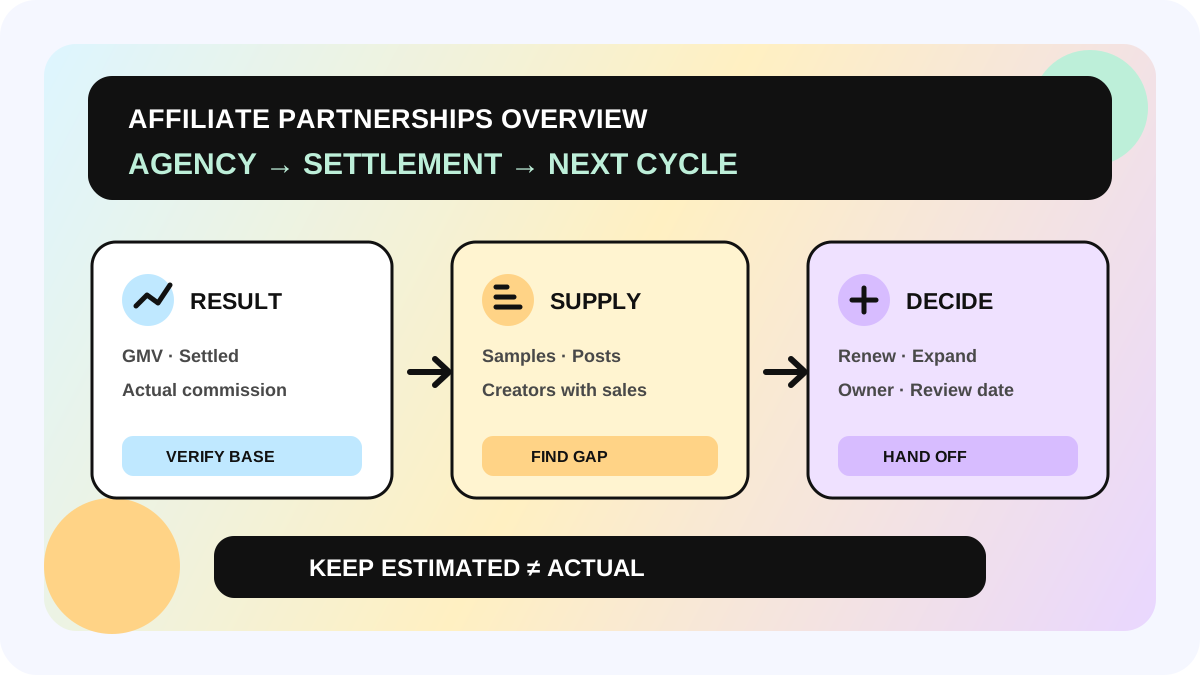
Use the Affiliate Partnerships Overview review for agency-led results. Send unclear rates or payouts to the creator commission discrepancy workflow rather than rewriting history in the collaboration table.
Minimum collaboration ledger
- market, shop, account, and UI checked at;
- collaboration entry and initiating party;
- product or SKU, inventory, and sample rule;
- creator, invitation or application status, and deliverable;
- standard, Shop Ads, or flat-fee structure and active period;
- content, order, refund, and settlement status;
- owner, next action, and next review date.
This ledger does not replace TikTok Shop records. It gives BD, operations, samples, content, and finance one collaboration source so a navigation change does not leave the team acting on old screenshots or stale rates.
Fit and non-fit boundaries
The workflow fits teams managing several products, creators, or collaboration sources. A small shop with one product, a few creators, and one owner can start with a lighter sheet. More fields are not useful if nobody updates them.
It does not replace platform eligibility, campaign terms, contracts, inventory judgment, or human creator selection. Platform Campaigns does not imply every account can participate. A Target invitation does not guarantee acceptance. Open visibility does not guarantee content or sales. When a rate, regional entry, or eligibility condition is unclear, use the current account and the applicable official guide.
The allymatic view: the entry is a trigger; collaboration state is the durable asset
Menus change. The durable record is who initiated the match, why this creator and product were selected, where the collaboration is blocked, which compensation is active, and who owns the next move. allymatic recommends using creator ID, product ID, and collaboration source as keys. Open, Platform, and Target can live in one operating system while keeping distinct funnels.
Run a one-week test with three products: one available through Open, one used to validate a selected Target list, and one entered into Platform Campaigns only if a real opportunity exists. The next review should not ask only which entry produced the most GMV. Ask which entry moved the right product, creator, and owner to the next verified state with the least ambiguity.
FAQ
Were Open Collaboration and Target Collaboration removed?
No. TikTok says they remain available. Open is now standalone, Target keeps direct outreach, and platform-led opportunities are grouped under Platform Campaigns.
Can one product be in Open and Target Collaboration?
Yes. TikTok's setup guide says products can use multiple collaborations. For the same creator and product, Target standard commission takes priority over Open standard commission. Verify the live commission history and active period.
Why can I not see Platform Campaigns or Seller Funded Campaign?
Availability can depend on market, eligibility, permission, and rollout. TikTok marks Seller Funded Campaign as a SEA-only option. Do not invent a route or apply another market's SOP when the entry is absent.
Does the new structure migrate every old collaboration automatically?
TikTok describes a reorganization rather than removal. Teams should still sample ongoing, expiring, canceling, and canceled work to confirm that products, creators, rates, and dates remain connected in the internal ledger.
Official Sources
Official Sources
Primary references used for this article.