What Counts as TikTok Shop Free-Sample Fulfillment? A Content-Type and LIVE Workflow
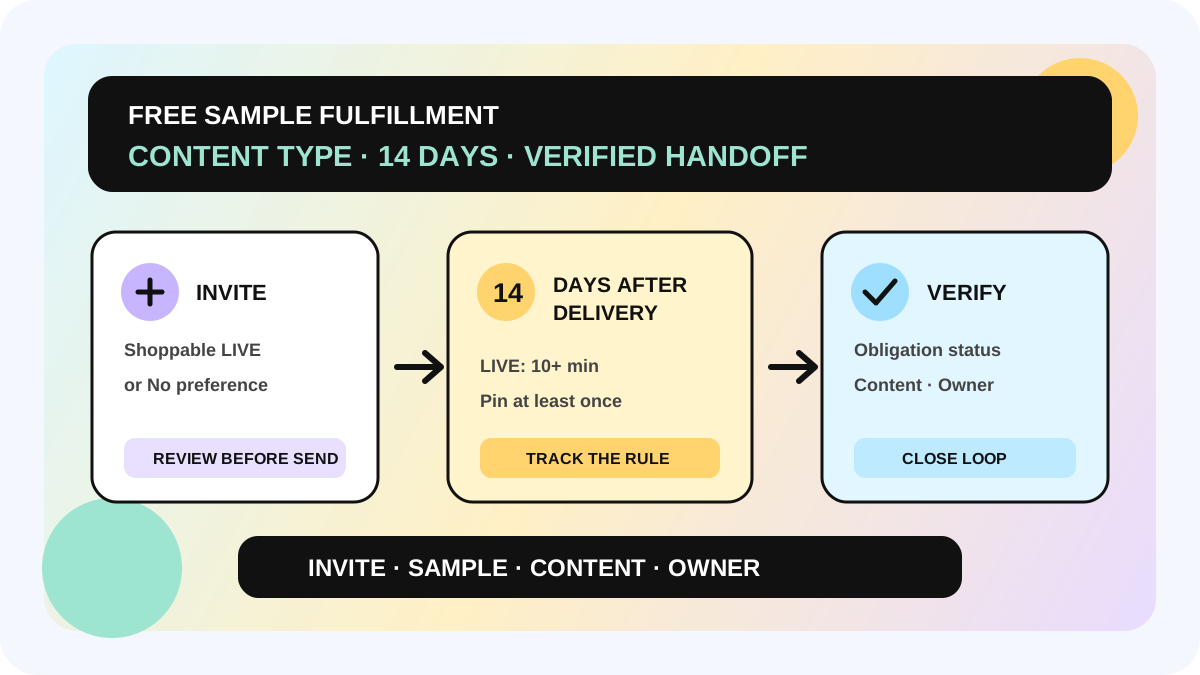
TikTok Shop has updated free-sample fulfillment for US Target Collaborations: the invitation's `Content type` is no longer just a creative preference; it determines which content closes the sample obligation. Choose `Shoppable LIVE` and the creator must fulfill through a qualifying LIVE. Choose `No preference` and either an eligible short video or qualifying LIVE can fulfill it. After the invitation is sent, the Content type and linked sample fulfillment requirement cannot be changed.
This guide is for seller teams that coordinate creator invites, sample management, LIVE scheduling, and fulfillment review. It answers which content the platform counts for a free sample—not whether a creator is allowed to publish other content. The official guidance applies to the United States. Availability and labels may differ by market and account, so the requirement shown in the live Seller Center remains the operational source of truth.
Direct answer: what each Content type requires
| Target Collaboration setting | What fulfills the sample obligation | Common misread |
|---|---|---|
| `Shoppable LIVE` | Within 14 days after receiving the sample, keep the product in the LIVE shopping bag for at least 10 minutes and pin it at least once | A creator may still publish a short video, but that video does not close this LIVE-only obligation |
| `No preference` | Either an eligible short video or a qualifying LIVE | It does not mean “no requirement”; it provides two valid content paths |
Sample fulfillment and commission are separate decisions. Content type controls what closes the sample obligation. Commission eligibility continues to follow the collaboration and order rules. A short video generating sales should not automatically be marked as fulfillment for a LIVE-only sample.
Why this changes a sample-management SOP
Many teams previously treated `Shoppable LIVE` as a preference in the brief and tracked every free sample as “content due in 14 days.” That record is now incomplete. Operations must confirm the path before sending the invitation. The sample owner can see `Only LIVE` or `No preference` on each product line when reviewing requests, and BD must explain the actual obligation before a creator accepts.
The important constraint is that sending locks the Content type and fulfillment requirement. Editing free-sample settings later does not change them. If the team chooses the wrong type and ships anyway, the platform record, creator expectation, and internal tracker can become three different versions of the deal.
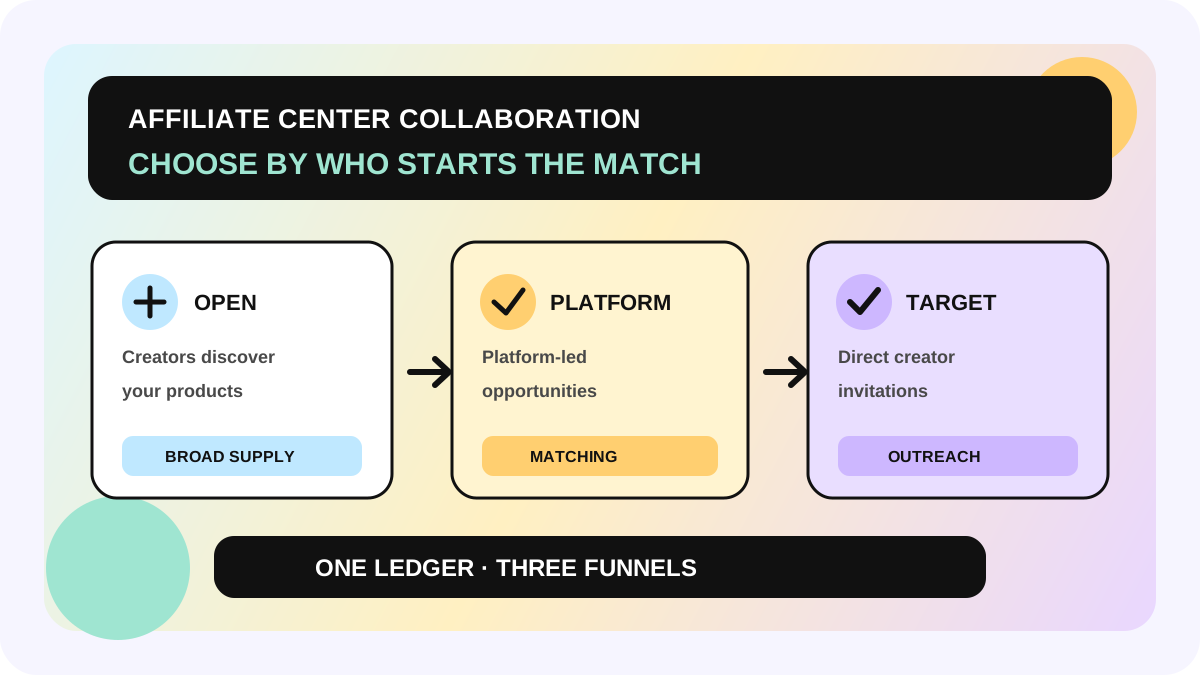
If Open, Platform Campaigns, and Target are not yet separated in your process, first use the Affiliate Collaboration entry workflow. This update focuses on Target Collaborations that include free samples; it should not be generalized to every sampling path.
A six-step, auditable sample workflow
1. Decide whether the outcome requires video or LIVE
Work backward from the actual content objective. Use `Shoppable LIVE` only when the product benefits from a live demonstration, the creator has LIVE access and capability, and the team can support the intended window. If either short video or LIVE can serve the objective, `No preference` better reflects the deal. Do not choose LIVE merely because it sounds stricter.
2. Build the Target Collaboration and enable free samples
In Affiliate Center, create the Target Collaboration, choose creators and products, set commission, and enable free samples. Select manual or automatic approval based on the relationship. Automatic approval moves eligible requests directly to `Ready to Ship`. For higher-cost products, use the sample ROI workflow to define internal approval boundaries without treating an internal score as a platform guarantee.
3. Run a two-person pre-send review
One person verifies Content type; another verifies the sample fulfillment requirement populated on the page. Confirm creator, product, Content type, approval mode, invitation expiry, and contact details. Compare the creator preview with the outreach message. Send only when both views agree, because these fulfillment fields are fixed after sending.
4. Preserve the request and shipment timeline
TikTok's US guidance says sellers must review a free-sample request within seven days or it is automatically canceled. After approval, the seller has another seven days to ship. Record request at, approved at, shipped at, delivered at, and fulfillment due at. The 14-day creator window starts after receipt, not from the invitation or approval date.
5. Verify the displayed requirement, not merely “content posted”
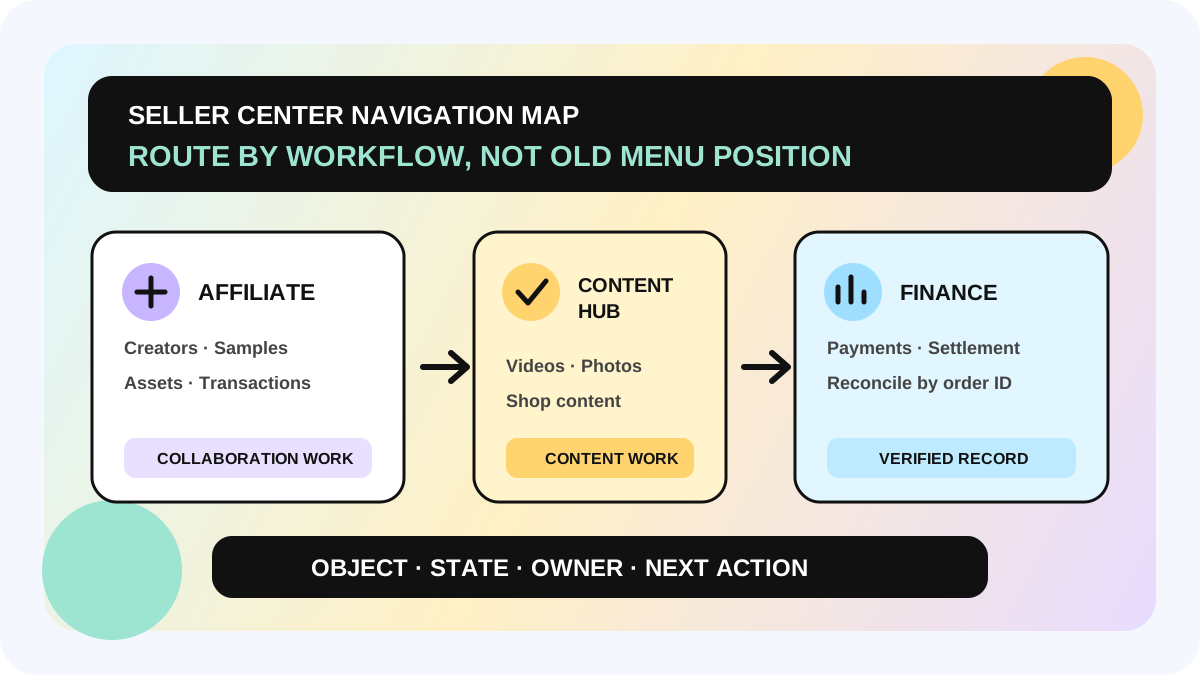
For LIVE only, verify that the product stayed in the LIVE shopping bag for at least 10 minutes and was pinned at least once. For `No preference`, verify the eligible video or qualifying LIVE recognized by the platform. Target Collaboration content data can have a one-day delay, so do not mark a just-finished session as failed immediately. The Seller Center navigation map can help teams locate Sample Requests and collaboration details.
6. Route exceptions to the right control
Missing the displayed requirement may affect a creator's sample credit. If the product is deleted, inactive, under review, or sold out, TikTok may cancel or pause fulfillment requirements. Preserve the product state rather than labeling every exception as creator non-performance. If a sample is defective or unsuitable, the creator can use the support flow shown on the sample order. The seller should not invent a platform exemption.
How to migrate invitations created before November 10, 2026
For invitations created before Sample Fulfillment Requirements launched, TikTok Shop generates a requirement from the existing Content type and prompts the seller to confirm it during a later action. The confirmed requirement applies only to new sample applications. Existing applications keep their original rules.
Do not bulk-reclassify every sample in an older collaboration. Split the ledger by invitation and application: preserve the original rule for existing applications, then record the generated and confirmed requirement for new ones. Save the confirmer and timestamp so two legitimate rule sets inside one Target Collaboration remain explainable.
Minimum sample-fulfillment ledger
- shop, market, Target Collaboration ID, creator ID, and product ID;
- invitation created at, sample requested at, approved at, and delivered at;
- Content type and displayed sample fulfillment requirement;
- manual or automatic approval;
- 14-day due at, content URL, and Video or LIVE type;
- LIVE shopping-bag duration and pin evidence when applicable;
- platform status, verified at, owner, and exception reason.
This is not a second Seller Center. It connects the invitation, sample, content, and owner on one timeline. The Creator Sample Score selection framework can support creator review, but a score cannot replace checking the Content type and the creator's real ability to fulfill it.
Fit and non-fit boundaries
This workflow fits US Target Collaborations that include free samples, especially when one team manages both short-video and LIVE creators. It is not the full Open Collaboration sampling rule set, and it does not cover refundable-sample refund criteria, TikTok's final commission determination, or policies for other markets.
If these fields do not appear in an account, do not manufacture them from another market's screenshot. Preserve the account, market, and page evidence, then verify through the applicable Seller Center support route. Choosing LIVE also does not guarantee GMV; Content type defines fulfillment, not performance.
The allymatic view: define “done” before the product ships
The most expensive sampling failure is often not a missed reminder. It is the brand, creator, and platform holding three different definitions of completion. allymatic recommends making Content type a pre-send gate: BD explains the obligation, operations owns configuration and dates, the LIVE owner confirms capability and schedule, and the reviewer closes the task against platform status.
Before the next Target Collaboration goes out, ask three questions: Do we need a short video or LIVE? Can this creator fulfill the selected path? Does the displayed requirement match the outreach message? Approve the sample only when all three have clear answers.
FAQ
Can a creator still post a short video after Shoppable LIVE is selected?
Yes. LIVE only controls what fulfills the sample obligation; it does not prohibit other eligible content. The short video simply does not replace the required LIVE for that sample.
How long must the LIVE run for fulfillment?
The US guidance says that within 14 days after receipt, the product must remain in the LIVE shopping bag for at least 10 minutes and be pinned at least once. Verify the status and requirement shown on the specific sample record.
Can Shoppable LIVE be changed to No preference after sending?
No. Content type and the linked sample fulfillment requirement are fixed after the invitation is sent. Editing free-sample settings does not change them.
Does the migration rewrite every unfinished sample in an old invitation?
No. TikTok derives and asks the seller to confirm a requirement for invitations created before launch, but the new requirement applies only to new sample applications. Existing applications keep their original rules.
Official Sources
Official Sources
Primary references used for this article.